
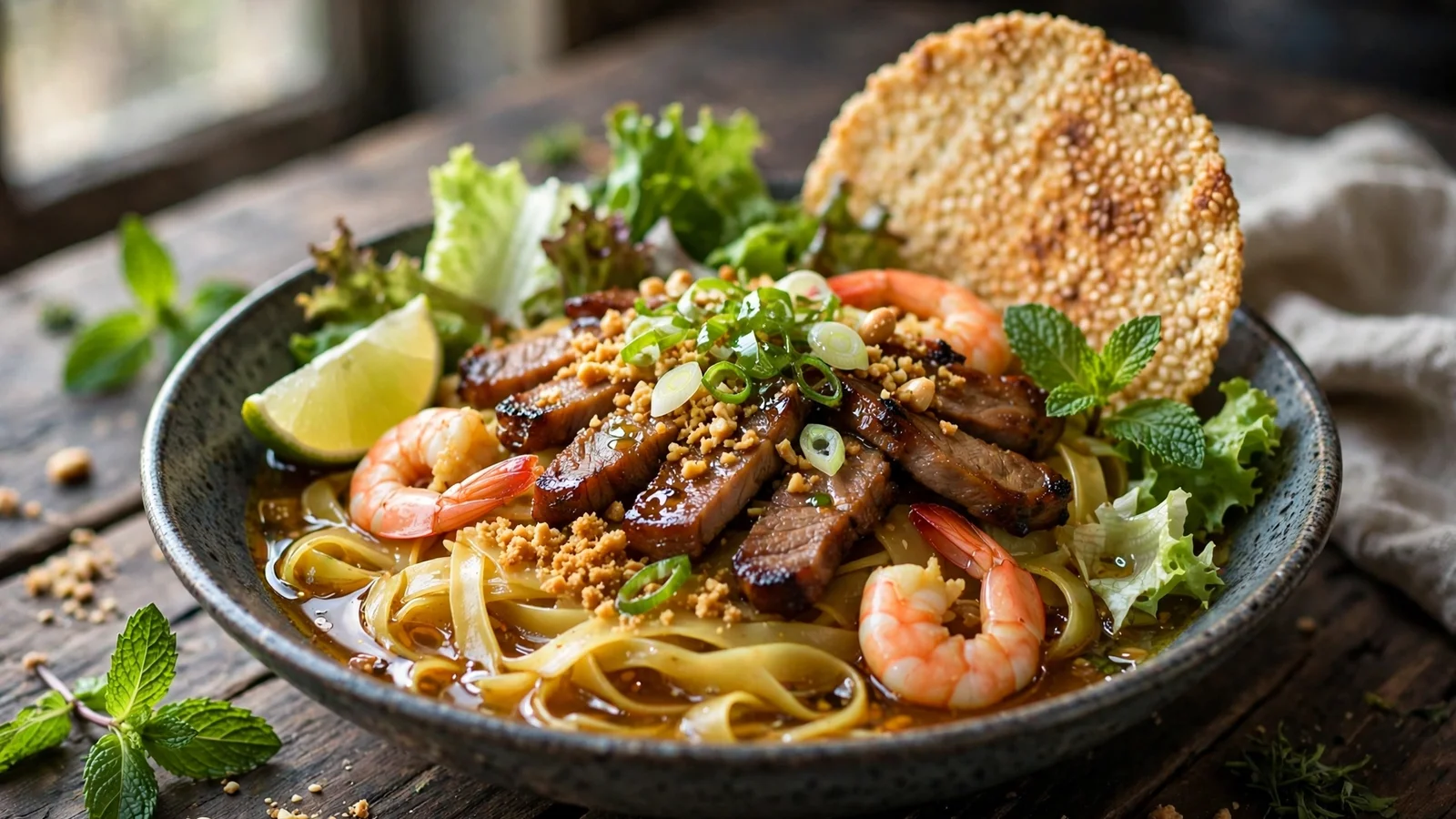
Mi quang is the kind of dish that makes you wonder why it took so long to meet it. It's a signature of Quang Nam province in central Vietnam — wide rice noodles tinted a gorgeous gold with turmeric, topped with shrimp and pork, showered in fresh herbs, and finished with crushed roasted peanuts and crackly sesame rice crackers. The whole bowl comes together in about an hour, and it hits that perfect Vietnamese balance of savory, fresh, crunchy, and bright.
If you've never had mi quang, imagine your favorite parts of a noodle soup and a noodle salad having a very delicious baby. Let's make it.
What Is Mi Quang?
Mi quang (pronounced "mee kwahng") comes from Quang Nam, the province around Hoi An in central Vietnam. The noodles are flat rice noodles, wider than pho noodles but not as wide as banh cuon sheets, and they're tinted yellow — traditionally from turmeric mixed into the rice batter. If you visit Hoi An, you'll see vendors with steaming baskets of these golden noodles; every family has a strong opinion about who makes the best bowl.
The dish is traditionally a celebration food in Quang Nam, made for family gatherings and festivals. At home, it's a very doable weekend project. The broth is simpler than a pho broth (no charring of aromatics, no 6-hour simmer), and the toppings are mostly assembly. The one specialty item is the noodles: look for packages labeled "mi quang noodles" at Vietnamese or Chinese markets. In a pinch, wide flat rice noodles (the pad see ew kind, about 1/4 inch wide) work — the turmeric tint is traditional, but the dish survives without it.
Ingredients
For the broth:
- 1 lb pork neck bones or spare ribs
- 8 oz shrimp, peeled and deveined (save the shells)
- 6 cups water
- 1 tablespoon neutral oil
- 1 tablespoon annatto seeds (for color) or 1/2 teaspoon turmeric powder
- 1 small shallot, minced
- 3 cloves garlic, minced
- 2 tablespoons fish sauce, plus more to taste
- 1 teaspoon sugar
- 1/2 teaspoon black pepper
For the noodles and toppings:
- 12 oz dried mi quang noodles (or wide flat rice noodles)
- 8 oz pork belly or pork shoulder, thinly sliced
- 1 teaspoon turmeric powder (for the pork marinade)
- 1 tablespoon fish sauce (for the pork marinade)
- 1/2 teaspoon black pepper
- 4 scallions, thinly sliced (greens and whites separated)
- 3 tablespoons neutral oil (for scallion oil)
- 1/3 cup roasted peanuts, coarsely crushed
- 4 large sesame rice crackers (banh trang me), toasted
- Lime wedges, for serving
- Sliced Thai chilies or chili sauce, for serving
For the herb plate:
- 2 cups shredded lettuce or cabbage
- 1 cup bean sprouts
- 1/2 cup thinly sliced banana blossom (optional but traditional; soak in lemon water to prevent browning)
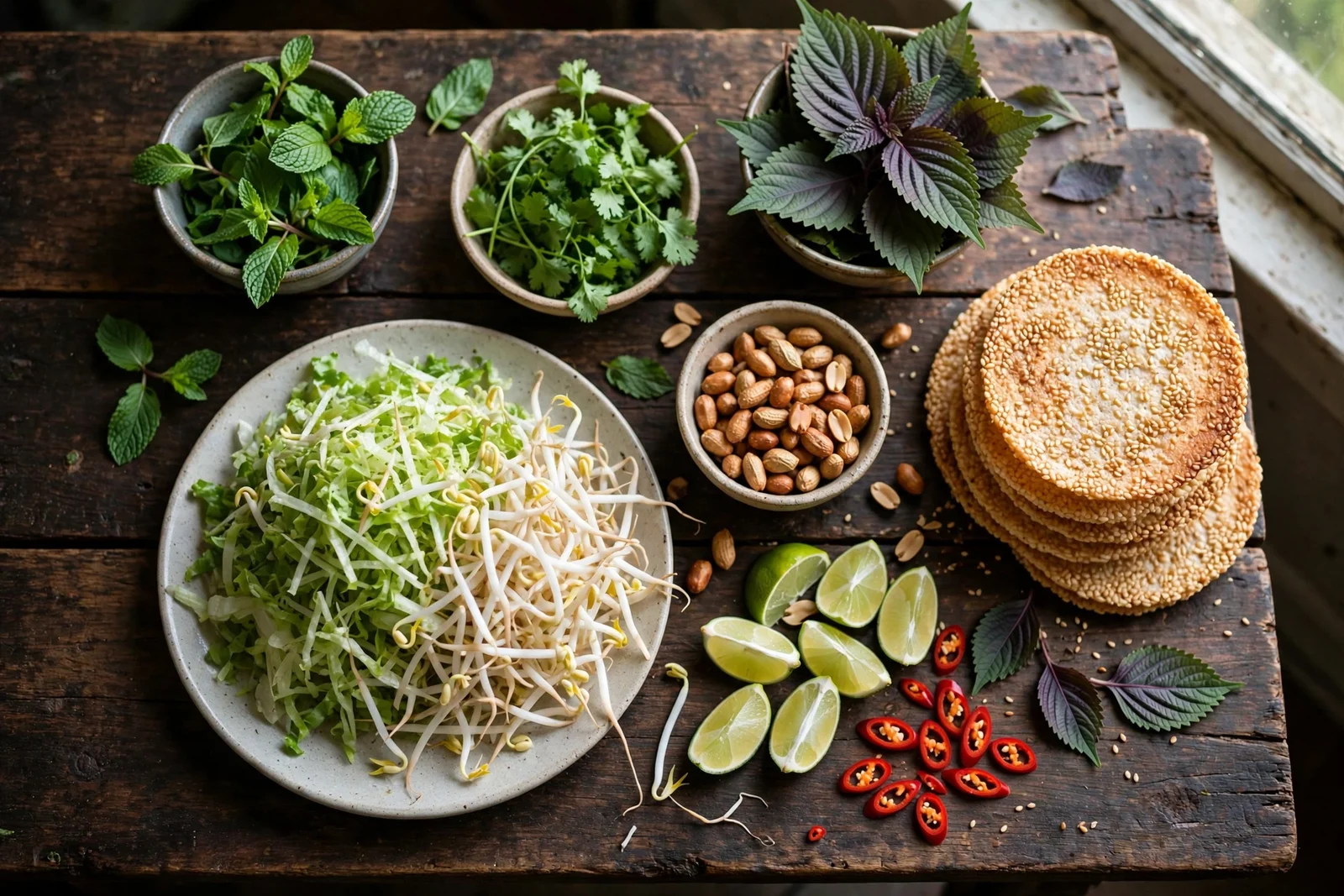
- Fresh mint, cilantro, and Vietnamese perilla (tia to), as available
### A Note on the Noodles
Real mi quang noodles have a slightly chewy, substantial bite that stands up to the toppings. Dried mi quang noodles need a soak in warm water for about 20 minutes before a quick boil — check the package, since thickness varies. Don't overcook them; they should be tender but still have some bounce. Rinse briefly in cool water after draining so they don't glue together while you finish the broth.
Instructions
1. Make the broth. Put the pork neck bones and shrimp shells in a pot with 6 cups of water. Bring to a boil, skim off any foam, then reduce to a gentle simmer for 40 minutes. Strain and discard the bones and shells — you should have about 4 to 5 cups of clean, light stock. This is the backbone of the dish, so don't rush it.
2. Color and season the broth. Heat 1 tablespoon of oil in a pot over medium heat. Add the annatto seeds and stir for about 30 seconds until the oil turns a deep orange-red, then fish out and discard the seeds (they're bitter if left in). Add the minced shallot and garlic and cook until fragrant, about 1 minute. Pour in the strained stock, then stir in the fish sauce, sugar, and black pepper. Simmer gently for 10 minutes. Taste — it should be boldly seasoned, saltier and more intense than you'd expect, because only a small amount goes into each bowl. This broth is a seasoning, not a soup base.
3. Marinate and cook the pork. Toss the sliced pork with turmeric, fish sauce, and black pepper. Let it sit while the broth simmers. Heat a skillet or wok over medium-high heat with a splash of oil and sear the pork until golden at the edges and cooked through, about 5–6 minutes. Set aside.
4. Cook the shrimp. In the same skillet, cook the peeled shrimp for about 2 minutes per side, just until pink and curled. Don't overcook them — they'll firm up fast. Remove from heat.
5. Make the scallion oil. Heat 3 tablespoons of neutral oil until shimmering (not smoking), then pour it over the sliced scallion greens in a heatproof bowl. It will sizzle — that's exactly what you want. This fragrant green oil gets spooned over every bowl.
6. Cook the noodles. Boil the soaked noodles according to the package directions, usually 4–6 minutes. Drain and rinse briefly in cool water. Divide among 4 wide, shallow bowls.
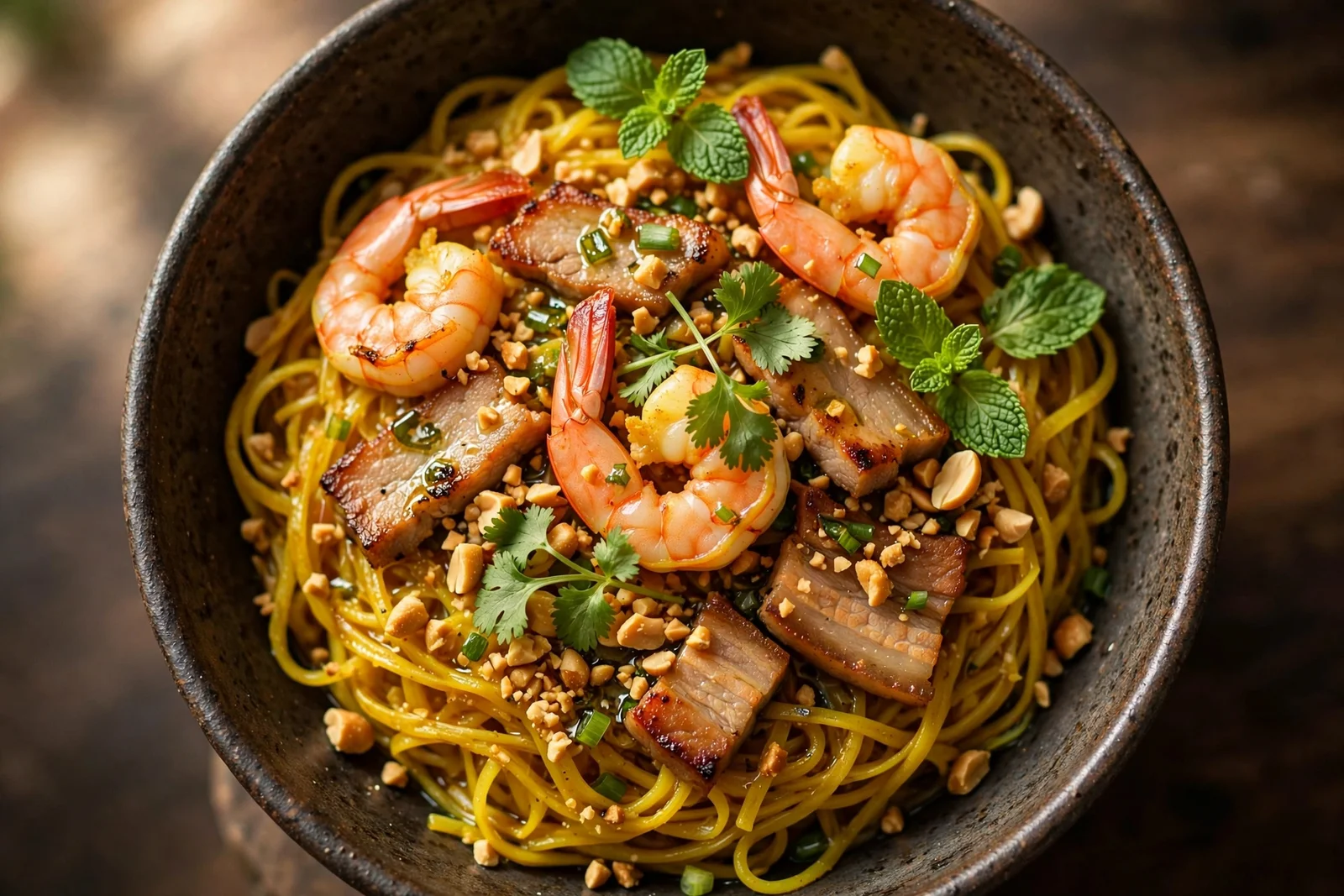
7. Assemble. Arrange the pork and shrimp over the noodles. Ladle about 1/2 to 3/4 cup of hot broth over each bowl — just enough to pool at the bottom, not cover the toppings. Spoon over scallion oil, scatter the crushed peanuts, and add a handful of the herb plate to each bowl. Serve immediately with toasted sesame rice crackers, lime wedges, and chilies on the side.
Tips for the Best Mi Quang
Season the broth aggressively. The most common mistake is a timid broth. Since each bowl only gets a ladle or two, the broth needs to be concentrated — think of it as a sauce. Taste it on its own; it should make you reach for water. Once it's diluted across noodles and herbs, it lands exactly right.
Don't drown the noodles. If you're used to pho, your instinct will be to fill the bowl. Resist. Mi quang should look almost dry compared to a soup — the broth pools at the bottom and everything else sits on top, crisp and distinct. You can always add more at the table.
Toast the rice crackers properly. Banh trang me should be heated until they puff slightly and turn fragrant — a dry skillet, a hot oven, or a few seconds over a gas flame with tongs. A limp cracker is a sad cracker. Break it into shards and press them into the bowl so they catch broth and shatter into the noodles.
Prep the herbs like you mean it. The herb plate isn't garnish — it's a structural element. Be generous. The cool crunch of lettuce, sprouts, and banana blossom against the warm turmeric noodles is the whole point of the dish.
Variations
- Chicken mi quang: Swap the pork for boneless chicken thighs, sliced thin and seared the same way. Use chicken stock for the broth base.
- Vegetarian mi quang: Use a mushroom-based stock, replace pork and shrimp with king oyster mushrooms and fried tofu, and add extra peanuts. Fish sauce can be swapped for a vegetarian mushroom "fish sauce."
- Spicier version: Simmer 2–3 dried chilies in the broth, or serve with a spoonful of chili garlic sauce. Central Vietnamese food runs hot, so this is very much in spirit.
- Quail egg addition: Halved hard-boiled quail eggs are a classic Quang Nam topping — a dozen quail eggs, boiled 4 minutes, add a rich little bite to each bowl.
What to Serve With Mi Quang
Mi quang is a complete meal in a bowl — noodles, protein, herbs, crunch — so it doesn't need much alongside it. If you're building a bigger spread, a light starter works well: the fresh rolls-style contrast of something like banh xeo (share the herb plate between both dishes) makes a great Vietnamese-themed dinner. To drink, something cold and sweet-tart like thai iced tea cuts through the richness of the pork and peanuts. And if the turmeric noodle technique intrigued you, our guide on wok hei explains the high-heat searing behind the pork's caramelized edges.
Storing and Reheating
Store the components separately: broth in a jar, noodles in a container tossed with a teaspoon of oil, toppings in their own containers. Everything keeps 2–3 days in the fridge. To serve, reheat the broth to a boil, warm the noodles with a quick dip in hot water, and reassemble fresh — the herbs and crackers should always be fresh, never stored in the bowl. Assembled leftovers don't keep well; the noodles absorb the broth and the crunch is gone.
Prep time: 25 min · Cook time: 55 min · Total: 1 hr 20 min · Servings: 4
Ingredients
Method
- Simmer the pork neck bones and shrimp shells in 6 cups of water for 40 minutes, skimming foam. Strain and discard the solids.
- Heat 1 tablespoon oil, sizzle the annatto seeds 30 seconds until the oil turns orange-red, then discard the seeds. Add shallot and garlic; cook 1 minute. Add the strained stock, fish sauce, sugar, and black pepper; simmer 10 minutes. Season boldly — the broth should taste intense.
- Toss the sliced pork with turmeric, fish sauce, and black pepper. Sear in a hot skillet with a splash of oil until golden at the edges, 5–6 minutes. Set aside.
- Sear the shrimp in the same skillet, about 2 minutes per side, until pink and curled. Remove from heat.
- Heat 3 tablespoons neutral oil until shimmering and pour over the sliced scallion greens in a heatproof bowl to make scallion oil.
- Boil the soaked noodles 4–6 minutes until tender with a bit of bounce. Drain, rinse briefly in cool water, and divide among 4 wide, shallow bowls.
- Arrange pork and shrimp over the noodles. Ladle 1/2 to 3/4 cup of hot broth over each bowl — just enough to pool at the bottom. Spoon over scallion oil, scatter crushed peanuts, and add a handful of herbs. Serve immediately with toasted sesame rice crackers, lime wedges, and chilies.