
Laksa sits at the crossroads of Chinese noodle soups and Malay curries, and that is exactly why it tastes so complete in a single bowl. You get noodles in a coconut curry broth, something savory from shrimp paste and curry paste, something fresh from bean sprouts and herbs, and enough toppings that every spoonful lands a little differently. It is a hawker-style bowl in spirit: fast to assemble once the broth is built, generous with toppings, and meant to be eaten hot while the noodles still have spring.
There are two broad families. Curry laksa, the version here, uses a coconut milk broth scented with a rempah spice paste. Asam laksa from Penang skips the coconut and leans on tamarind and fish for a sour, punchy broth. Both share the same DNA of noodles, seafood, and herbs, but they eat like very different soups. If you want the rich, gently spicy bowl most people picture when they hear laksa, curry laksa is the place to start.
What Makes the Broth Work
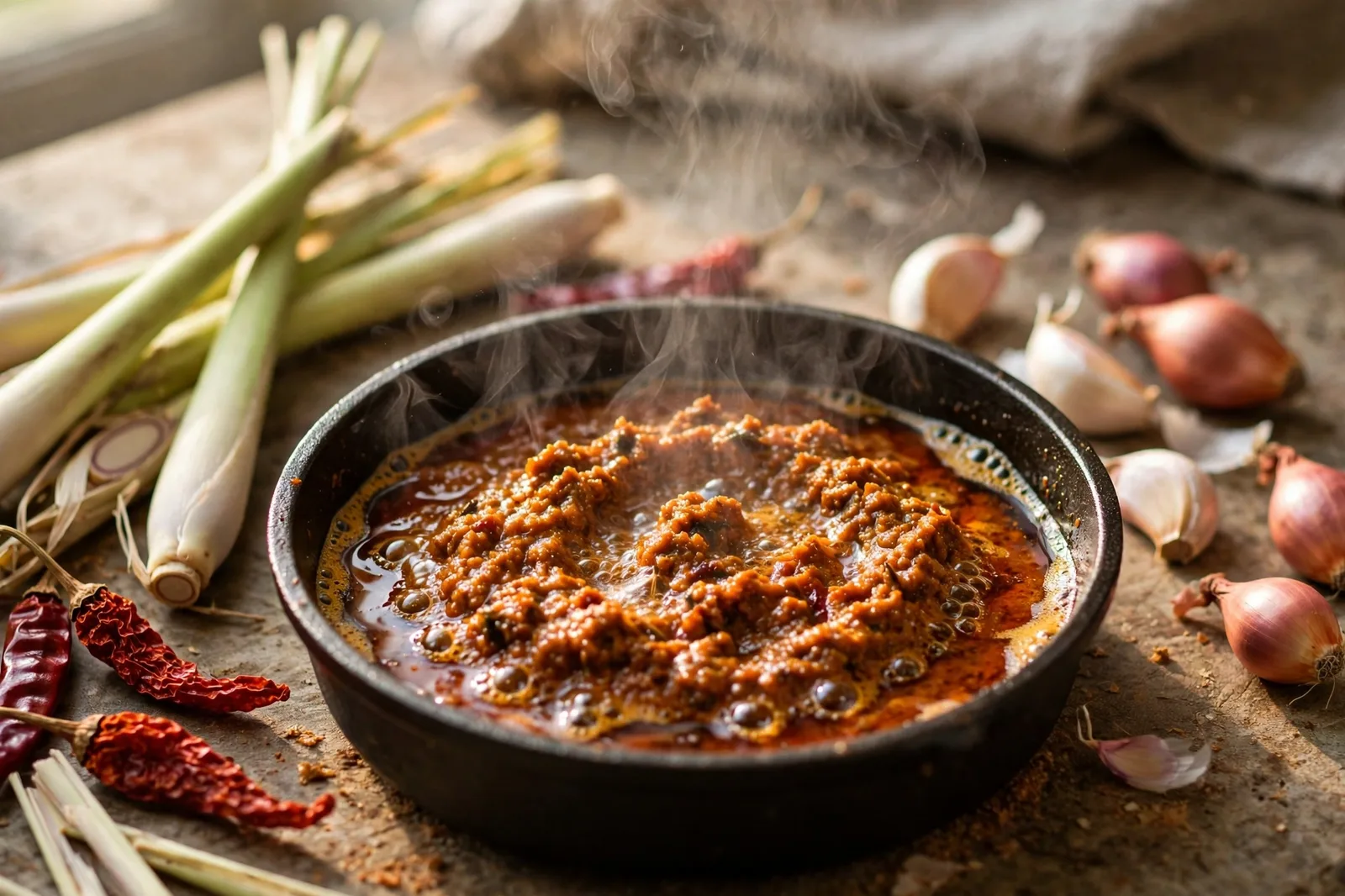
The broth has three moving parts that need to stay in balance. First is the rempah, a pounded or blended paste of chiles, garlic, shallots, galangal, lemongrass, turmeric, and belacan. Frying that paste in oil until it darkens and the raw edge cooks off is the whole game; a paste that only gets warmed through tastes thin and a little harsh. Second is shrimp or chicken stock, which gives the soup body without heaviness. Third is coconut milk, added after the paste has bloomed, so the broth stays fragrant instead of splitting into oil and water.
Curry laksa should be rich but not cloying. One can of coconut milk stretched with good stock hits that mark for most home pots. If the broth tastes flat, it usually needs salt or a squeeze of lime at the table rather than more coconut. Fish sauce deepens it quickly. A small spoon of sugar, the same trick that rounds out a plate of Sambal Kangkong, takes the rough corners off the chile heat.
Tamarind is optional here. A teaspoon or two of paste adds the faint sour note that keeps a coconut broth lively, especially if you are using canned stock. Keep it subtle; this is not asam laksa, and the broth should still read as curry first.
Laksa: Coconut Curry Noodle Soup
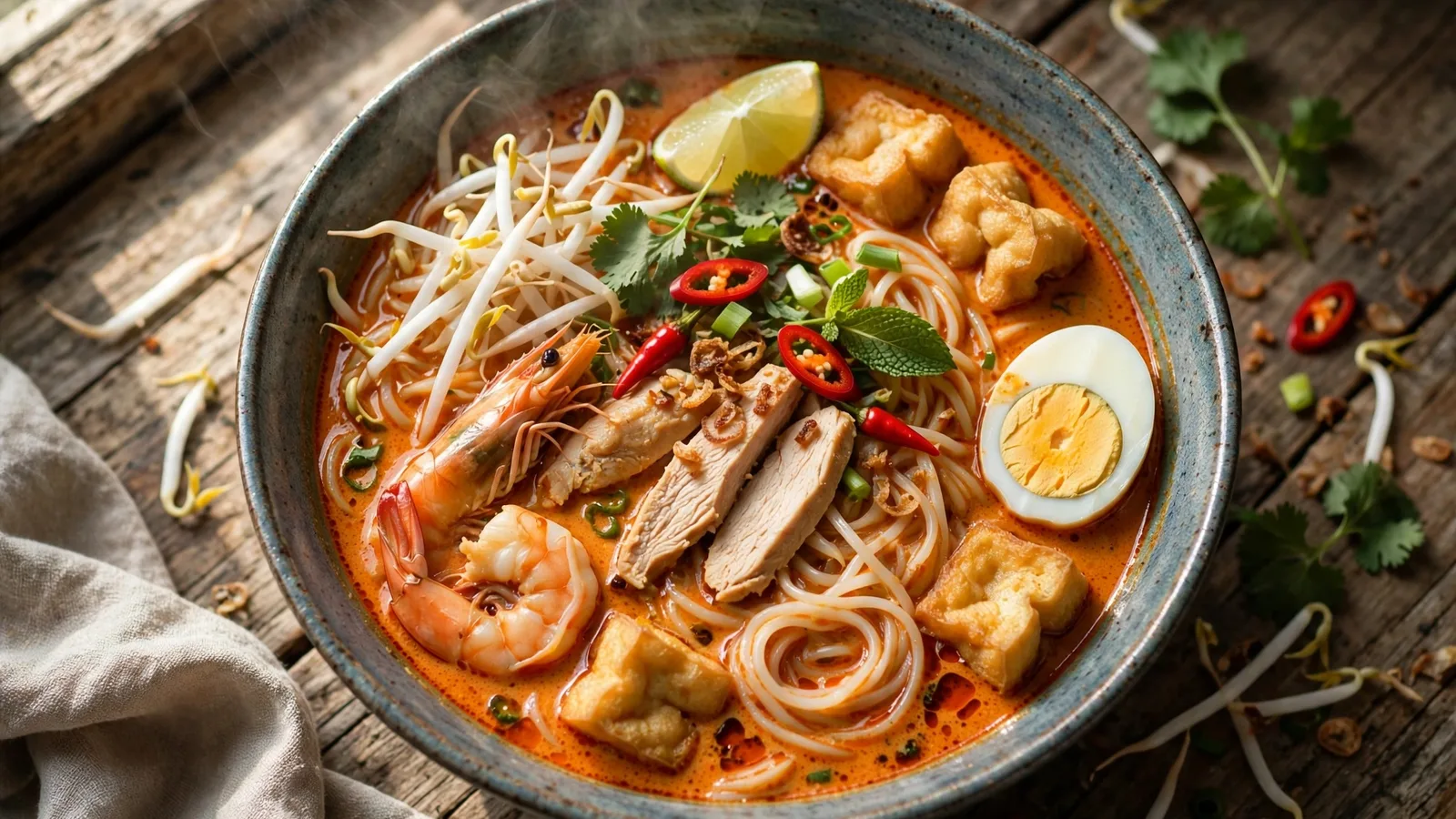
Noodles in a fragrant coconut curry broth with shrimp, chicken, tofu puffs, bean sprouts, and herbs, finished with lime and sambal at the table.
Prep time: 25 minutes
Cook time: 30 minutes
Total time: 55 minutes
Servings: 4 bowls
Ingredients
- 14 oz (400 g) rice vermicelli or laksa noodles (thick round rice noodles)
- 2 tablespoons neutral oil
- 1/4 cup (60 g) laksa paste or red curry paste
- 1 stalk lemongrass, bruised and cut into 3 pieces
- 4 cups (950 ml) chicken or shrimp stock
- 1 can (14 oz / 400 ml) coconut milk
- 1 tablespoon fish sauce, plus more to taste
- 1 to 2 teaspoons tamarind paste (optional)
- 1 teaspoon sugar
- 8 oz (225 g) raw shrimp, peeled and deveined
- 8 oz (225 g) boneless chicken breast or thigh, thinly sliced
- 4 oz (115 g) tofu puffs, halved
- 2 cups (120 g) bean sprouts
- 2 hard-boiled eggs, halved
- 1 small cucumber, julienned
- Fresh mint, Vietnamese mint (laksa leaf), or cilantro, for serving
- Lime wedges and sambal oelek, for serving
- Fried shallots, for serving (optional)
Instructions
- Soak or cook the noodles according to the package directions until just tender. Drain, rinse briefly under cold water to stop the cooking, and set aside. Keep them loose; clumped noodles are hard to portion into bowls.
- Heat the oil in a large pot over medium heat. Add the laksa paste and lemongrass and fry, stirring often, for 3 to 4 minutes, until the paste darkens slightly and smells deeply fragrant. This step builds the flavor base, so give it the full time.
- Pour in the stock and bring to a gentle simmer. Stir in the coconut milk, fish sauce, tamarind if using, and sugar. Simmer for 10 minutes without a hard boil, which keeps the coconut milk from splitting.
- Add the chicken slices and simmer for 3 to 4 minutes, until just cooked through. Add the shrimp and tofu puffs and simmer 2 minutes more, until the shrimp turn pink and opaque. Taste the broth and adjust with fish sauce for salt, sugar for balance, or lime for brightness.
- Blanch the bean sprouts in the hot broth for about 30 seconds, then lift them out so they stay crisp. Divide the noodles among four warm bowls, then add sprouts, cucumber, and halved eggs.
- Ladle the hot broth with chicken, shrimp, and tofu puffs over each bowl. Finish with herbs, fried shallots if using, a wedge of lime, and sambal on the side so everyone can set their own heat.
Notes
- Fry the paste properly. If the broth tastes raw or one-note, the paste likely needed another minute in the oil before the stock went in.
- Keep the broth at a simmer, not a rolling boil, after the coconut milk goes in. Boiling can split the broth and dull the color.
- Set out the sambal separately. Laksa heat is personal, and the table-side spoon lets the broth stay balanced for everyone.
Toppings Are Not Decoration
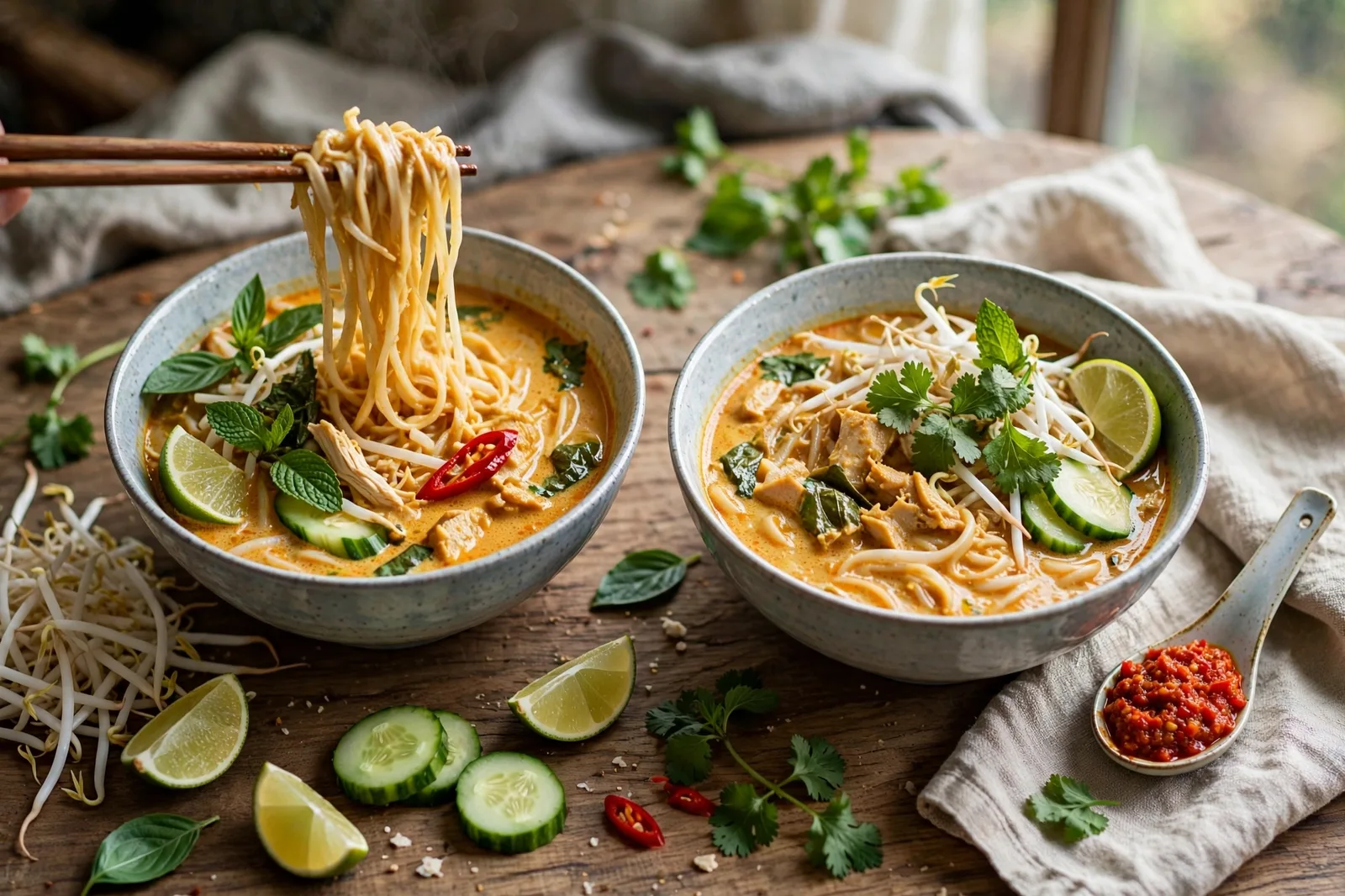
In laksa, toppings carry real jobs. Bean sprouts add crunch against soft noodles. Cucumber cools the broth. Herbs, especially Vietnamese mint, bring the bright, almost peppery note that keeps a rich soup from sitting heavy. Tofu puffs soak up broth like sponges and are often the bite people remember most, which is why they are worth seeking out at an Asian market. If you cannot find them, cubes of firm tofu warmed in the broth work fine.
The protein split here, half shrimp and half chicken, is the classic hawker compromise. Whole shrimp give the broth a seafood sweetness, while chicken keeps the bowl familiar and filling. Fish balls or sliced fish cake are common swaps, and a few cockles are traditional in some Singapore stalls, though they are an acquired taste and entirely optional at home.
Hard-boiled eggs are standard in Malaysian curry laksa and add richness without cost. Fry or boil them ahead; they hold well while the broth simmers. A jammy six-minute egg is lovely too, but the firmer hawker-style egg stands up better to hot broth.
Variations Worth Trying
- Seafood laksa: Skip the chicken and double the shrimp, then add 8 oz of fish balls or sliced fish cake in the last three minutes. Keep the cooking brief so the seafood stays tender.
- Vegetarian laksa: Use vegetable stock, swap fish sauce for soy sauce plus a pinch of salt, and load the bowl with tofu puffs, mushrooms, and extra sprouts. Pick a curry paste without shrimp paste, or make the heat gentler with yellow curry paste.
- Curry mee style: Use a mix of yellow wheat noodles and rice vermicelli in the same bowl, a combination common in Malaysia that gives you chew and slurp at once.
- Extra sour: Add more tamarind a teaspoon at a time and a splash of lime at the table. It will not be asam laksa, but it nudges the bowl brighter.
- With leftovers: The broth keeps for up to three days in the fridge and freezes well without the noodles. Cook fresh noodles and sprouts when reheating so the texture stays right.
For another coconut-based bowl with a different spice profile, our Thai Green Curry with Chicken uses a similar paste-frying technique, and the Tom Yum Fried Rice hits nearby sour-spicy notes in a dry, wok-tossed form.
Serving and Storing
Serve laksa as soon as the bowls are built. Noodles keep drinking broth as they sit, so a bowl that waits ten minutes eats thicker and softer than one served right away. Warm bowls help more than people expect; a quick rinse under hot water keeps the soup from cooling on contact.
Leftover broth and noodles should always be stored separately. Refrigerate the broth for up to three days and the cooked noodles for a day at most, tossed with a few drops of oil so they do not glue together. Reheat the broth to a simmer, add fresh sprouts and herbs, then pour over the noodles. The herbs and cucumber should never be reheated; their raw freshness is the point.
One final note on heat: the broth here lands at a comfortable medium. Laksa paste brands vary a lot, so if yours is mild, stir a spoon of sambal into the pot rather than adding more paste, which can throw off the salt. If it is fierce, an extra splash of coconut milk brings it back without thinning the soup the way water would.
Laksa: Coconut Curry Noodle Soup
Ingredients
Method
- Soak or cook the noodles according to the package directions until just tender. Drain, rinse briefly under cold water to stop the cooking, and set aside, kept loose.
- Heat the oil in a large pot over medium heat. Add the laksa paste and lemongrass and fry, stirring often, 3 to 4 minutes, until the paste darkens slightly and smells deeply fragrant.
- Pour in the stock and bring to a gentle simmer. Stir in the coconut milk, fish sauce, tamarind if using, and sugar. Simmer 10 minutes without a hard boil so the coconut milk does not split.
- Add the chicken slices and simmer 3 to 4 minutes, until just cooked through. Add the shrimp and tofu puffs and simmer 2 minutes more, until the shrimp turn pink and opaque. Taste and adjust with fish sauce for salt, sugar for balance, or lime for brightness.
- Blanch the bean sprouts in the hot broth about 30 seconds, then lift them out so they stay crisp. Divide the noodles among four warm bowls and add the sprouts, cucumber, and halved eggs.
- Ladle the hot broth with the chicken, shrimp, and tofu puffs over each bowl. Finish with herbs, fried shallots if using, a wedge of lime, and sambal on the side.
1 thought on “Laksa: Coconut Curry Noodle Soup”