
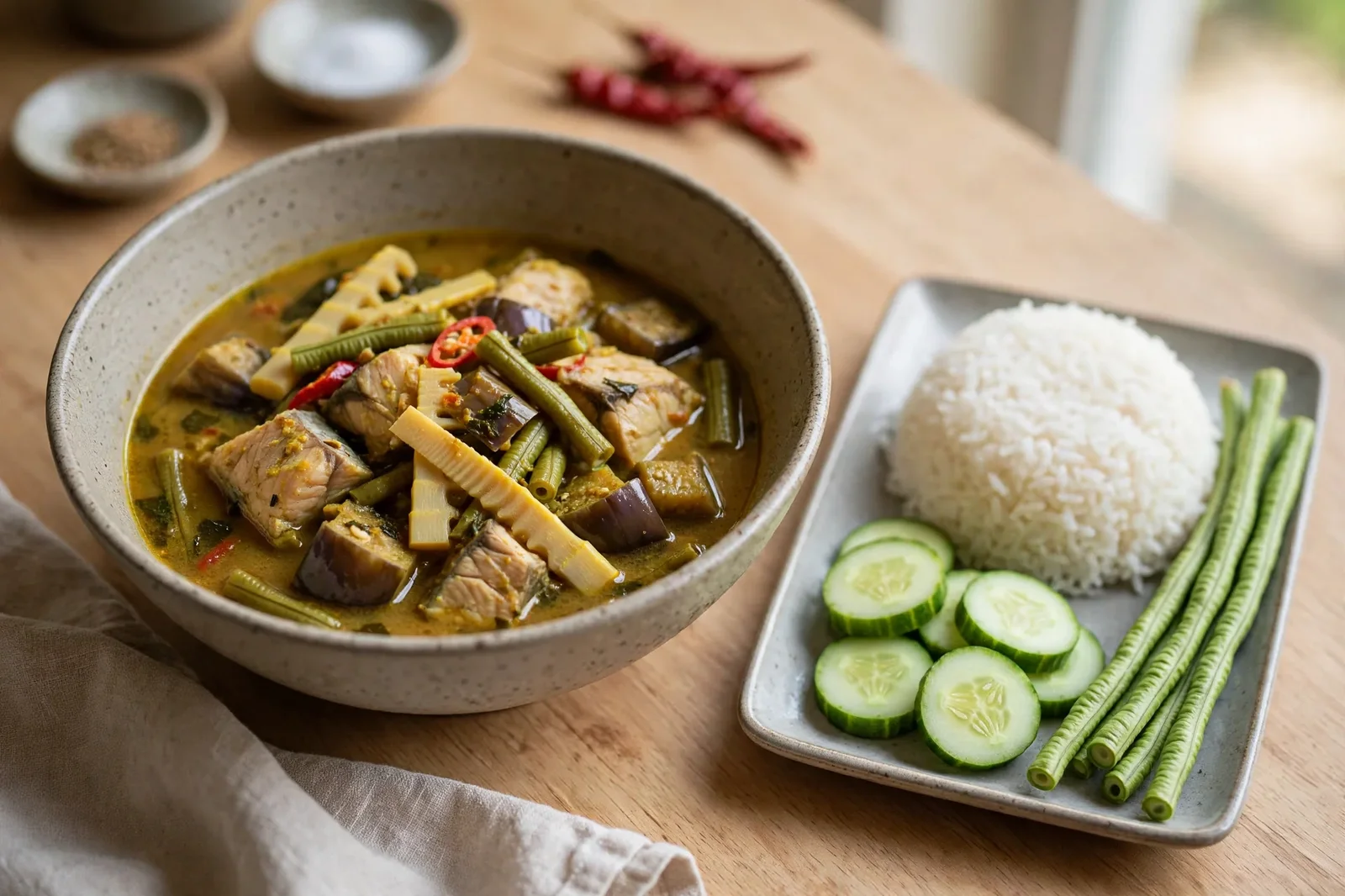
Gaeng tai pla is the curry southern Thai cooks reach for when they want heat, salt, and funk in one bowl. The base is tai pla, a sauce made from salted fish stomach and entrails fermented for 10 to 30 days, simmered in water and strained into a cloudy, deeply savory stock. A pounded paste of dried chilies, turmeric, lemongrass, and black pepper goes in next, then bamboo shoots, Thai eggplant, and yardlong beans, with chunks of firm fish added at the very end. It is served with jasmine rice and a plate of raw vegetables, and the first spoonful tells you why southern Thai food has its own reputation.
This is not a mild curry, and I will not pretend it is. It is salty, fiery, and unmistakably fishy in the way fermented fish sauce is fishy. If you like green curry, this is its louder cousin from the south, made with water instead of coconut milk so nothing softens the edges. My version follows the classic shape: strain the tai pla, pound the paste fresh, and keep the fish out of the pot until the last few minutes.

What is gaeng tai pla?
Gaeng tai pla, also spelled kaeng tai pla, is a curry from southern Thailand built on tai pla, fermented fish entrails. The entrails, usually from catfish or snakehead fish, are salted and left to ferment for 10 to 30 days before they are cooked. That fermented sauce is the whole point of the dish. It gives the curry a strong smell and a deep umami taste that fish sauce alone cannot match, and it cannot be swapped for something else. If you leave out the tai pla, you have a different curry.
The curry is made mainly with fish and vegetables. The usual vegetables are bamboo shoots, Thai eggplant, pea eggplant, yardlong beans, and fresh chilies. Some versions add pumpkin or baby corn, and a few use coconut milk instead of water, but the classic southern version uses water, which lets the tai pla and the chili heat sit at the front. It is very spicy, very salty, and usually served with rice or khanom jeen, fermented rice noodles, plus fresh vegetables to cool each bite down.
In the south it is everyday food, not a restaurant showpiece. Families in Nakhon Si Thammarat and Songkhla eat it with rice and a plate of raw long beans, cucumber, and Thai eggplant on the side. The raw vegetables matter. They are not a garnish. They give you something cool and crisp between spoonfuls of a curry that runs hot and salty from start to finish.
The tai pla base: strain it first
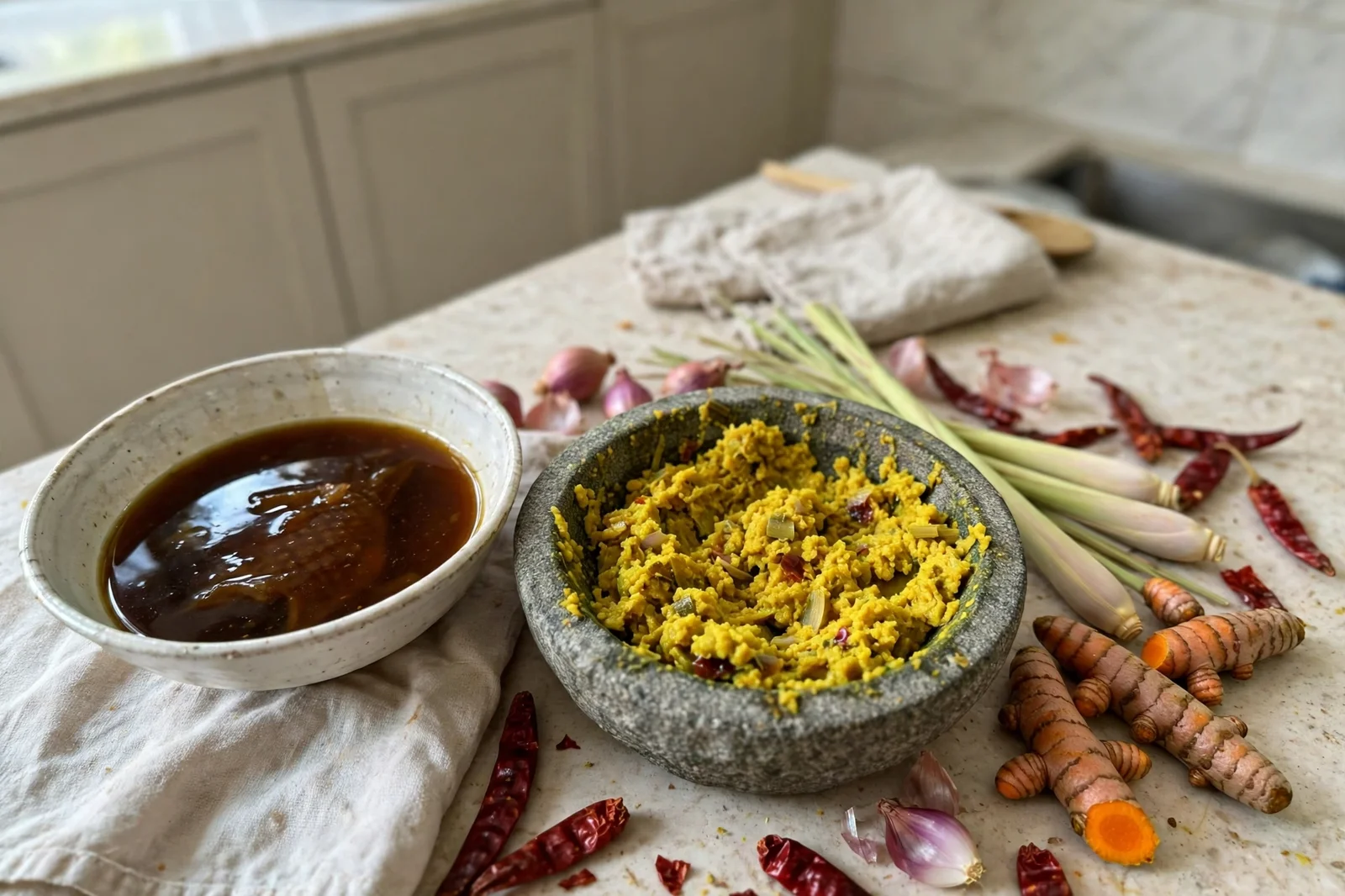
One step decides whether this curry tastes clean or gritty, and it happens before the paste goes in. Bottled tai pla carries bone fragments and sediment from the fermentation. If you pour it straight into the pot, that grit stays in the broth. Simmer the tai pla in water first, then pour it through a fine mesh strainer and throw the solids away. What comes through is a cloudy, amber stock that smells strong and tastes intensely salty. That is your base.
The ratio I use is half a cup of tai pla to 1 cup of water for the simmer, then 2 more cups of water in the pot. That gives a broth that is salty enough to season the whole pot without extra fish sauce. Taste the strained stock before you add anything else. It should taste too salty on its own. The vegetables, the fish, and the palm sugar will pull it back into balance, and the rice on the side does the rest.
The ingredients
For the tai pla stock:
– 1/2 cup bottled tai pla (fermented fish entrails sauce)
– 3 cups water, divided
For the curry paste:
– 10 dried bird’s eye chilies, soaked in warm water for 15 minutes and drained
– 2 tablespoons black peppercorns
– 2-inch piece fresh turmeric, peeled and sliced
– 3 stalks lemongrass, tender lower part only, thinly sliced
– 1-inch piece galangal, sliced
– 5 shallots, peeled and quartered
– 4 garlic cloves
– 1 tablespoon shrimp paste (kapi)
For the curry:
– 12 oz firm white fish, such as mackerel, kingfish, or cod, cut into 1 1/2-inch chunks
– 1 cup bamboo shoots, canned, rinsed, or fresh and boiled
– 8 Thai eggplant, quartered
– 1 cup yardlong beans, cut into 2-inch pieces
– 5 kaffir lime leaves, torn
– 1 tablespoon palm sugar
– Fish sauce, only if needed after tasting
– 1 lime, cut into wedges, for serving
For serving:
– Steamed jasmine rice
– Raw vegetables: cucumber, yardlong beans, and Thai eggplant
How to make gaeng tai pla
Pound the paste while the tai pla simmers, then build the curry in the order below. The vegetables go in by cooking time, longest first, and the fish goes in last.
1. Simmer the tai pla: put the tai pla and 1 cup of water in a small pot with 2 smashed lemongrass stalks and 3 kaffir lime leaves if you have them spare. Bring it to a gentle boil and simmer for 5 minutes. Pour it through a fine mesh strainer into a bowl and discard the solids.
2. Pound the paste: grind the black peppercorns first, then add the soaked chilies, turmeric, lemongrass, galangal, shallots, and garlic, pounding each addition until it breaks down before adding the next. Work in the shrimp paste last. The paste should look coarse and smell sharp and citrusy. A food processor works, but pound it in a mortar if you can. The paste takes about 10 minutes by hand.
3. Fry the paste: heat a dry wok or wide pot over medium heat. Add the paste and stir it for 2 minutes until it smells fragrant and darkens a shade. There is no oil in this step. The paste fries in its own moisture, and the smell will tell you when it is ready.
4. Build the broth: pour in the strained tai pla stock and the remaining 2 cups of water. Stir in the palm sugar and bring it to a boil, then lower the heat to a steady simmer.
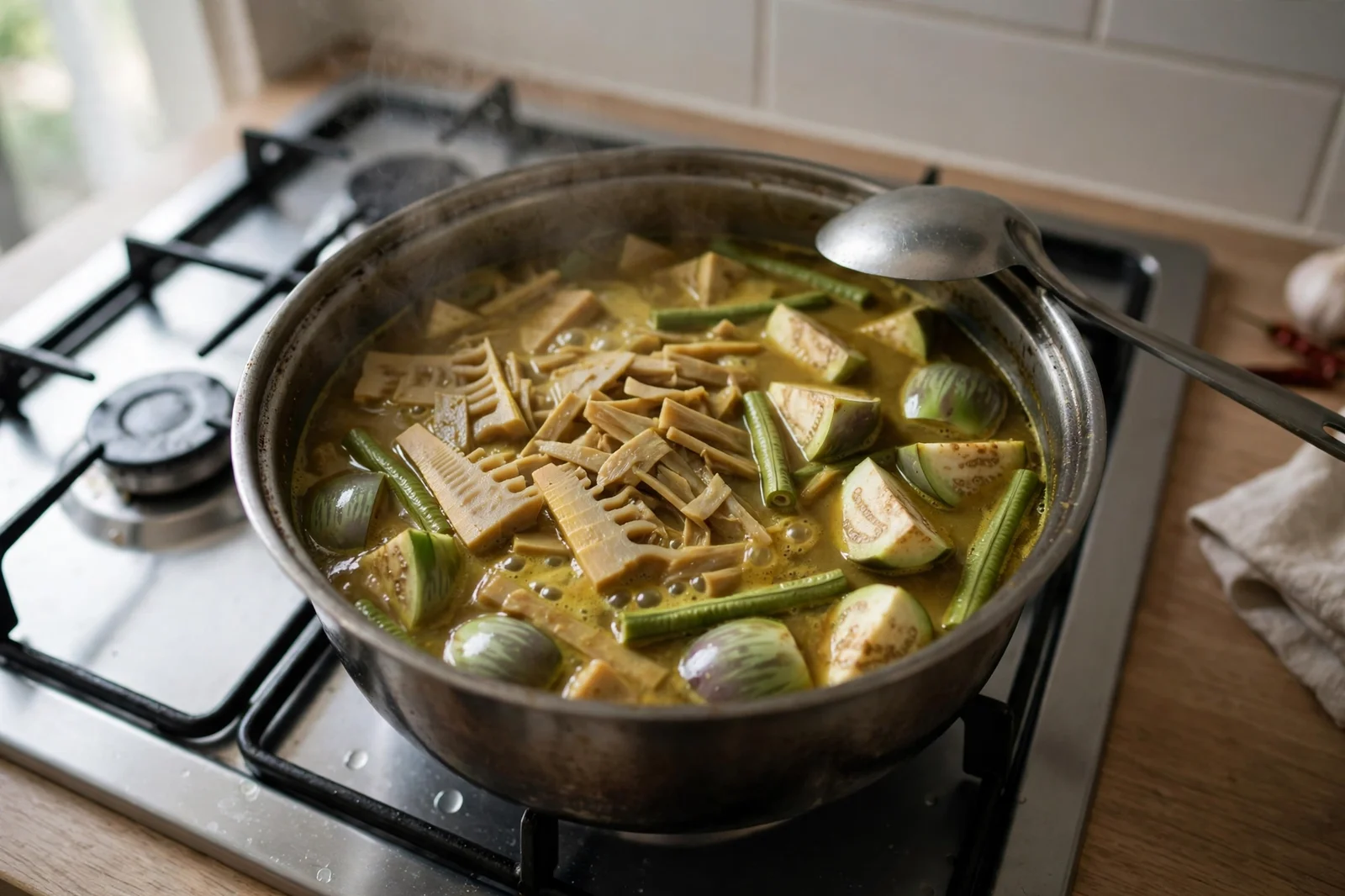
5. Cook the vegetables in order: add the bamboo shoots first and simmer for 10 minutes. Add the Thai eggplant and simmer for 6 minutes, then the yardlong beans for 4 minutes. The eggplant should be soft but still hold its shape, and the beans should stay crisp.
6. Add the fish last: slide the fish chunks into the simmering broth in a single layer. Do not stir. Spoon broth over the top, cover the pot, and cook for 6 to 8 minutes, until the fish turns opaque and flakes with a fork. Taste the broth now. Add fish sauce a teaspoon at a time only if it needs more salt. Most batches need none.
7. Finish and serve: tear in the remaining kaffir lime leaves and take the pot off the heat. Serve hot over jasmine rice with lime wedges and the plate of raw vegetables on the side.
The salt rule: taste before you add more
The most common mistake with this curry is adding fish sauce the way you would to any other Thai curry. Tai pla is already a salt bomb. My strained stock measures out at half a cup of tai pla to 3 cups of water, and that alone seasons the pot. If you add a tablespoon of fish sauce on top before tasting, the curry crosses from salty to inedible, and there is no way back except diluting the whole pot with water and losing the paste flavor with it.
So hold the fish sauce until step 6, after the fish is in and the broth has had time to take on the vegetables. Taste a spoonful of broth, not a piece of fish. If it tastes flat rather than salty, add fish sauce a teaspoon at a time and taste after each one. If it tastes too salty, stir in another half cup of water and a teaspoon of palm sugar, then taste again. The sugar does not make the curry sweet. It rounds off the sharp salt edge so the turmeric and lemongrass can come through.
The same rule applies to the chilies. Ten dried bird’s eye chilies with 2 tablespoons of black pepper is hot by any measure, and that is the southern standard. If you want it milder, cut the chilies to 5 and keep the black pepper where it is. The pepper heat and the chili heat are different, and the pepper is what gives this curry its southern character. Do not cut both at once or the paste turns flat.
Tips and variations
Use a firm fish. Cod, halibut, kingfish, and mackerel hold their shape in a simmering broth. Delicate fish like sole or flounder break into shreds within minutes, and the curry turns cloudy with fish flakes. Cut the chunks large, about 1 1/2 inches, and keep them in a single layer when they go in. The fish is done when it turns opaque and flakes with a fork, usually 6 to 8 minutes. Pull the pot off the heat the moment it gets there. The broth stays hot enough to finish the job.
For the bamboo shoots, canned shoots need a rinse and a 5-minute boil in fresh water with a pinch of salt and half a teaspoon of sugar, then a drain, before they go into the curry. That step takes out the canned taste and any leftover bitterness. Fresh shoots need a full boil until tender, with the cooking water thrown away, and never eat them raw. If you skip this prep, the shoots bring a tinny, bitter note into a broth that has nowhere to hide it.
The coconut milk version is a real variation in the south, but it is a different dish in the bowl. Add 1 cup of coconut milk in place of 1 cup of water at step 4, and the curry turns softer and rounder, closer to my Thai green curry with chicken. I keep the water version as the default because it shows the tai pla clearly, and the contrast with coconut milk is worth knowing. My guide to coconut milk vs coconut cream covers which one to buy if you go that route.
Leftovers keep for 2 days in the fridge, and the flavor actually settles overnight. The fish will soften on reheating, so warm it gently over low heat and do not let it boil. My guide on how to store leftover curry and reheat it well covers the same low-heat rule. The vegetables go soft the second day, so if you plan for leftovers, pull out a portion of the vegetables before they go in and cook them fresh when you reheat.
If you want to build the pantry for this kind of cooking, my essential Asian pantry guide lists the shrimp paste, dried chilies, and palm sugar this paste depends on, and where each one earns its shelf space.
Troubleshooting: Fix My Gaeng Tai Pla
Too salty, fish in shreds, bitter bamboo shoots, or heat you cannot eat through. Each failure has a cause and a fix. Tell the tool what went wrong:
HERB & LIME · KITCHEN HELP
Fix My Gaeng Tai Pla
Choose what went wrong to see a practical next step.
Possible cause
What to try next
For next time
From Paul's kitchen. Results vary with tai pla brand, fish size, and stove heat, adjust timing to your setup.
Quick reference (also works without JavaScript)
The curry tastes too salty
Cause: Tai pla is already very salty, and any fish sauce added before tasting pushes the broth past the point of balance.
Try: Stir in half a cup of water and a teaspoon of palm sugar, taste again, and serve the curry with plain rice and raw vegetables so each bite averages out.
Prevent: Hold all fish sauce until the fish is in and the broth has cooked with the vegetables, then add it a teaspoon at a time, tasting after each one.
The fish fell apart in the curry
Cause: Delicate fish, small pieces, or stirring after the fish goes in will break the flesh into shreds in a simmering broth.
Try: Fish out what is left with a slotted spoon and serve it over the broth as it is, the flavor is still there even if the pieces are gone.
Prevent: Use a firm fish like cod, halibut, kingfish, or mackerel, cut it into 1 1/2-inch chunks, add it last, keep the broth at a gentle simmer, and spoon broth over it instead of stirring.
The bamboo shoots taste bitter or canned
Cause: Canned shoots carry brining liquid and a metallic edge, and fresh shoots carry bitter compounds that only boiling removes.
Try: Lift the shoots out, rinse them, boil them for 5 to 7 minutes in fresh water with a pinch of salt and half a teaspoon of sugar, drain, and return them to the pot.
Prevent: Always rinse canned shoots and boil them before they go in, and boil fresh shoots until tender and throw the cooking water away.
The curry is too hot to eat
Cause: Ten dried bird's eye chilies plus black pepper is a southern heat level, and the water base has no coconut milk to soften it.
Try: Stir in half a cup of water or coconut milk and a teaspoon of palm sugar, and serve each bowl with plenty of rice and raw cucumber and long beans.
Prevent: Cut the dried chilies to 5 for your first batch and keep the black pepper where it is, so you can judge the heat before making the full-strength version.
The broth tastes gritty
Cause: Bottled tai pla carries bone fragments and sediment from fermentation, and pouring it straight into the pot leaves that grit in the broth.
Try: Take the pot off the heat, let it sit for 5 minutes so the sediment settles, then ladle the broth through a fine mesh strainer into a clean pot and reheat gently.
Prevent: Simmer the tai pla in water for 5 minutes and strain it through a fine mesh strainer before it goes anywhere near the curry paste.
Gaeng Tai Pla: Thai Southern Curry with Fish
Ingredients
Method
- Simmer the tai pla: put the tai pla and 1 cup of water in a small pot with 2 smashed lemongrass stalks and 3 kaffir lime leaves if you have them spare. Bring it to a gentle boil and simmer for 5 minutes. Pour it through a fine mesh strainer into a bowl and discard the solids.
- Pound the paste: grind the black peppercorns first, then add the soaked chilies, turmeric, lemongrass, galangal, shallots, and garlic, pounding each addition until it breaks down before adding the next. Work in the shrimp paste last. The paste should look coarse and smell sharp and citrusy.
- Fry the paste: heat a dry wok or wide pot over medium heat. Add the paste and stir it for 2 minutes until it smells fragrant and darkens a shade.
- Build the broth: pour in the strained tai pla stock and the remaining 2 cups of water. Stir in the palm sugar and bring it to a boil, then lower the heat to a steady simmer.
- Cook the vegetables in order: add the bamboo shoots first and simmer for 10 minutes. Add the Thai eggplant and simmer for 6 minutes, then the yardlong beans for 4 minutes.
- Add the fish last: slide the fish chunks into the simmering broth in a single layer. Do not stir. Spoon broth over the top, cover the pot, and cook for 6 to 8 minutes, until the fish turns opaque and flakes with a fork. Taste the broth now. Add fish sauce a teaspoon at a time only if it needs more salt.
- Finish and serve: tear in the remaining kaffir lime leaves and take the pot off the heat. Serve hot over jasmine rice with lime wedges and the plate of raw vegetables on the side.
Notes
More Thai recipes
If this hit the spot, keep going: Thai Green Curry with Chicken for the coconut-milk cousin of this curry, Panang Curry with Chicken for a milder, peanut-sweet curry, Tom Yum Goong for another hot and sour southern favorite, and Thai Red Curry with Duck for a curry that shows what dried chilies do when coconut milk is in the pot.
From the garden
Thai eggplant is the vegetable in this curry that repays a pot on a balcony. One plant in a 5-gallon container gives a steady run of small green fruit through the warm months, and the fruit you pick yourself is firmer than the ones that sit in a market bin. Pick them small, about the size of a golf ball, and quarter them straight into the pot. My guide on growing Thai eggplant in pots covers the pot size and watering that keep a plant fruiting.