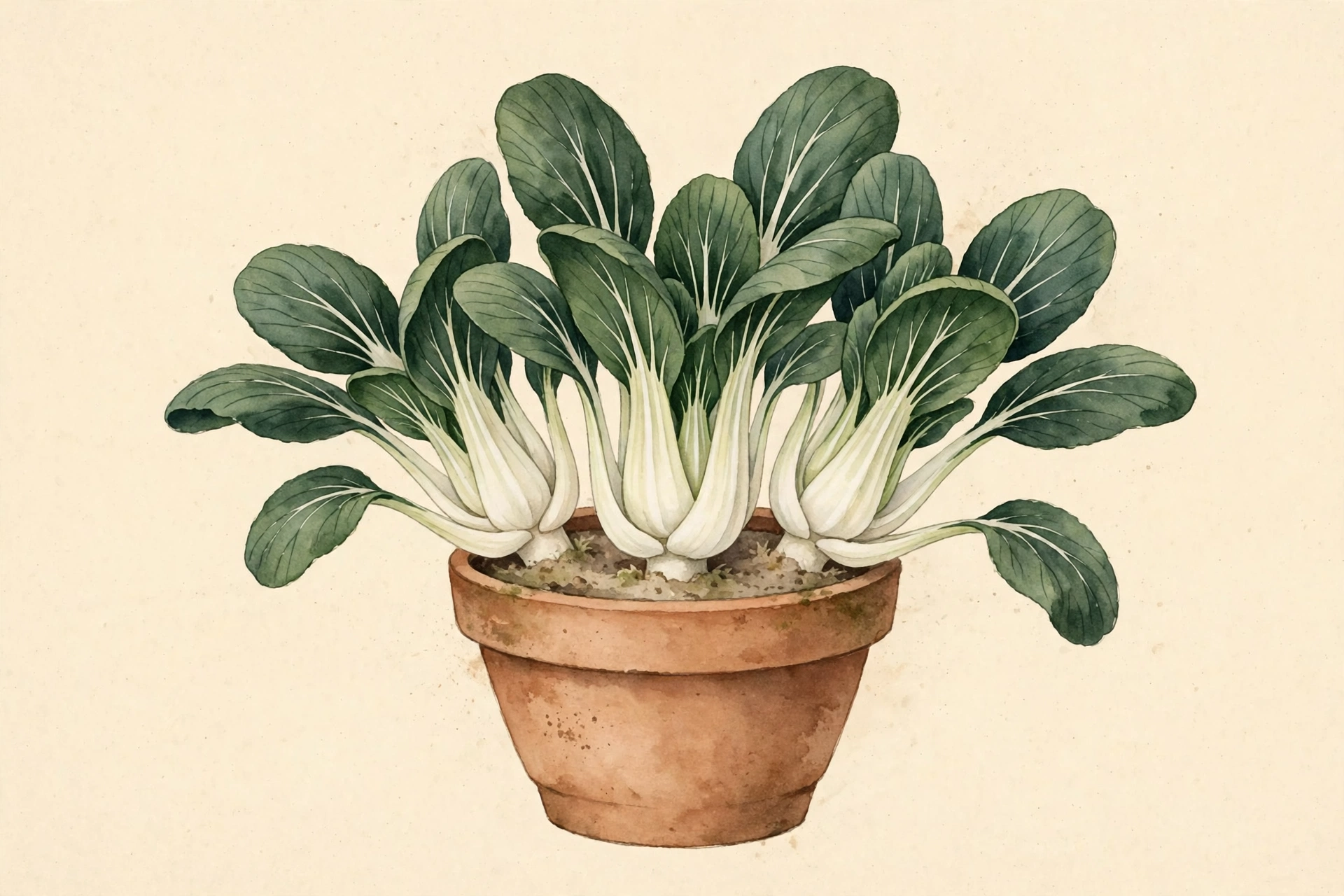
Bok choy might be the most rewarding vegetable for a first-time container gardener. It’s fast (baby bok choy in as little as 30 days, full heads in 45–60), it doesn’t need a huge pot, and it actually prefers the cool weather that makes tomatoes sulk. If you’ve got a patio pot and a bag of potting mix, you can grow a stir-fry.
A note on how this guide was written: we haven’t grown bok choy in our own garden yet, so this isn’t a personal growing diary. Everything below comes from university extension research, cited at the bottom. Some timing guidance below is regional (Santa Clara County, California) and labeled as such.
Cool weather is the point
Bok choy is a cool-season crop in the cabbage family. It grows best when daytime temperatures are in the 60s°F and bolts (flowers prematurely) when sustained heat arrives. UC Santa Clara’s extension guidance frames it as a fall-through-spring crop for mild-winter areas: sow in late summer for fall harvest, or in late winter for spring harvest. In cold-winter climates, it’s a spring and fall crop — time it around your local frost dates, not a fixed calendar month.
Container and spacing
Bok choy has shallow roots, so a pot 8–10 inches deep is plenty — but go wide rather than deep. UC guidance suggests spacing plants 6–8 inches apart; in containers, that means a 12-inch pot holds 2–3 plants comfortably, a 16-inch pot holds 4–5. Crowded bok choy stays small, so thin seedlings ruthlessly once they have a few true leaves.
Use a quality potting mix (not garden soil, which compacts in pots). Bok choy likes steady moisture, so a pot with drainage holes plus regular watering is the setup — soggy is bad, dry is worse.
Sowing
Sow seeds about ¼–½ inch deep, directly in the container — bok choy transplants okay as seedlings, but direct sowing avoids disturbing the roots. Seeds germinate in 5–10 days in cool soil. For a continuous harvest, sow a new small batch every 2–3 weeks during the cool season.
Water, feed, and mulch
Keep the mix consistently moist — bok choy is mostly water, and drought stress makes it bolt and turns the stems pithy. A layer of mulch on the surface helps containers hold moisture. Feed lightly: a half-strength balanced liquid fertilizer every 2–3 weeks is enough for container plants. Over-fertilized bok choy grows soft and pest-prone.
Bolting and pests
Bolting is the main enemy. Once the plant sends up a flower stalk, the leaves turn bitter — harvest immediately or compost it. Heat, drought, and root crowding all trigger it, so the prevention is the same advice as everything else: cool timing, steady water, proper spacing.
Pest-wise, the usual cabbage-family suspects apply: flea beetles (tiny shot-holes in leaves) and cabbage worms. Row cover over the container is the simplest organic defense — it blocks the adult insects from laying eggs in the first place. A strong spray of water knocks off aphids.
Harvesting
Harvest baby bok choy at 4–6 inches tall, or let heads mature to full size. Cut the whole head at the base, or harvest outer leaves individually for a cut-and-come-again approach. Morning harvest, as always, for the crispest leaves. Fresh bok choy wilts fast — get it into the fridge (or the wok) promptly.
In the kitchen
Bok choy is built for the wok: high heat, garlic, a splash of sauce, done in minutes. Our Garlic Bok Choy Stir-Fry and Bok Choy and Mushroom Soup both start here.
Sources
- UC Agriculture and Natural Resources, Santa Clara County — bok choy container and timing guidance. https://cesantaclara.ucanr.edu/