
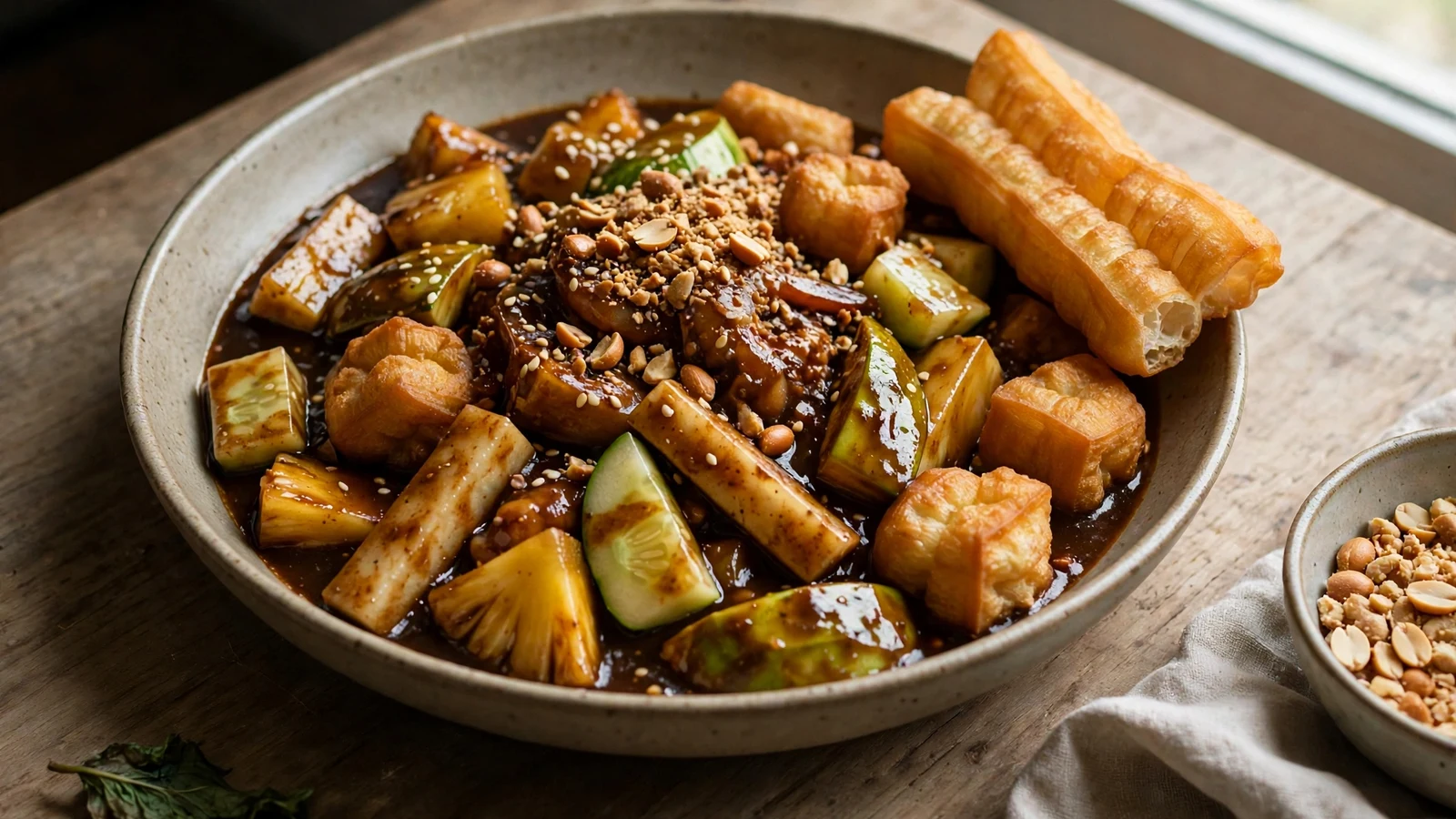
Rojak is the snack Paul reaches for when the fruit bowl is full and dinner is still an hour away. Crisp jicama, pineapple, cucumber and green mango go into a bowl with fried tofu puffs and youtiao, and a thick tamarind and shrimp-paste sauce coats every piece. Crushed peanuts and sesame seeds go on top. It takes about 30 minutes, most of it cutting, and it serves four as a snack or a side. The sauce carries four tastes at once: sweet palm sugar, sour tamarind and lime, salty shrimp paste, and chili heat.
What is rojak?
Rojak means mixture in Malay, and the name fits: this is a salad built from whatever crisp fruit, vegetables and fried bits are on hand, tossed in a dark, sticky sauce. Hawker stalls across Malaysia and Singapore sell it by the plate, and every stall mixes its own sauce. The Penang version leans on hae ko, a thick black shrimp paste, while Singapore stalls often use belacan, a block of fermented shrimp paste, pounded with peanuts. Both land in the same place: sweet, sour, salty and hot, with crunch from the fruit and the fried pieces. It works as a snack on its own, and it sits well on a table with nasi lemak with coconut rice and sambal.
Ingredients
For the sauce
- 3 tablespoons tamarind paste, seedless
- 3 tablespoons palm sugar, finely chopped
- 2 tablespoons hae ko (thick black shrimp paste)
- 1 teaspoon belacan, toasted
- 1 tablespoon sambal oelek, or 1 red chili, finely chopped
- 2 tablespoons lime juice
- 1 tablespoon dark soy sauce
- 1 tablespoon water
- 1/4 cup roasted peanuts, finely ground
For the salad
- 1/2 small pineapple, peeled and cut into bite-size chunks (about 2 cups)
- 1 medium cucumber, deseeded and cut into thick half-rounds (about 1 1/2 cups)
- 1 small jicama, peeled and cut into matchsticks (about 1 1/2 cups)
- 1 firm green mango, peeled and julienned (about 1 cup)
- 1 cup bean sprouts, rinsed and drained
- 4 fried tofu puffs, halved
- 1 youtiao (Chinese cruller), cut into 1-inch pieces
For serving
- 1/4 cup roasted peanuts, roughly chopped
- 1 tablespoon toasted sesame seeds
How to make it
Cut the pineapple into bite-size chunks, the cucumber into thick half-rounds, the jicama into matchsticks, and the green mango into thin strips. Keep the pieces chunky: small dice turns to mush once the sauce goes on, while thick pieces stay crisp. Rinse the bean sprouts and drain them well, halve the tofu puffs, and cut the youtiao into 1-inch pieces. The bean sprouts go in raw; I grow mine indoors, and my guide to growing bean sprouts indoors covers the jar method from seed to harvest.

Toast the belacan in a dry pan over low heat for about 1 minute, until it smells fragrant, then pull it off the heat before it darkens. Put the tamarind paste, palm sugar, hae ko, belacan, sambal, lime juice, soy sauce and water in a small pot over low heat. Stir for 2 to 3 minutes until the sugar dissolves and the sauce coats the back of a spoon, then stir in the ground peanuts and take the pot off the heat. Let the sauce cool for 10 minutes. The sauce follows a 3-3-2 ratio by the spoon: 3 of tamarind paste, 3 of palm sugar, 2 of hae ko. Taste it now: it should read sweet first, then sour, with salt and heat behind. If palm sugar is hard to find, dark brown sugar works, and my palm sugar substitutes guide lists the swaps by dish.

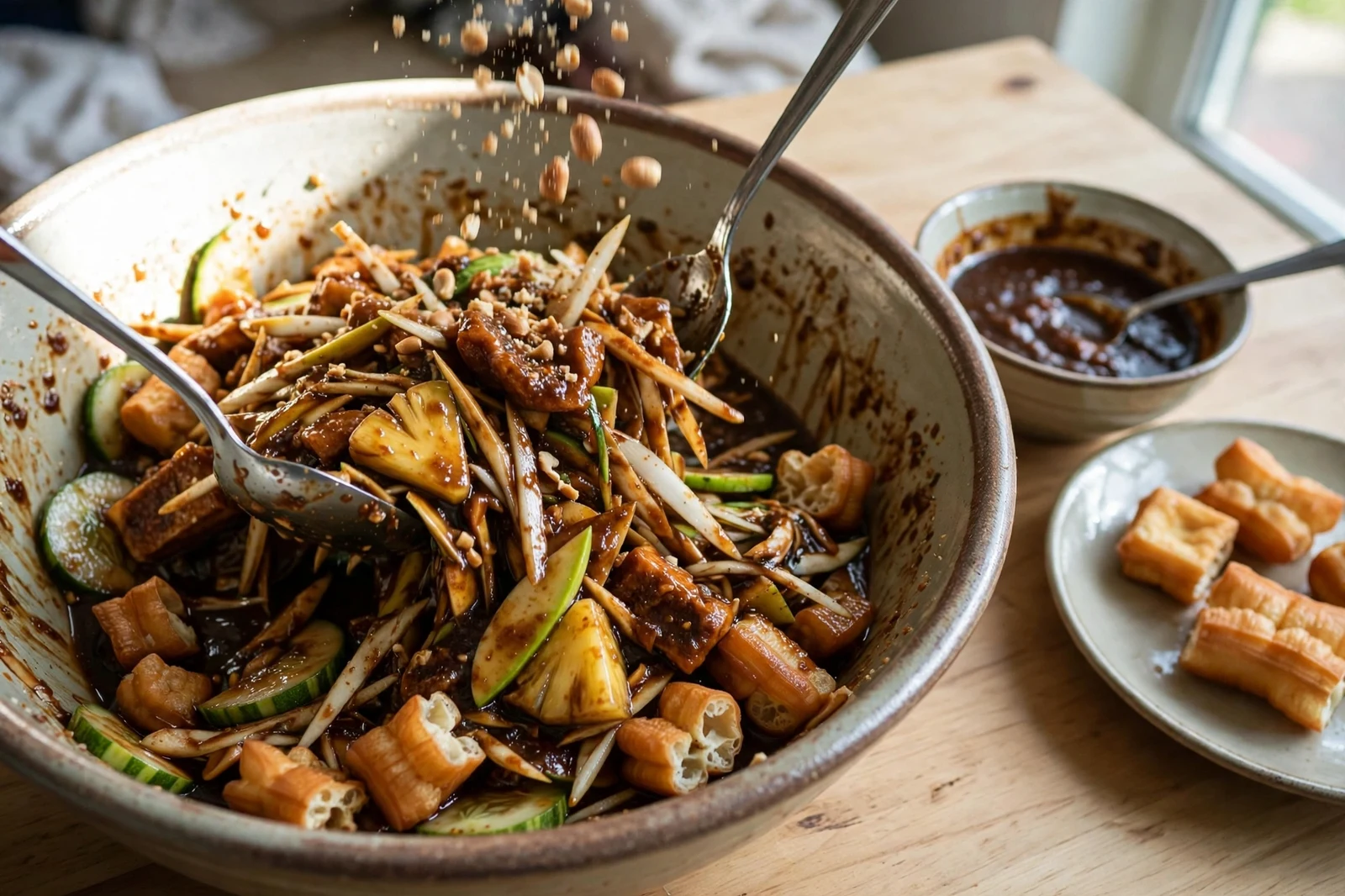
Put the pineapple, cucumber, jicama, mango, bean sprouts and tofu puffs in a large bowl. Pour over about three quarters of the sauce and toss with two spoons until every piece is coated. Add the rest of the sauce only if the bowl looks dry. Add the youtiao last, toss once, and top with the chopped peanuts and sesame seeds. Serve right away: the youtiao stays crisp for about 5 minutes once it meets the sauce, and the cut fruit starts to weep juice after about 30 minutes, which thins the sauce.
Troubleshooting: Fix My Rojak
Most rojak problems trace back to the sauce or the timing. Pick the problem that matches your bowl below for a practical next step.
HERB & LIME · KITCHEN HELP
Fix My Rojak
Choose what went wrong to see a practical next step.
Possible cause
What to try next
For next time
From Paul's kitchen. Results vary with tamarind paste brand, palm sugar, and fruit ripeness, adjust seasoning to your setup.
Quick reference (also works without JavaScript)
The sauce is too thin and slides off the fruit
Cause: Too much water or lime juice went in, and the sauce has nothing to give it body.
Try: Stir in a spoonful of finely ground roasted peanuts or a little more grated palm sugar, and toss again. Both thicken the sauce without changing its flavor much.
Prevent: Add water a teaspoon at a time and stop when the sauce coats the back of a spoon. If the sauce is too thick, thin it the same way, a spoonful of water at a time.
The youtiao turned soggy
Cause: The fried dough sat in the sauce too long before serving, so it soaked up liquid and lost its crunch.
Try: Fish out the soft pieces and add a fresh batch of toasted youtiao just before serving.
Prevent: Toast the youtiao in a dry pan or oven until crisp, add it last, toss once, and serve within 5 minutes.
The belacan tastes harsh and fishy
Cause: The shrimp paste went in raw, or it was toasted past fragrant into burnt.
Try: Balance the bowl with an extra squeeze of lime juice and a spoonful of palm sugar, and add more fruit so the sauce is less concentrated.
Prevent: Toast the belacan in a dry pan over low heat for about 1 minute, until it smells fragrant, and pull it off the heat before it darkens.
The sauce is too sweet or too sour
Cause: Tamarind paste strength varies by brand, so the same spoonful can land sweeter or sharper than expected.
Try: Too sweet: add lime juice a teaspoon at a time. Too sour: add grated palm sugar a teaspoon at a time. Taste after each addition.
Prevent: Taste the sauce before tossing, not after. Season in small steps, since the fruit and peanuts also add sweetness once mixed in.
The sauce is too spicy
Cause: Too much chili or sambal went in at once, and the heat has nothing mild to hide behind.
Try: Stir in a spoonful of palm sugar and a spoonful of ground peanuts. Sweetness and fat both soften chili heat.
Prevent: Start with half the chili, deseed it, and add more only after tasting. The sauce should read sweet first, then sour, with heat behind.
Rojak: Malaysian Fruit and Vegetable Salad
Ingredients
Method
- Cut the pineapple into bite-size chunks, the cucumber into thick half-rounds, the jicama into matchsticks, and the green mango into thin strips. Keep the pieces chunky so they stay crisp under the sauce. Rinse the bean sprouts and drain well, halve the tofu puffs, and cut the youtiao into 1-inch pieces.
- Toast the belacan in a dry pan over low heat for about 1 minute, until it smells fragrant, then pull it off the heat before it darkens.
- Put the tamarind paste, palm sugar, hae ko, belacan, sambal, lime juice, soy sauce, and water in a small pot over low heat. Stir for 2 to 3 minutes until the sugar dissolves and the sauce coats the back of a spoon, then stir in the ground peanuts and take the pot off the heat. Let the sauce cool for 10 minutes, then taste: it should read sweet first, then sour, with salt and heat behind.
- Put the pineapple, cucumber, jicama, mango, bean sprouts, and tofu puffs in a large bowl. Pour over about three quarters of the sauce and toss with two spoons until every piece is coated. Add the rest of the sauce only if the bowl looks dry.
- Add the youtiao last, toss once, and top with the chopped peanuts and sesame seeds. Serve right away.
Notes
From the garden
The bean sprouts in this salad come from a jar on my kitchen counter. They go into the bowl raw, and their clean crunch sits against the soft fruit. My guide to growing bean sprouts indoors covers the jar, the rinsing rhythm, and when to harvest.
More Malaysian recipes
Try nasi lemak with coconut rice and sambal, Malaysian char kuey teow, roti canai, Malaysian flaky flatbread, and laksa, coconut curry noodle soup next.
From Paul’s kitchen.