
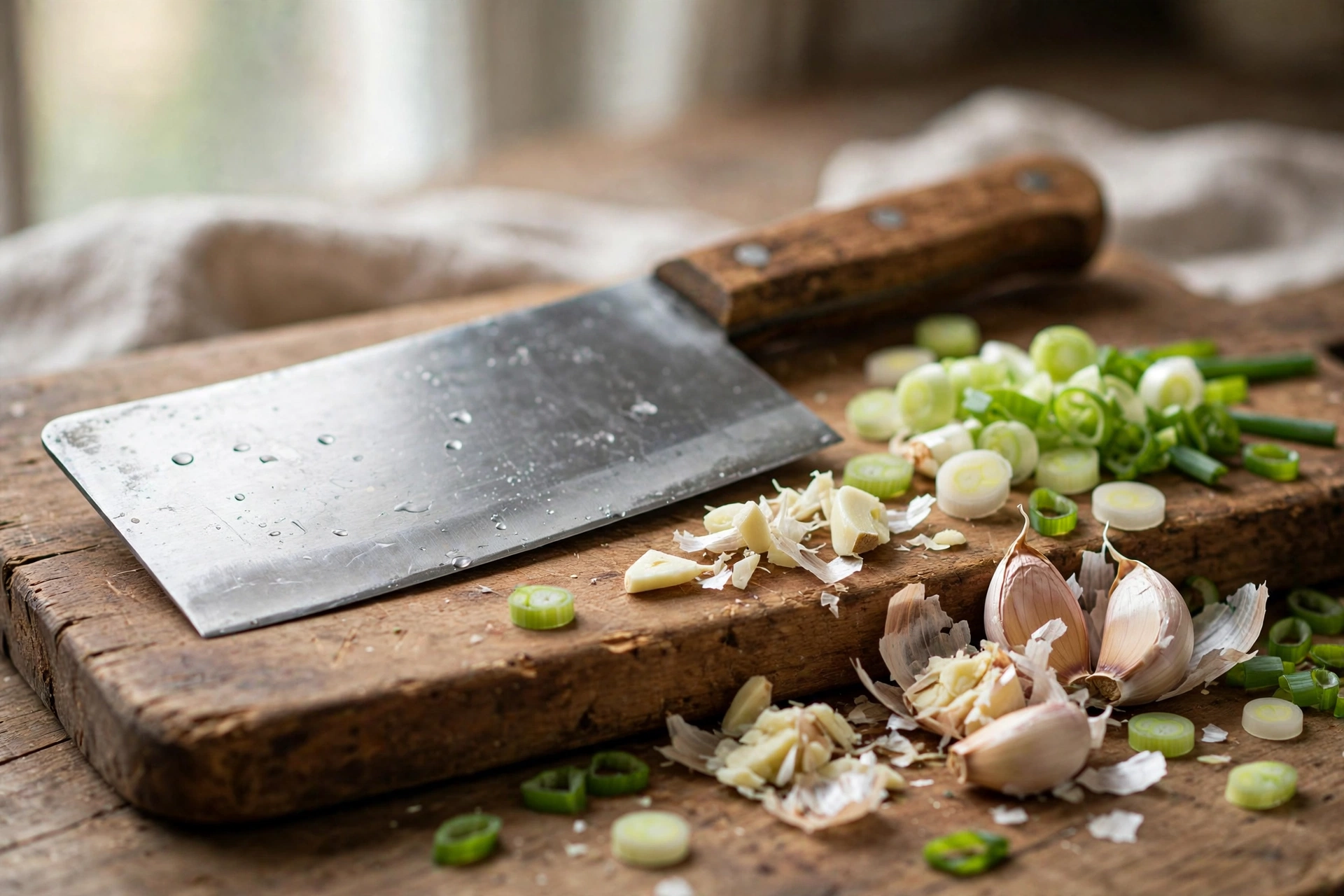
First, Know Which Cleaver You Own
"Chinese cleaver" covers two different tools that happen to share a tall, rectangular shape, and they want different care. Sharpening a heavy chopper like a thin slicer (or the other way around) is how edges chip and grinds go wavy.
| Type | Blade | Made for | Edge angle (per side) |
|---|---|---|---|
| Vegetable cleaver (sang dao / slicer) | Thin, light, flat-ish belly | Vegetables, tofu, boneless meat, garlic smashing | 12 to 15 degrees |
| Medium cleaver (all-purpose) | Slightly thicker spine | Poultry with small bones, hard squash, everyday prep | 15 to 18 degrees |
| Bone chopper (gudao) | Thick, heavy, convex edge | Splitting chicken backs, pork bones, frozen-freezer finds | 20 to 25 degrees |
A quick test: if you can flex the blade's edge area with firm thumb pressure from the side (carefully, on the flat, never the edge), you have a slicer. If the spine is as thick as two stacked quarters, treat it as a chopper and keep it away from delicate work it was never meant for.
The grip, the claw guide hand, and the core cuts for either blade are covered step by step in our Knife Skills Basics for Asian Home Cooking guide. This page picks up where that one stops: keeping the edge itself in shape.
Carbon Steel or Stainless? Care Follows the Metal
Most traditional cleavers are carbon steel. Carbon takes a very fine edge and sharpens fast on a stone, but it reacts with food and water: it will darken into a gray-blue patina and rust if it sits wet. Stainless cleavers trade a little of that easy sharpness for a blade you can leave in the dish rack without consequences.
- Carbon steel routine: Wash, dry immediately with a towel, and store dry. A drop of neutral oil wiped over the blade pays off if your kitchen is humid or the cleaver will sit unused for a week.
- Stainless routine: Wash and dry the same way, more for the edge than the metal. Water spots are cosmetic; a wet edge left in a drawer block dulls and can still pit over time.
- The smell test: Carbon steel can give a metallic taste to raw onion or cabbage the first few uses. That fades as the patina builds. Cooking a batch of oily food (a stir-fry with plenty of oil) speeds the patina along.
Honing Is Not Sharpening
These two jobs get mixed up constantly, and doing the wrong one is why a cleaver can feel dull even though you "sharpen" it every week.
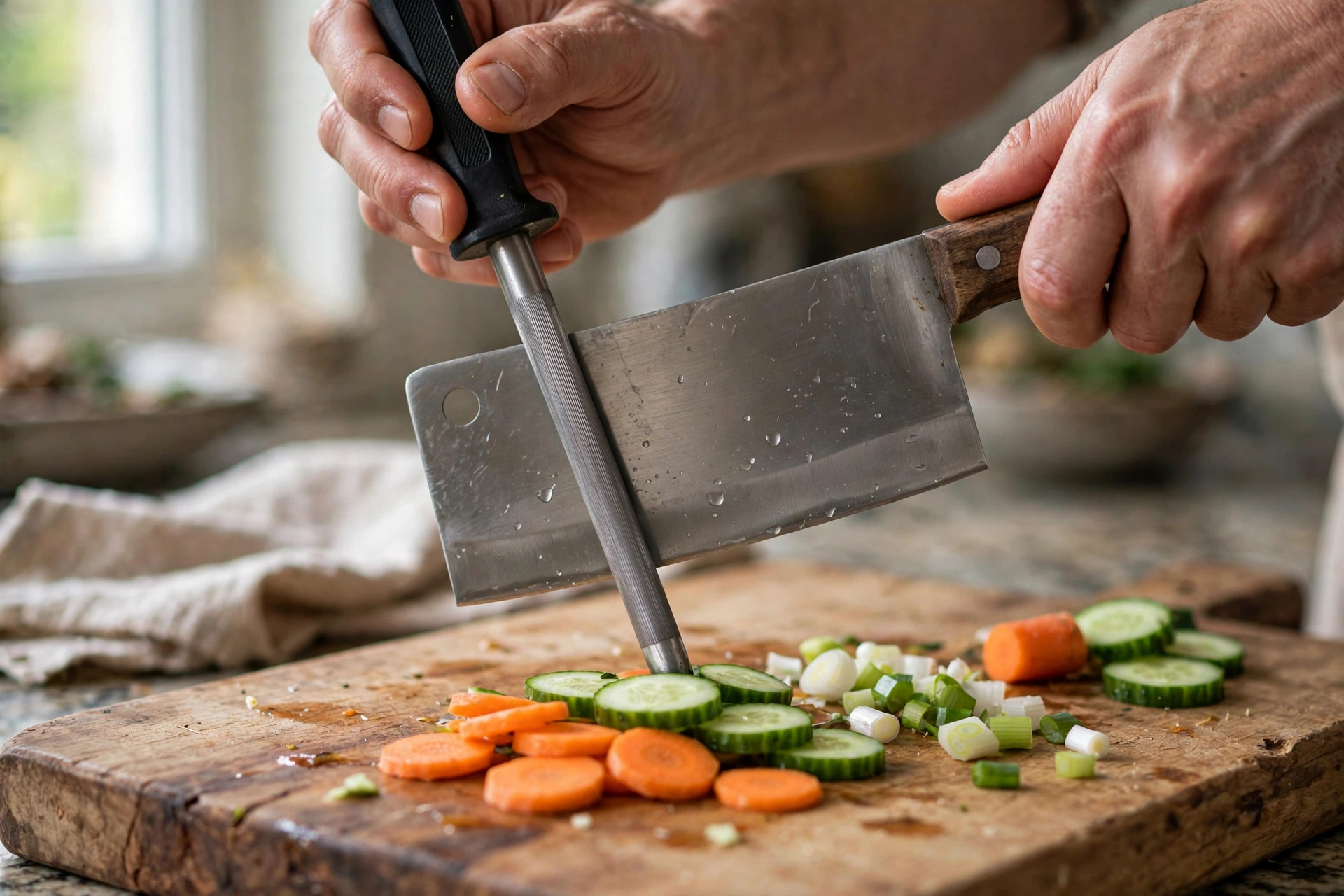
- Honing (the steel rod): Realigns a bent edge. It removes almost no metal. Use it often — a few light strokes per side before a big prep session keeps a slicer feeling fresh for months.
- Sharpening (the whetstone): Grinds a new edge when honing stops helping. For a home cook using a cleaver most days, that is usually every 2 to 4 months for a slicer, less often for a chopper.
- Stropping (leather or newspaper): Optional polish after the stone. Nice for a slicer you use on herbs and scallions; skip it for a chopper.
Hone at the same angle you sharpen. For most slicers that means holding the blade so a stack of two coins fits under the spine at the stone (or rod) — a simple visual gauge that lands you near 15 degrees without a protractor.
Sharpening on a Whetstone, Step by Step
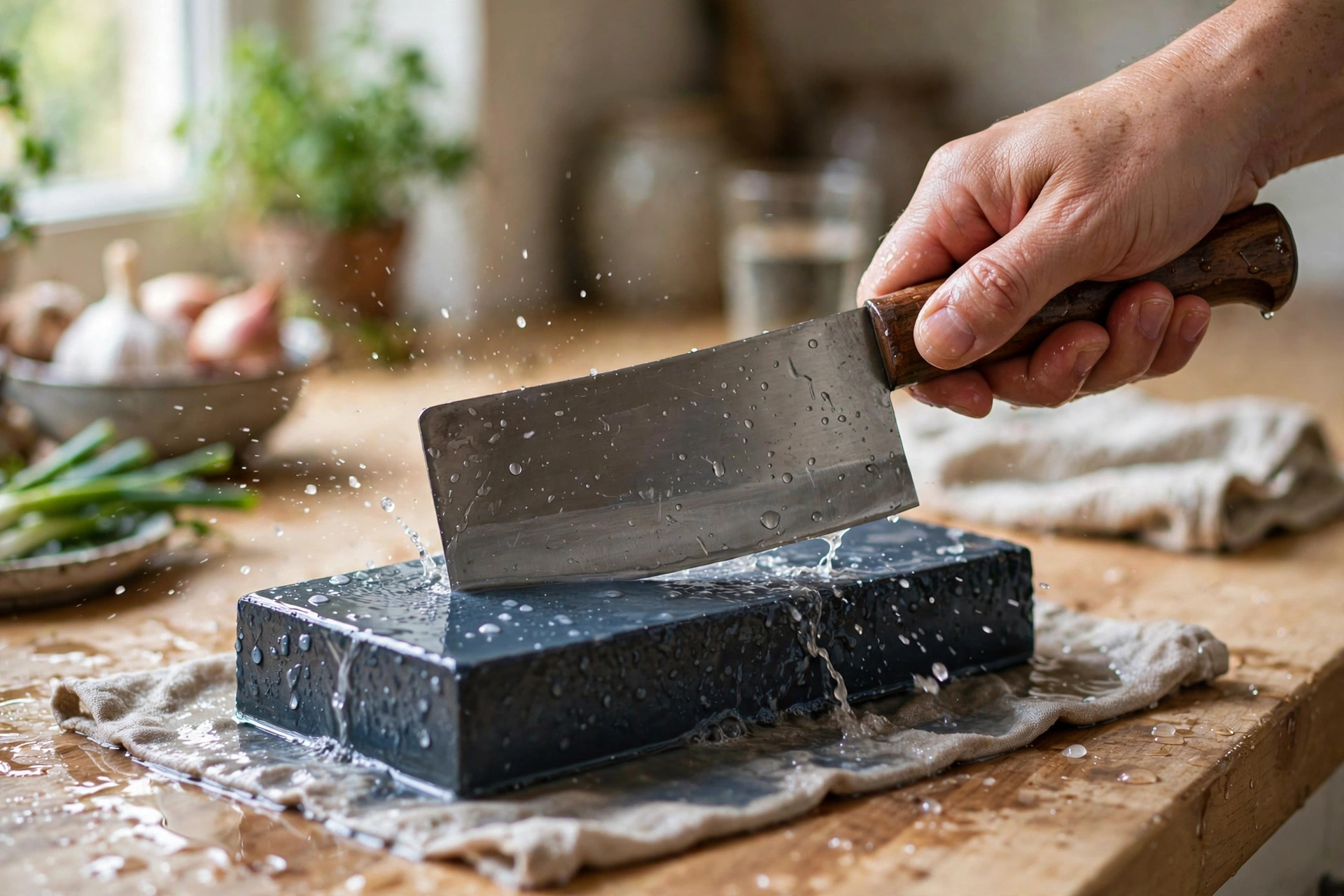
A 1000/3000 or 1000/6000 combination stone covers nearly every home cleaver. Soak it until bubbles stop rising (about 10 minutes), set it on a damp towel so it cannot skate, and keep a small cup of water nearby to keep the surface wet.
1. Start on the 1000 side. Hold the cleaver with the edge facing you, spine raised to your angle, and push the blade away and across the stone in one smooth stroke, as if slicing a thin layer off the stone's surface. Work from heel to tip so the whole edge gets even passes.
2. Count strokes, then flip. Five to ten strokes on one side, then the same number on the other. Alternate sides rather than grinding one side flat; a cleaver edge should stay centered.
3. Feel for the burr. Run a fingertip lightly across (never along) the edge from the opposite side. A fine wire of metal — the burr — tells you the two bevels have met. Raise the burr along the full length before moving on.
4. Refine on the finer side. Repeat with lighter pressure on the 3000 or 6000 side, then a few alternating strokes with almost no pressure to knock the burr off.
5. Test on paper, then produce. A sharp slicer edge slices printer paper cleanly and bites into a tomato skin without pressure. If it skates on the tomato, go back to the 1000 side for a few more passes rather than pressing harder next time you cut.
Two cleaver-specific notes: the tall blade wants a longer stroke than a chef's knife, so use the full length of the stone; and the flat belly means you sharpen in three zones (heel, middle, tip) with overlapping strokes instead of one curved sweep.
Everyday Care That Prevents Most Problems
- Cut on wood or soft plastic, never glass or stone. A glass board can roll a thin slicer edge in one session. End-grain or edge-grain wood is kindest; a quality plastic board is a fine second.
- Use the spine, not the edge, to scoop. The broad blade is a built-in bench scraper, but scrape with the spine side or the flat — dragging the edge across the board to gather scallions dulls it fast.
- Wash by hand, dry right away. The dishwasher's heat, detergent, and rattling are rough on edges and wooden handles alike. Thirty seconds with a sponge and a towel is the whole job.
- Never use a slicer as a can opener, pry bar, or bone splitter. Twisting forces chip thin edges. That is chopper work, or work for a different tool entirely.
Heat is the other slow enemy. A cleaver left on a hot stove edge or run under very hot water and left to air-dry can lose temper over time and pick up water spots that turn to rust on carbon steel. The same respect for hot metal applies to the pan beside it; our guide to seasoning a carbon steel wok covers the dry-it-on-the-heat habit that both tools reward.
Storage: Off the Counter Pile, Away From the Edge
A cleaver's worst storage is loose in a drawer, where the edge knocks against every other utensil each time the drawer opens. Better options, in order of how well they protect the edge:
- Magnetic wall strip: Best for most kitchens. The blade hangs flat, dry, and visible. Set the spine against the magnet first, then roll the blade flat so the edge never snaps into the strip.
- Blade guard or saya: A fitted sheath makes drawer storage safe. Make sure the blade goes in bone dry; a guard traps moisture against carbon steel.
- In-drawer knife tray: Fine if each slot holds the blade still. Avoid the kind of slotted block where the edge rides on wood every time you pull the cleaver out.
- Never store it wet "to wash later." Ten minutes in a puddle in the sink is enough to spot a carbon blade and dull any edge against the sink's steel.
Troubleshooting: Dull Spots, Chips, and Rust
- One dull section, sharp elsewhere: You are sharpening in two zones instead of three. Mark the dull stretch with a marker on the bevel, then sharpen until the marker is gone evenly along that section.
- Small chips along the edge: Usually bones, frozen food, or a glass board. Work them out on the 1000 stone with a few extra passes at a slightly raised angle, then re-establish your normal angle. Chips deeper than a grain of rice are a job for a coarser 400-grit stone or a professional.
- Rust spots on carbon steel: Scrub with a paste of baking soda and water on a cork or the cut side of a lemon, rinse, dry, and oil lightly. Surface rust comes off; deep pitting stays, and a pitted section will keep catching on food — sharpen past it if it is near the edge.
- A wavy, uneven bevel: Comes from changing angle mid-stroke. Slow down, lock your wrist, and let the stone do the work. The fix is patient, even passes, not more pressure.
- Food sticks to the blade: Not an edge problem — a flat, tall blade creates suction on potatoes, cucumbers, and cheese-like tofu. A few shallow granton-style dimples help on some blades; otherwise, a slight rocking lift between slices breaks the seal.
A Simple Care Rhythm
You do not need a calendar alert for any of this. Let the knife tell you: hone when the edge stops biting a tomato skin, sharpen when honing no longer brings it back, and oil a carbon blade whenever it will sit for more than a few days. Stored dry, honed often, and sharpened a few times a year, a decent Chinese cleaver will outlast the cutting board under it — and every scallion, smashed cucumber, and wok of greens in our Wok Hei guide starts with exactly that edge.