
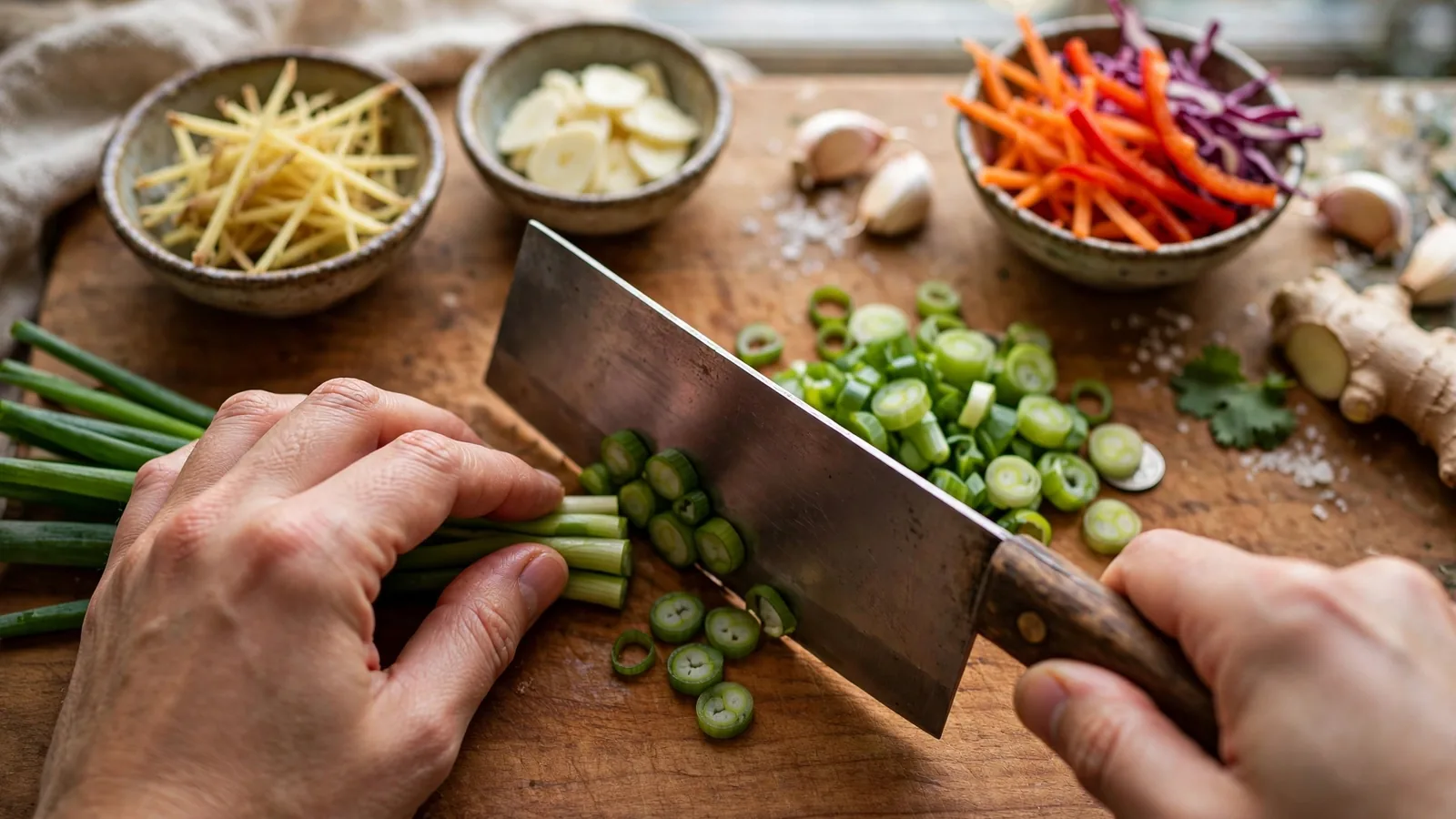
If you have ever watched someone break down a pile of scallions in seconds — neat coins, no crushed stems, fingers safely out of the way — you have seen the real secret behind fast Asian home cooking. It is comfortable, repeatable knife work.
One sharp chef’s knife or Chinese cleaver, a stable board, and a handful of core cuts will handle ninety percent of pan-Asian prep: julienned ginger, smashed garlic, bias-cut scallions, and thin-sliced proteins that cook evenly in a wok.
This guide covers the grip, the cuts, and the daily care that make prep feel calm instead of chaotic.
Start With One Good Knife and a Stable Board
Most Asian home kitchens run on one main knife. In Chinese cooking that is often a cai dao — a broad cleaver that slices, smashes, and scoops. In Japanese and Korean cooking it is just as often a santoku or chef’s knife. Pick the knife that fits your hand, holds an edge, and feels balanced when you lift it.
- Blade length: 7 to 8 inches for a chef’s knife or santoku is the sweet spot. A Chinese cleaver (about 7 inches long, 3 to 4 inches tall) gives you knuckle clearance and a built-in bench scraper.
- Weight and balance: The knife should feel like an extension of your arm, not a workout. If your wrist tires in two minutes, the knife is too heavy or the grip is fighting you.
- The board matters as much as the blade. A large board that does not slide is nonnegotiable. Put a damp towel or non-slip mat under it.
- Keep a small bowl nearby. Asian prep moves fast once the wok is hot. Having aromatics, vegetables, and protein cut and grouped means you are not scrambling with a knife in hand while oil smokes.
If your pantry is still coming together, our essential Asian pantry guide pairs well with this setup — the same ingredients show up again and again once your cuts are consistent.
The Grip That Keeps You Safe and Fast
Hold the knife with a pinch grip, not a fist. Pinch the blade right where it meets the handle, between your thumb and the side of your index finger. Wrap your remaining three fingers loosely around the handle. It feels odd for a day, then it feels like control.
Your guide hand does the safety work. Curl your fingertips inward like you are holding an invisible tennis ball — the claw. Your knuckles guide the flat of the blade while your fingertips stay tucked behind them. The knife slides against your knuckles, never over your nails.
- Slow is smooth first. Cut at a pace where you can keep the claw and pinch without thinking. Speed comes from repetition, not rushing.
- Keep the tip or heel in contact. For most vegetable cuts, the knife rocks or slides rather than lifting high and chopping straight down.
If you are new to a Chinese cleaver, use the same pinch grip and let the tall blade ride against your knuckles. That broad face becomes the best scoop you own for moving sliced garlic straight into the wok.
The Core Cuts You Will Use Every Week
Asian recipes name cuts because size controls cooking time. A thick carrot coin and a thin carrot julienne cannot go into the same stir-fry and finish together. Learn these seven and you can read almost any ingredient list without guessing.
1. Slice (coins and ovals)
The default cut for water chestnuts, lotus root, Chinese sausage, and firm tofu. Slice straight down in even thickness — about 1/8 to 1/4 inch for stir-fries. For long vegetables like scallions, cucumbers, and Chinese eggplant, cut on a sharp bias (a long diagonal) for more surface area and a shape that tumbles nicely in the wok.
Even slicing matters. In Japanese cucumber sunomono, thin slices go limp while thick ones stay raw if the sizes vary.
2. Julienne and matchsticks
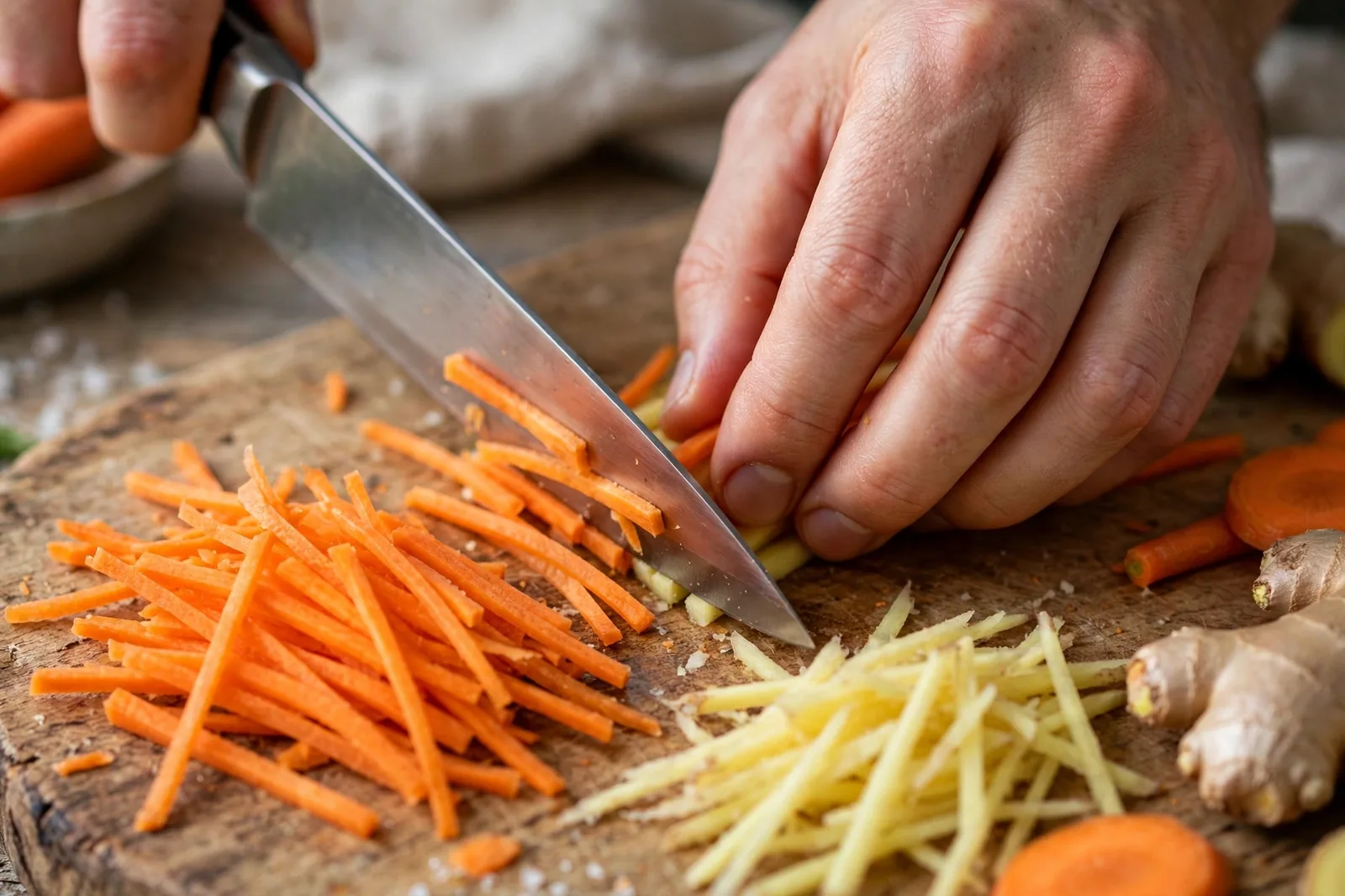
First slice the ingredient into thin planks, stack two or three, then cut them into sticks about 1/8 inch thick and 2 inches long. Ginger, carrots, bell peppers, and bamboo shoots are classic candidates.
Julienned aromatics melt into a dish instead of sitting in chunks. In japchae, where vegetables are cut to match the noodles, even sticks make a unified bite.
3. Dice and mince
For dice, start with sticks, then cut across them into cubes — onion, bell pepper, water chestnuts, and firm tofu all take it well. For mince (garlic, ginger, fermented black beans, Thai chilies), rock the knife over the pile, gather it back together, and repeat until fine and even.
For garlic, smash each clove first with the flat of the blade. The skin slips off, the clove flattens, and mincing takes half the time. Press gently — you are not pounding.
4. Roll cut
Roll cuts suit carrots, burdock, and Asian eggplant in braises and stews. Make a diagonal cut, roll the vegetable a quarter turn toward you, cut again on the same diagonal. You get chunky pieces with angled faces that soak up sauce and cook at roughly the same rate, even where the vegetable tapers.
5. Smash
Some ingredients are better broken than sliced. Chinese smashed cucumbers are hit firmly with the flat of a cleaver until they crack into rough chunks — the jagged edges drink up dressing in a way clean slices never do. Lemongrass is bruised the same way with the spine of the knife to release its oils before mincing or simmering.
6. Thin-slicing meat for stir-fries
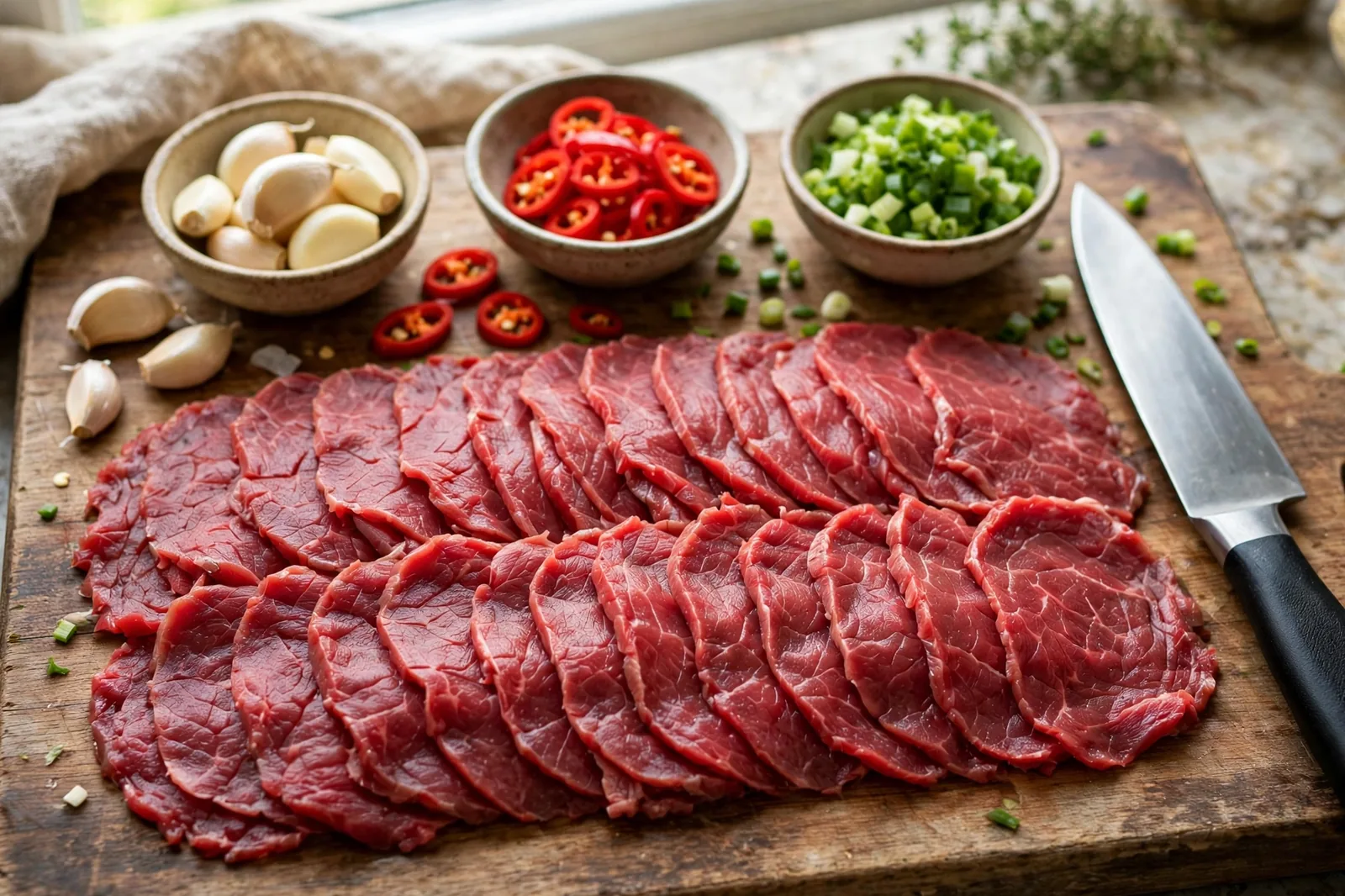
Partially freeze beef, pork, or chicken for 20 to 30 minutes until firm but not rock-hard. Slice across the grain about 1/8 inch thick. Cutting across the grain shortens the muscle fibers, so the meat stays tender over high heat.
This is the cut behind Bo Luc Lac shaking beef. Slice with the grain and the same meat turns chewy. Look for the lines running through the meat and cut perpendicular to them.
7. Butterfly and score
Butterflying means slicing a thick piece horizontally and opening it like a book so it cooks evenly. Scoring means shallow crosshatch cuts on squid, fish, or thick pork to help heat and marinade penetrate. Go shallow — about a third of the way into the flesh.
Knife Care: Sharp Is Safer Than Dull
A dull knife is the dangerous one. It skids off onion skins, needs force to start a cut, and tears herbs instead of slicing them. A sharp knife goes where you point it with light pressure.
Honing vs. sharpening. A honing steel does not sharpen — it realigns a slightly bent edge. A few light strokes on each side before a big prep session can restore that just-sharpened feel for a few weeks. Actual sharpening removes metal and restores the edge angle, usually on a whetstone or with a professional service. Most home cooks need it a few times a year if they hone and store knives well.
Whetstone basics. Start with a 1000/3000 or 1000/6000 combination stone. Soak it until bubbles stop, keep it wet, and hold a consistent angle — roughly 15 degrees for Japanese blades, about 20 degrees for most Western and Chinese knives. Draw the blade across in smooth arcs, heel to tip, the same number of strokes per side.
Storage and washing:
- Never toss a knife loose in a drawer. Use a magnetic strip, blade guard, or block.
- Hand-wash and dry right away. Dishwashers bang the edge, dull the blade, and can crack handles.
- Use the spine, not the edge, to scrape the board.
A sharp knife gives you thin, even cuts; those cuts are what let high heat work in seconds. Our guides to wok hei and seasoning a carbon steel wok build directly on this prep.
A Simple Practice Plan for the First Two Weeks
You do not need drills. You need a few forgiving ingredients and ten minutes at a time.
Days 1–3: Scallions and cucumbers. Practice the claw and bias cuts until the ovals come out roughly the same thickness.
Days 4–7: Carrots and bell peppers. Planks, then sticks, then dice. Aim for consistency over speed.
Week 2: Ginger and garlic — smash, peel, mince. Then slice a partially frozen chicken breast across the grain and stir-fry it with those aromatics in a hot, well-oiled pan.
Two safety resets: if your fingertips creep forward, stop and reset the claw. If you are tired or rushing, slow down and finish the cut you are on. Almost every home knife nick happens during a hurried last slice.
Putting It Together at the Board
Good knife skills in Asian cooking are not about fancy blades. They are about a pinch grip you trust, a claw that keeps your fingers safe, and five or six cuts you can repeat without thinking. Slice evenly so food cooks evenly. Julienne aromatics so they disappear into the sauce. Slice meat thin and across the grain so high heat makes it tender instead of tough. Keep the edge sharp, the board still, and your mise en place ready before the wok gets hot.
That steady prep is what makes the rest of the cuisine feel easy — from a weeknight stir-fry to a pot of pho ga where every garnish is cut and waiting. Start with one knife, one carrot, and the claw. The speed shows up on its own.