
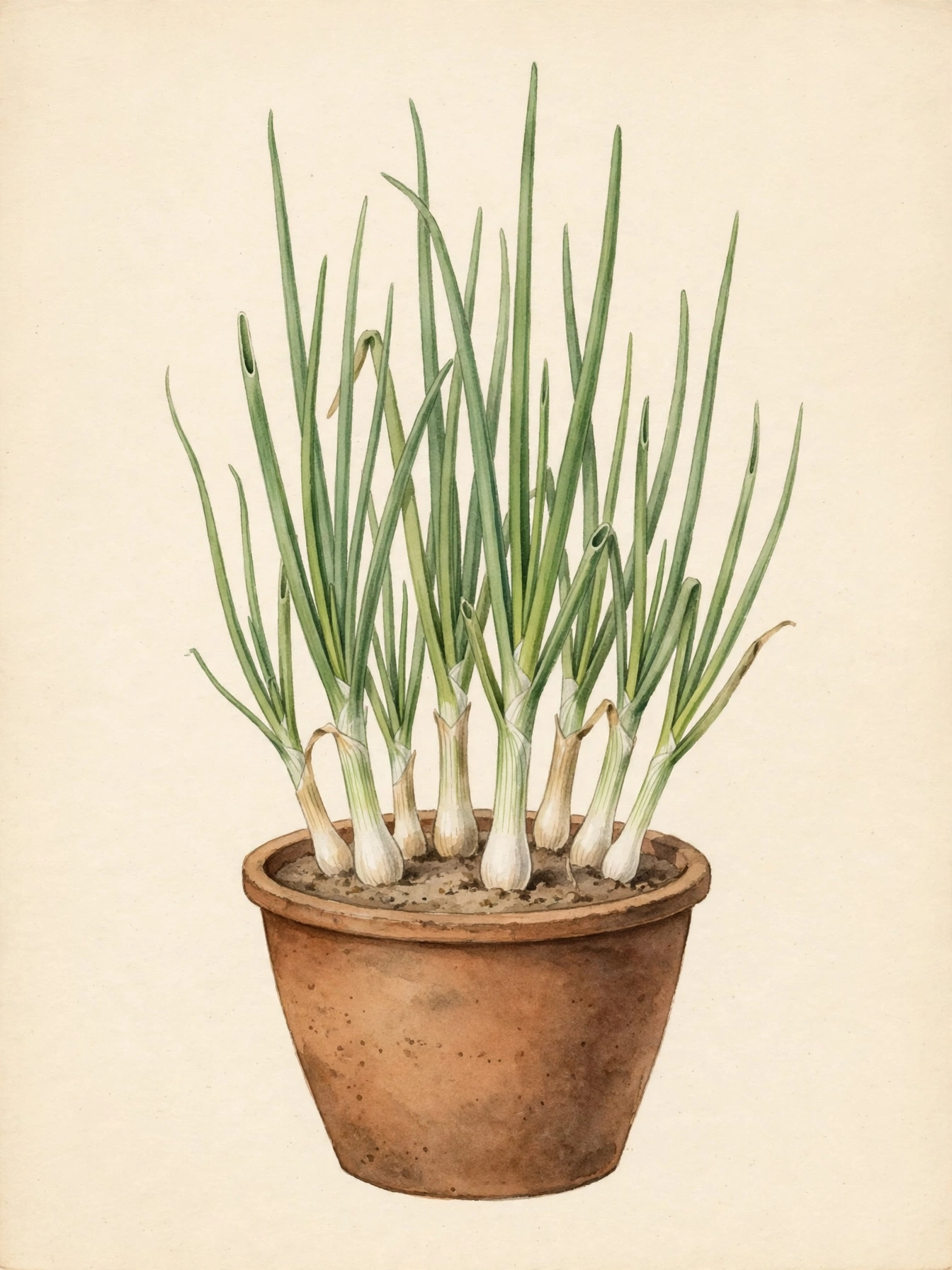
Green onions might be the highest-return crop in container gardening: nearly zero skill required, harvestable in weeks, and used in practically everything we cook. But there’s a popular myth worth clearing up first — the glass-of-water-on-the-windowsill trick. Regrowing scallion bases in water alone gives you a quick flush of weak, pale regrowth that declines fast. For a real, sustained supply, the bases need to go into soil. This guide covers both, honestly.
The growing backbone is Oregon State University’s horticulture profile on green bunching onions, plus the USDA storage guidance it cites. Our standard honesty note: we haven’t grown green onions in our own garden yet — this is compiled extension research, not a personal trial.
Know what you’re planting
“Green onions,” “scallions,” and “spring onions” get used interchangeably, and Oregon State confirms the terms all describe immature onions — but the plant underneath varies. The green bunching onion of commerce today is most often Allium fistulosum (a non-bulbing species, sometimes called Welsh onion), while many home gardeners grow Allium cepa — ordinary bulb onion varieties — planted thickly and harvested young. For eating, the difference barely matters: both give you the green stalks and white bases you cook with.
One practical ID trick from OSU if you’re ever curious: look at the leaf cross-section near where green turns white. D-shaped (flat on one side) means A. cepa; round means A. fistulosum.
Option 1: from seed (the real crop)
Seeds give you the most productive, longest-lived plants.
- When: Oregon State lists March through mid-August for seeding (Oregon timing — adjust to your climate; the point is a long sowing window, not one specific month).
- How: sow ¼ inch deep in potting mix, about an inch apart. Onion seed germinates from 46°F to 86°F, with the best germination above 60°F. Use fresh seed — OSU warns onion seed has poor longevity, under two years unless stored well.
- Where: full sun. A pot at least 6 inches deep with drainage holes; wider is better since you’ll sow thickly.
- Soil: OSU prefers pH 6.5–7.0 for mineral soils. Standard potting mix is fine. A soil test is the gold standard for fertilizer, but for a pot of scallions, a modest balanced fertilizer at planting is plenty.
Green onions are shallow-rooted and thirsty: OSU says to keep the top foot of soil at 65–70% of field capacity — in plain terms, don’t let the pot dry out. Consistent moisture, never waterlogged.
Harvest: OSU’s commercial standard is a ¼-to-½-inch diameter at the base with at least 2 inches of white shank — for home use, pull them whenever they look like the green onions you’d buy. You can pull whole plants or cut greens and let them regrow; cutting gives you multiple harvests from one sowing.
Option 2: from grocery-store bases (the honest version)
This works — with caveats. Save the white root ends (about 1–2 inches) from a grocery bunch and plant them directly into moist potting mix, roots down, about 2 inches deep. Keep the pot moist and sunny. You’ll see new green growth within a week or two in the growing season.
What we won’t claim: that this gives you infinite green onions. Water-only regrowth is short-lived and gets weaker each cycle — the plant is running on stored energy with no soil nutrients. Planted in soil and given light, the bases establish properly and keep producing. That’s the difference between a fun week and an actual supply.
Feeding and care
Green onions respond strongly to nitrogen — OSU’s field guidance centers on keeping tops green and vigorous with sidedressed nitrogen, guided by a soil test. In a container, translate that modestly: a balanced liquid fertilizer every few weeks during active growth, backed off if tops are lush and dark. Pale, slow tops usually mean hungry or dry — check water first, then feed.
Daylength sensitivity is worth knowing: onions respond to day length, which is part of why A. cepa types may try to bulb as days lengthen. If you want true non-bulbing scallions, A. fistulosum varieties (look for “bunching” or “Japanese bunching” types like ‘Tokyo Long White’ in catalogs) are the purpose-built choice.
Troubleshooting
Thin, floppy seedlings. Not enough light, or sown too thickly without thinning. Full sun, and give them room.
Yellowing tips. Usually inconsistent watering or hunger. Containers dry fast — check moisture before assuming fertilizer.
Mushy bases. Too wet, poor drainage. This is the main killer in pots. Drainage holes are non-negotiable, and the pot shouldn’t sit in a saucer of water.
Pests. Green onions are relatively trouble-free in containers. Aphids and thrips are the occasional visitors; a strong spray of water or insecticidal soap handles them.
Storing the harvest
Green onions are perishable. The USDA guidance quoted by OSU: hold at 32°F and high humidity for 3–4 weeks max; at 50°F they last about a week. In practice: refrigerate promptly in a bag, use within a week or two, and harvest only what you need — the pot is the storage.
In the kitchen
If there’s one container crop that pays for its pot in a month, it’s this one. Ginger Scallion Sauce is basically a celebration of the green onion; Chinese Scallion Pancakes need them by the bunch; and they finish the Steamed Fish with Ginger and Scallions and most of our stir-fries. Until then, the rule is simple: slice the greens fresh over finished dishes, and save the white bases — into soil, not just water.
Sources
- Oregon State University, “Onions, Green Bunching” horticulture profile, https://horticulture.oregonstate.edu/oregon-vegetables/onions-green-bunching