
Murtabak is the flatbread I make when I want a meal that fills the table and uses one pan. A sheet of dough gets stretched until it turns almost see-through, then it folds around spiced minced beef, beaten egg, and chopped onion like an envelope. A few minutes in a hot pan turns it crisp outside and juicy inside, and it lands on the table cut into squares with a small bowl of curry sauce for dipping.
This is Malaysian street food from the mamak stalls, the Indian Muslim restaurants that stay open late and cook on wide flat griddles. The dough is the same dough as roti canai, and if you have made our roti canai before, you already know how it behaves. The new part is the fold, and it is easier than it looks. The active work takes about an hour, plus two hours while the dough rests in oil. Start the dough after lunch and you will be frying by dinner.

What is murtabak?
Murtabak comes from the Arabic word for folded, and the name says what it is: a flatbread folded around a filling. In Malaysia it shows up at mamak stalls, stuffed with minced beef, mutton, or chicken, egg, and onion, and served with a ladle of curry sauce or dhal and a few slices of red onion. The same idea turns up across the region under other names, and the Indian version is often called Mughlai paratha.
Expect a contrast in every bite. The outside fries crisp and a little flaky where the dough folded over itself, while the inside stays soft and savory from the egg and the spiced meat. It eats like a meal on its own, and it also works cut into small squares as a snack to share. This version uses ground beef because it browns fast and cooks dry, and it keeps the spice mix short: curry powder, turmeric, cumin, and chili flakes.
The dough: give it time
The dough is simple: flour, salt, a little sugar, an egg, and warm water. Knead it for a good 8 to 10 minutes until it turns smooth and springs back when you press it. Then divide it into 4 balls, coat each one in oil, and leave them to rest for at least 2 hours. The oil soak is the step that makes the dough stretch instead of tear. Skip it or cut it short and the dough will fight you and rip. Leave the balls in the fridge overnight and they stretch even better the next day.
Stretching takes patience, not strength. Oil your countertop and your hands, press a ball flat, then pull the edges out a little at a time until the sheet turns almost see-through, about 12 to 14 inches across. Small tears at the edges do not matter. A tear in the middle does, so patch it by pinching the dough together. Never use a rolling pin here: it presses the dough flat instead of stretching it, and the layers turn tough.

The filling: cook it dry, cool it down
Brown 1 pound of ground beef in a tablespoon of oil, breaking it up as it cooks. Add a diced onion, garlic, curry powder, turmeric, cumin, and chili flakes, and keep cooking until the pan looks dry, about 10 to 12 minutes in all. The filling has to be dry. A wet filling steams inside the dough and turns the murtabak soggy from the inside out, so cook off the liquid and drain any fat that pools in the pan.
Let the filling cool for at least 15 minutes before you touch the eggs. Hot filling poured over beaten egg scrambles the egg on contact and tears the thin dough underneath. Once it cools, stir in the beaten eggs, half a cup of chopped raw onion, and cilantro. The raw onion stays a little sharp inside and keeps the filling from tasting flat.
Fold it like an envelope, fry it crisp
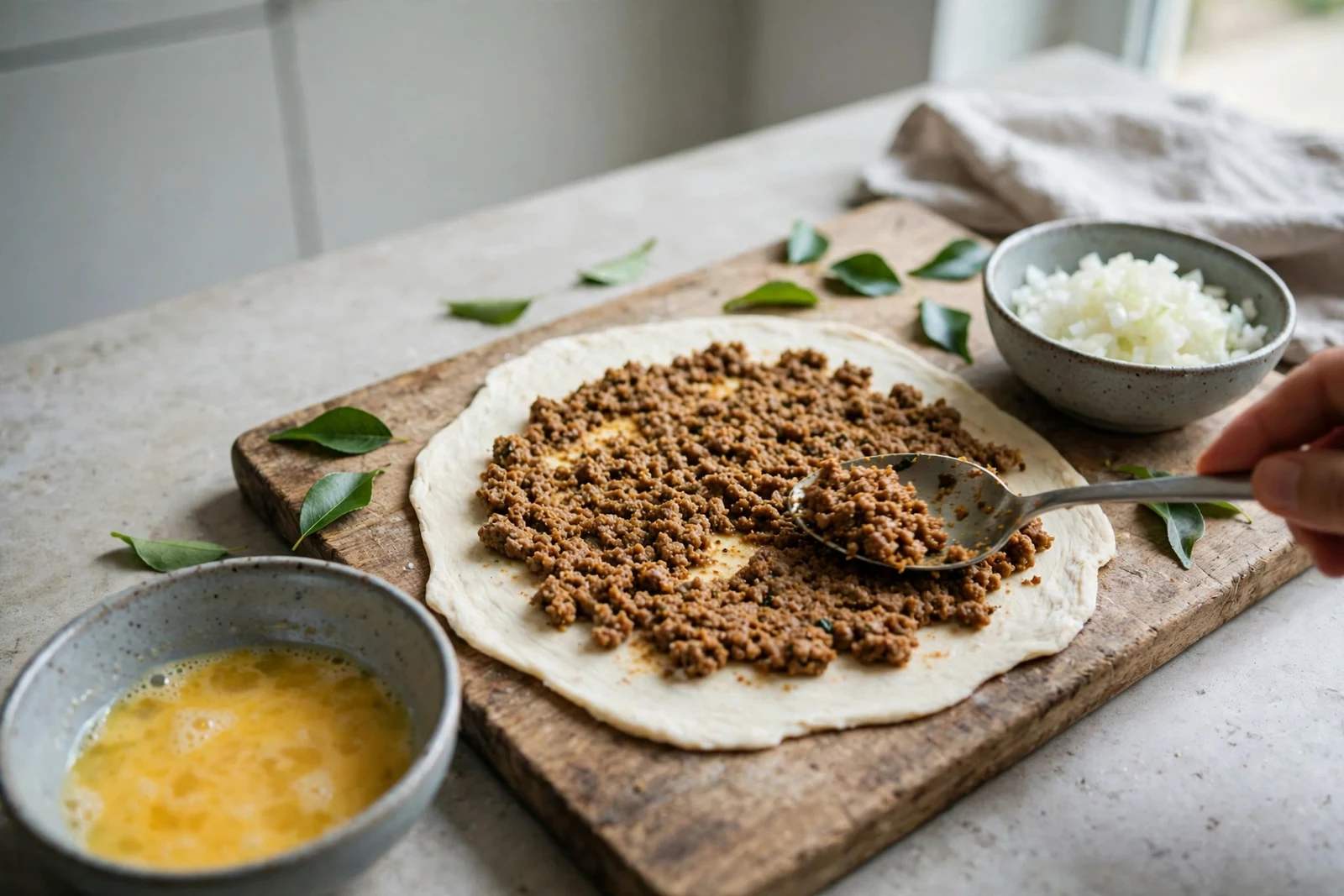
Spoon a quarter of the filling into the center of a stretched sheet and spread it into a square, leaving a wide border of bare dough on all four sides. Fold the top edge down over the filling, then the bottom edge up, then the left and right sides in, so the folds overlap in the middle. Press the seams flat with your palm. The packet should be a square about 7 inches across, with the filling fully covered.
Heat 2 tablespoons of oil in a large pan over medium heat and slide the packet in seam-side down. Fry 3 to 4 minutes until the bottom turns deep golden, then flip and fry the other side the same way. Medium heat is the right call. High heat browns the outside before the egg inside has set, and you end up with a dark crust and a runny center. Poke the middle with a knife when you think it is done: the blade should come out clean, with no raw egg on it.

Tips and variations
Fry one murtabak at a time if your pan is small. A crowded pan drops the oil temperature and the dough soaks up oil instead of crisping.
Lamb or chicken mince work in place of beef. Chicken needs a minute or two more in the pan to cook through, so break it up small while it browns.
Leftover murtabak reheats in a dry pan over medium heat, 2 minutes a side. The microwave turns it soft, so skip it.
Serve it with the curry sauce you have on hand. Leftover beef rendang gravy works well as a dip, and a simple dhal does too.
Troubleshooting: Fix My Murtabak
Dough that tears, filling that leaks, a murtabak that comes out soggy, an outside that browns before the egg sets, or eggs that scramble before the fold. Each failure has a cause and a fix. Tell the tool what went wrong:
HERB & LIME · KITCHEN HELP Choose what went wrong to see a practical next step. From Paul's kitchen. Results vary with dough rest time, oil heat, and stove heat, adjust timing to your setup. Quick reference (also works without JavaScript) Cause: The dough did not rest long enough in oil, so the gluten stayed tight and snapped instead of stretching. Try: Put the dough ball back in its oil, cover it, and rest it 30 minutes more, then stretch again slowly from the center outward. Pinch any small tear closed, it seals itself in the hot pan. Prevent: Knead the dough 8 to 10 minutes until smooth and elastic, then soak the balls fully in oil for at least 1 hour, 2 hours is better, before stretching. Cause: Too much filling went in, or the dough was stretched too thin in the middle, so the folds could not hold it. Try: Press the open seam flat with a spatula while it fries, and if egg is running out, flip the packet seam-side down right away so the heat seals it. Prevent: Use no more than a quarter of the filling per murtabak, keep it in a square in the center, and fold the edges so they overlap in the middle with the seams pressed flat. Cause: The pan was not hot enough, or there was too little oil, so the dough steamed instead of frying. Try: Slide the murtabak into a dry pan over medium heat for 2 minutes per side to crisp it back up, and serve it right away. Prevent: Fry on a well greased pan over medium heat, 3 to 4 minutes per side, until deep golden, and drain the packet on a wire rack, not paper towels. Cause: The heat was too high, so the outside browned before the egg in the center had time to set. Try: Move the packet to a sheet pan and bake it in a 350 degree Fahrenheit oven for 5 to 8 minutes until a knife poked into the middle comes out clean. Prevent: Fry over medium heat, never high, and give each side the full 3 to 4 minutes so the heat reaches the center before the crust darkens. Cause: The filling was still hot when the egg went in, so the egg cooked on contact and the heat tore the thin dough underneath. Try: Scoop out the scrambled bits if you can, beat a fresh egg, and fold it in only after the filling has cooled. If the dough already tore, start that packet over with a fresh ball. Prevent: Let the cooked meat cool at least 15 minutes to room temperature before stirring in the beaten egg and raw onion.Fix My Murtabak
Possible cause
What to try next
For next time
The dough tears when I stretch it
The filling leaks out while frying
The murtabak is pale and soft, not crisp
The outside is brown but the egg inside is still runny
The hot filling scrambled the egg
Murtabak: Malaysian Stuffed Flatbread
Ingredients
Method
- Make the dough: stir the flour, salt, and sugar in a large bowl. Add the egg, ghee, and warm water and mix until a shaggy dough forms. Turn it out and knead 8 to 10 minutes until smooth and elastic. Divide into 4 equal balls, coat each one in oil, cover, and rest at least 2 hours at room temperature, or overnight in the fridge.
- Cook the filling: heat 1 tablespoon of oil in a skillet over medium-high heat. Brown the ground beef, breaking it up as it cooks, about 5 minutes. Add the diced onion, garlic, curry powder, turmeric, cumin, chili flakes, and salt. Keep cooking until the pan looks dry, about 10 to 12 minutes in all. Drain off any fat that pools in the pan.
- Cool the filling: take the skillet off the heat and let the filling cool at least 15 minutes. Once it is cool to the touch, stir in the beaten eggs, the chopped raw onion, cilantro, and curry leaves if you use them.
- Stretch the dough: oil your countertop and your hands. Press a ball flat, then pull the edges out a little at a time until the sheet turns almost see-through, about 12 to 14 inches across. Patch any small tear by pinching the dough together. Do not use a rolling pin.
- Fill and fold: spoon a quarter of the filling into the center of the sheet and spread it into a square, leaving a wide border of bare dough on all four sides. Fold the top edge down over the filling, then the bottom edge up, then the left and right sides in, so the folds overlap in the middle. Press the seams flat with your palm. The packet should be a square about 7 inches across.
- Fry: heat 2 tablespoons of oil in a large pan over medium heat. Slide the packet in seam-side down and fry 3 to 4 minutes until the bottom turns deep golden. Flip and fry the other side the same way. Poke the middle with a knife: the blade should come out clean, with no raw egg on it.
- Rest and cut: lift the murtabak onto a wire rack and rest 2 minutes, then cut into 4 squares.
- Serve: serve at once with curry sauce or dhal for dipping, sliced red onion, and lime wedges. Repeat with the remaining dough balls and filling.
Notes
More Malaysian recipes
Roti Canai uses the same stretched dough with no filling; Malaysian Curry Puffs fold a similar spiced filling into flaky pastry; Nasi Lemak is the coconut rice plate to serve beside it; and Beef Rendang gives you the curry sauce for dipping.
From Paul's kitchen.