
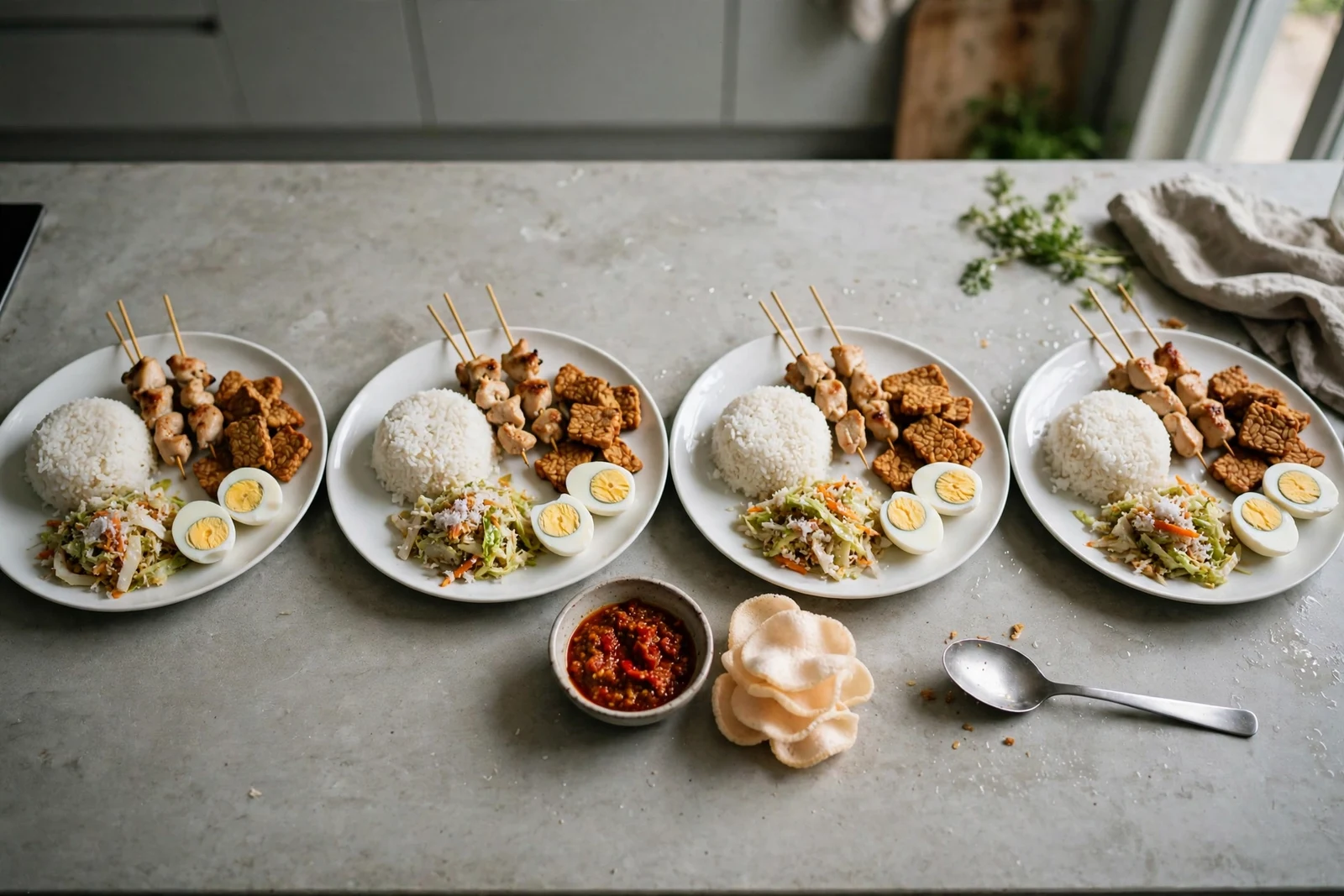
Nasi campur is the plate I make when I want one dinner that feeds four people and lets each person build their own bite. A mound of steamed rice sits in the middle, and around it go small piles of food that do not agree with each other: smoky chicken satay, sweet fried tempeh, cool coconut vegetables, a halved boiled egg, cucumber, and a spoonful of sambal for anyone who wants heat. Nothing on the plate is hard on its own. The work is in the timing, getting six small dishes to the table at the same moment.
This version keeps the parts simple enough for a weeknight. The satay uses chicken thigh and a short marinade. The tempeh fries in the same pan while the rice steams. The urap takes ten minutes. The sambal blends in a minute. Start the rice first, then the eggs, and everything else falls into place in a little over an hour.

What is nasi campur?
Nasi campur means mixed rice in Indonesian, and the name says what the plate is: steamed rice served with small portions of many dishes. In Indonesia it is also called nasi rames, and the exact mix changes by region and by cook. A Balinese warung might serve ayam betutu and lawar, while a Javanese stall might lean on fried chicken, tempeh, and urap. The idea stays the same: rice in the center, a little of this and a little of that around it, so each bite can be different.
The plate works because the parts balance each other. The rice is plain and soft. The satay brings smoke and salt. The tempeh brings sweetness. The urap brings cool crunch. The egg brings something mild to rest on. The sambal brings heat, and because it sits on the side, each person decides how much heat their plate gets. If you like Indonesian rice dishes, nasi goreng is the fried-rice cousin of this plate, but nasi campur keeps every part separate so you taste each one on its own.
The rice: start it first
Use 2 cups of jasmine rice and 2 1/2 cups of water. That is 1 cup of rice to 1 1/4 cups of water, and it gives soft separate grains that still hold a mound shape on the plate. Rinse the rice until the water runs clear, then cook it covered on low heat until the water is gone, about 18 minutes, and let it rest 10 minutes with the lid on. Do not lift the lid while it cooks. Rice that dries out on the plate was usually rushed: the lid came off early, or the water ran short.
While the rice cooks, put the eggs on. Four eggs in a saucepan, covered with cold water by an inch. Bring to a gentle boil, then turn the heat down to a simmer and cook 10 minutes. Move them straight into a bowl of ice water. The ice bath stops the cooking and keeps the yolks yellow instead of green around the edges.
The satay and the tempeh
Cut 1 pound of boneless chicken thigh into strips about an inch wide. Toss them with 3 tablespoons of kecap manis, 2 minced garlic cloves, 1 teaspoon of ground coriander, 1 tablespoon of lime juice, and 1 teaspoon of palm sugar. Thirty minutes is enough for the marinade to do its work. Thread the strips onto 8 skewers, folding each strip back and forth so it cooks evenly.

Heat a grill pan over medium-high heat and brush it with oil. Cook the skewers 3 to 4 minutes per side, until the edges char a little and the centers reach 165 degrees Fahrenheit. Brush them once with the leftover marinade while they cook, and throw the rest of the marinade away. A crowded pan steams the chicken instead of browning it, so cook in two batches if the pan is full.
Cut 8 ounces of tempeh into cubes about an inch across. Fry them in 1/2 cup of oil over medium heat, turning once, until they turn golden on most sides, about 4 to 5 minutes. Lift them out onto a wire rack, not paper towels, so they stay crisp. While they are still hot, toss them with 2 tablespoons of kecap manis and 1 teaspoon of palm sugar. The sauce clings to the hot tempeh and turns sticky in about a minute. This is tempe manis, and it is the sweet note the plate needs.
The urap and the sambal
Urap is blanched vegetables tossed with spiced grated coconut, and it is the cool, fresh part of the plate. Boil 2 cups of green beans, cut into 2-inch pieces, for 2 minutes. Add 2 cups of bean sprouts for the last 30 seconds. Drain them in a colander and let the water drip off, then squeeze the vegetables lightly with your hands. Wet vegetables make a watery urap, and this is the step that decides it.

For the coconut, stir 1 cup of fresh grated coconut in a dry pan over medium heat with 1 minced shallot, 1 minced garlic clove, 1 minced red chili, 1/2 teaspoon of shrimp paste, and 1/4 teaspoon of salt. Cook about 5 minutes, stirring, until the mixture smells toasty and looks dry. Let it cool a minute, squeeze in 1 tablespoon of lime juice, and toss it with the vegetables. If you want the full version, our urap with spiced coconut walks through the same dish on its own.
The sambal takes a minute in a blender: 6 red chilies, 2 garlic cloves, 1 tablespoon of lime juice, and 1/2 teaspoon of salt. Blend it coarse, not smooth, and taste it. If it bites too hard, stir in 1/2 teaspoon of sugar and another squeeze of lime. Serve it in a small dish on the side, never poured over the rice, so each person controls the heat.
Tips and variations
Fry the krupuk last if you use them. They puff in hot oil in about 10 seconds, and they go soft if they sit. Slide them in one at a time, lift them out as soon as they flatten, and drain them on a rack. A few cucumber slices on each plate cool the palate between bites of sambal, and fried shallots over the rice add crunch. If chicken satay feels like too much work on a weeknight, our soto ayam is a one-pot Indonesian chicken soup that uses the same pantry.
A few swaps work well. Firm tofu stands in for the tempeh, fried the same way. Shrimp paste can be left out of the urap if you do not keep it, with an extra pinch of salt in its place. Peanuts can join the plate, fried or roasted, for another crunch. The plate keeps badly as leftovers: the rice dries, the tempeh softens, and the urap weeps. Cook the rice and the parts fresh, and save any leftover sambal in a jar in the fridge for a week.
Troubleshooting: Fix My Nasi Campur
Rice that dries out, tempeh that goes soft, urap that turns watery, an egg with a green ring, or sambal that burns too hot. Each failure has a cause and a fix. Tell the tool what went wrong:
HERB & LIME · KITCHEN HELP
Fix My Nasi Campur
Choose what went wrong to see a practical next step.
Possible cause
What to try next
For next time
From Paul's kitchen. Results vary with rice age, oil heat, and stove heat, adjust timing to your setup.
Quick reference (also works without JavaScript)
The rice came out dry or clumpy
Cause: Too little water went in, or the lid was lifted while the rice steamed, so the top layer dried out before the grains softened.
Try: Sprinkle 2 tablespoons of hot water over the rice, cover the pot, and let it rest on the lowest heat for 10 minutes, then fluff gently with a fork and serve.
Prevent: Rinse the rice until the water runs clear, measure 1 1/4 cups of water for each cup of rice, and keep the lid on for the full cook plus 10 minutes of rest.
The fried chicken or tempeh turned soggy
Cause: The oil was too cool, or too many pieces went in at once and dropped the temperature, so the coating soaked up oil instead of crisping.
Try: Heat fresh oil to about 350 degrees Fahrenheit and re-fry the pieces in small batches until crisp again, then drain them on a wire rack, not paper towels.
Prevent: Heat the oil to about 350 degrees Fahrenheit, fry in small batches with space between the pieces, and drain on a wire rack so steam can escape.
The urap turned watery
Cause: The vegetables carried blanching water into the coconut dressing, and the dressing slid off instead of coating them.
Try: Drain the vegetables again and squeeze them gently, then toss with a spoonful of fresh toasted coconut to take up the extra moisture.
Prevent: Strain the blanched vegetables well, squeeze them lightly with your hands, and cook the spiced coconut until it looks dry before mixing.
The boiled egg has a green ring around the yolk
Cause: The eggs cooked too long or cooled too slowly, so sulfur in the white reacted with iron in the yolk at the surface.
Try: Nothing fixes the ring once it forms, so serve the egg anyway, it is harmless, or turn the cut side down on the plate.
Prevent: Cook the eggs at a gentle simmer, time them at 10 minutes, and move them straight into an ice bath to stop the cooking.
The sambal is too hot to enjoy
Cause: Too many chilies went in, or the seeds stayed in, and the heat had nothing sweet, sour, or plain beside it to balance it.
Try: Serve the sambal in a small dish on the side, stir in a pinch of sugar and a squeeze of lime, and eat it with plain rice and cucumber slices.
Prevent: Start with fewer chilies, taste as you blend, and keep the sambal separate so each person controls how much heat goes on their plate.
Nasi Campur: Indonesian Mixed Rice Plate
Ingredients
Method
- Cook the rice: rinse 2 cups of jasmine rice until the water runs clear. Put it in a saucepan with 2 1/2 cups of water and 1/2 teaspoon of salt. Bring to a boil, cover, and cook on low heat for 18 minutes, until the water is gone. Take it off the heat and let it rest 10 minutes with the lid on, then fluff gently with a fork.
- Boil the eggs: put 4 eggs in a saucepan and cover with cold water by an inch. Bring to a gentle boil, turn the heat down to a simmer, and cook 10 minutes. Move the eggs straight into a bowl of ice water, then peel and halve them.
- Marinate the chicken: toss the chicken strips with 3 tablespoons of kecap manis, 2 minced garlic cloves, 1 teaspoon of ground coriander, 1 tablespoon of lime juice, and 1 teaspoon of palm sugar. Leave 30 minutes. Thread the strips onto 8 skewers, folding each strip back and forth.
- Fry the tempeh: heat 1/2 cup of oil in a skillet over medium heat. Fry the tempeh cubes, turning once, until golden on most sides, about 4 to 5 minutes. Lift them onto a wire rack to drain, then toss while hot with 2 tablespoons of kecap manis and 1 teaspoon of palm sugar until sticky.
- Cook the satay: heat a grill pan over medium-high heat and brush it with oil. Cook the skewers 3 to 4 minutes per side, until the edges char a little and the centers reach 165 degrees Fahrenheit. Brush once with the leftover marinade while they cook and throw the rest away. Cook in two batches if the pan is full.
- Make the urap: boil the green beans for 2 minutes, then add the bean sprouts for the last 30 seconds. Drain in a colander, let the water drip off, and squeeze the vegetables lightly with your hands. Stir the grated coconut in a dry pan over medium heat with the shallot, garlic, chili, shrimp paste, and salt for about 5 minutes, until toasty and dry. Let it cool a minute, add the lime juice, and toss with the vegetables.
- Blend the sambal: blend 6 red chilies, 2 garlic cloves, 1 tablespoon of lime juice, and 1/2 teaspoon of salt until coarse, not smooth. Taste it and stir in 1/2 teaspoon of sugar and another squeeze of lime if it bites too hard.
- Assemble: mound the rice in the center of 4 plates. Arrange the satay, tempeh, urap, egg halves, and cucumber slices around it. Put the sambal in a small dish on the side of each plate, with krupuk and fried shallots if you use them. Serve at once.
Notes
More Indonesian recipes
Nasi Goreng is the fried rice to try next; Soto Ayam is a one-pot chicken soup; Mie Ayam is chicken noodles with a sweet soy glaze; and Bakso is a beef meatball soup with noodles.
From the garden
A Thai chili plant in a pot gives more chilies than one household uses in a summer, and the fruits keep coming as long as you pick them. That is where the chilies for this sambal came from, and a few fresh ones beat a jar every time. Our guide to growing Thai chili peppers in pots covers the watering and the picking.
From Paul’s kitchen.