
Prik nam pla is the Thai table condiment: fish sauce sharpened with lime juice, studded with sliced bird’s eye chiles and garlic coins, rested until everything infuses. It sits on the table in a small dish with a spoon, and diners add it to their own plates a spoonful at a time.
It is not the same thing as Vietnamese nuoc cham. Nuoc cham is diluted with water and sugar and used as a dip; prik nam pla is undiluted, punchy, and used as a seasoning by the spoonful. Do not present them as interchangeable.
Ingredients
Makes about 1/3 cup.
- 1/4 cup fish sauce
- 1 1/2 tbsp fresh lime juice
- 6 Thai bird’s eye chiles, thinly sliced
- 2 garlic cloves, thinly sliced crosswise (not minced)
- 1/2 tsp granulated sugar (optional, to taste)
- 1 tbsp thinly sliced shallot (optional)
Method
- Thinly slice the chiles and the garlic. Slice the garlic crosswise into thin coins rather than mincing — several Thai sources specify this for texture.
- Combine the fish sauce and lime juice in a small bowl. Stir in the sugar, if using, until dissolved.
- Add the sliced chiles, garlic, and shallot (if using). Stir.
- Let rest 10 minutes so the chiles and garlic infuse the sauce, then taste and adjust: more lime for sour, more chiles for heat, a pinch more sugar to round it out.
- Serve in a small dish at the table with a spoon.
Tips and ingredient notes
- Chili/lime balance: this house ratio — 1 1/2 tbsp lime per 1/4 cup fish sauce — sits in the middle of the published range. A fish-sauce-forward version uses less lime; a brighter version uses more. Adjust to taste.
- Chile choice: bird’s eye chiles are the classic and genuinely hot. For a milder version, use long red chiles (fresno) or fewer bird’s eyes with seeds removed.
- Sugar: optional and minimal here — a pinch to round the edges, not the tablespoon-plus sweetness of nuoc cham, the Vietnamese fish-sauce dip. That dip is deliberately sweet-sour and diluted for dunking spring rolls and dressing salads; this one stays concentrated, so if you sweeten it past a pinch you are making a different condiment.
- Related but different: prik nam som is the vinegar-based cousin (chiles in white vinegar, no fish sauce), served with noodle soups — do not confuse the two. Our guide to Asian vinegars, from rice vinegar to black vinegar, is the place to compare the clean sourness prik nam som uses against the lime sourness here — they sit on the same table but do different jobs.
- There is no non-fish-sauce version of prik nam pla that is still prik nam pla. A soy-sauce-based approximation can be noted for readers who avoid fish sauce, but it should be labeled as an approximation, not the recipe. Our comparison of fish sauce vs. soy sauce lays out why the swap changes the character: fish sauce brings a fermented depth and a thinner salt, soy sauce brings a rounder, darker salt — useful to know if you do make the approximation, and a good reason to keep the two bottles separate in the pantry.
- Timing: about 5 minutes of hands-on work (slicing the chiles and garlic coins, squeezing the lime, and stirring everything together) plus the 10-minute rest in step 4, for 15 minutes total and no cooking — which is the timing shown in the recipe card below. The rest is where the sauce becomes itself: the chiles and garlic give up heat and aroma to the fish sauce, and a batch tasted straight after stirring reads sharper and more separate than one given its 10 minutes.
How to serve prik nam pla (and what it wakes up)
The small dish goes in the middle of the table with its own spoon, and everyone seasons their own plate. That matters because the heat is real: one diner’s perfect spoonful is another’s too much, and a sauce this concentrated should never be poured over a shared dish for the whole table. Start with a teaspoon, taste, then add a second if the plate still reads flat.
- Over plain rice and rice bowls: a spoonful over a bowl of steamed jasmine rice is the simplest test of a batch — rice, a fried or soft egg if you have one, and prik nam pla to season each bite. It is also the quickest way to learn your own balance: rice shows you the heat first, then the lime, then the salt.
- With fried rice and stir-fries that lean sweet or rich: dishes built on a sweet-salty glaze or coconut richness often need acid and heat at the table rather than in the pan, where they would cook off or thin the sauce. A spoonful stirred into your own portion keeps the pan sauce intact and lets each plate land where its eater wants it.
- Alongside grilled and roasted meats: serve a small dish per person, or one shared dish with a clean spoon, and let diners spoon it over sliced grilled pork, chicken, or fish a little at a time. The lime cuts richness in the moment rather than marinating it away, which is why this condiment is served at the table and not used as a marinade.
- What not to swap it into: recipes that call for a diluted dip — spring-roll dunking, salad dressing, vermicelli bowls — want nuoc cham’s water and sugar, not this. Using prik nam pla there undiluted makes the whole dish aggressively salty; using nuoc cham where prik nam pla belongs makes it weak and sweet. Keep both in the fridge if you cook both cuisines, label the jars, and let each one do its own job.
If the batch will sit out through a meal, set the dish over a small plate and keep the serving spoon in the sauce, handles out — and put what is left back in the fridge as soon as the meal ends rather than leaving it on the counter. The storage note below covers the week-long fridge life; the table habit is simply to treat it like the fresh, uncooked condiment it is.
Storage and food safety
Allergen note: contains fish (fish sauce). This is an uncooked condiment: refrigerate in a sealed jar, use within 1 week for best flavor, and always use a clean communal spoon — never double-dip. Do not leave it at room temperature all day; treat it as perishable.
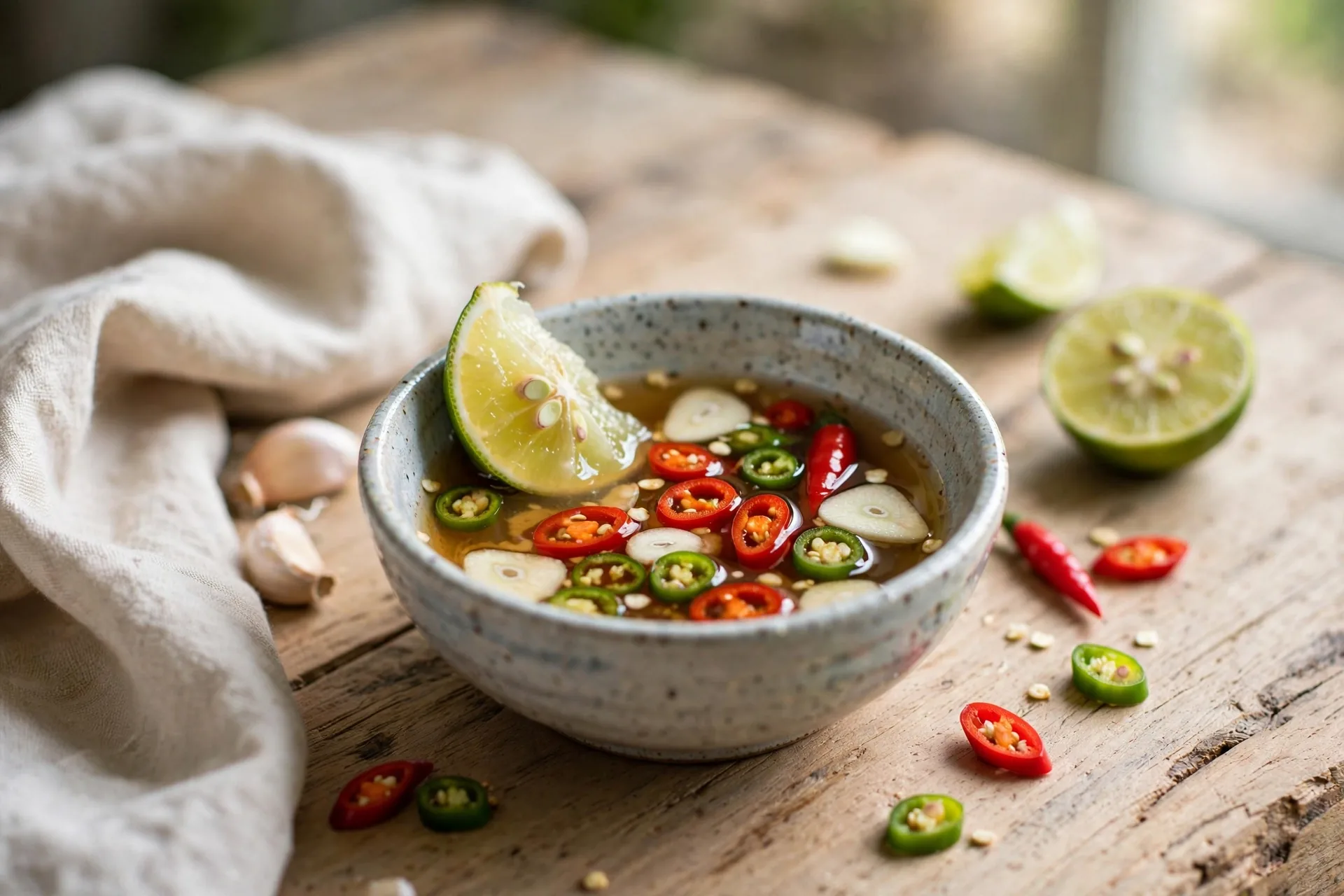
Prik Nam Pla: Thai Chili Fish Sauce
Ingredients
Method
- Thinly slice the chiles and the garlic. Slice the garlic crosswise into thin coins rather than mincing — several Thai sources specify this for texture.
- Combine the fish sauce and lime juice in a small bowl. Stir in the sugar, if using, until dissolved.
- Add the sliced chiles, garlic, and shallot (if using). Stir.
- Let rest 10 minutes so the chiles and garlic infuse the sauce, then taste and adjust: more lime for sour, more chiles for heat, a pinch more sugar to round it out.
- Serve in a small dish at the table with a spoon.
1 thought on “Prik Nam Pla: Thai Chili Fish Sauce”