
Maki rolls are the most forgiving form of sushi to make at home. You do not need to handle raw fish or shape rice with your hands. With a bamboo mat, a sharp knife, and about an hour (most of it rice time), you can put a plate of neat, tight rolls on the table. This guide walks through the equipment, the rolling technique for both regular and inside-out rolls, how to slice cleanly, and the three mistakes that break rolls in my experience.

What is maki sushi?
Maki is sushi that is rolled with a bamboo mat, rather than pressed by hand (nigiri) or shaped freehand (temaki hand rolls). There are three forms you will see most often. Hosomaki are thin rolls made with half a sheet of nori, holding one or two fillings. Futomaki are thick rolls made with a full sheet, packed with several fillings. Uramaki are inside-out rolls, with the rice on the outside of the nori and often finished with sesame seeds. The rolling motion is the same for all three, so once you learn the hosomaki, the others come quickly.
What you need
Equipment first. You need a bamboo rolling mat (called a makisu), a sharp chef’s knife, a small bowl of water, a rice paddle or spoon for spreading the rice, plastic wrap if you plan to make inside-out rolls, and a cutting board.
For ingredients, cook sushi rice seasoned with rice vinegar and keep it warm, not hot and not cold. You also need full-size nori sheets and simple fillings. Good first-roll fillings are cooked shrimp, cucumber cut into matchsticks, avocado slices, and strips of tamagoyaki. Keep to two or three fillings per roll; each one will show as a distinct stripe in the cross-section, which is half the pleasure of maki.
How to roll a hosomaki, step by step
- Lay the bamboo mat flat on your work surface. Set a half sheet of nori on it with the shiny side down and a long edge facing you. Tearing or cutting a full sheet in half gives you the right size.
- Dip your hands in the bowl of water so the rice does not stick to them. Spread about 1/2 cup of rice (roughly 110 grams) over the nori in an even layer about 1 centimeter thick. Leave a 1-inch strip of bare nori along the far edge; that strip is what seals the roll.
- Lay a thin line of filling across the center of the rice. No thicker than your thumb is the measure that works.
- Lift the mat edge closest to you and start rolling away from yourself, pressing gently to tuck the filling inside on the first turn. The first tuck decides how tight the whole roll is.
- Roll all the way to the bare strip of nori, wet the strip lightly with water, and press it down to seal. Set the roll seam-side down and let it rest for a minute before slicing.


How to roll an inside-out roll
Inside-out rolls need one change: wrap the bamboo mat tightly in plastic wrap first, or the rice will stick to every slat. Cover a full sheet of nori with rice edge to edge, then flip the sheet so the rice faces the mat. Add your fillings to the nori side and roll the same way, tucking on the first turn. A light sprinkle of toasted sesame seeds over the rice before you flip keeps the outside from sticking to itself and adds a little crunch.

Slicing cleanly
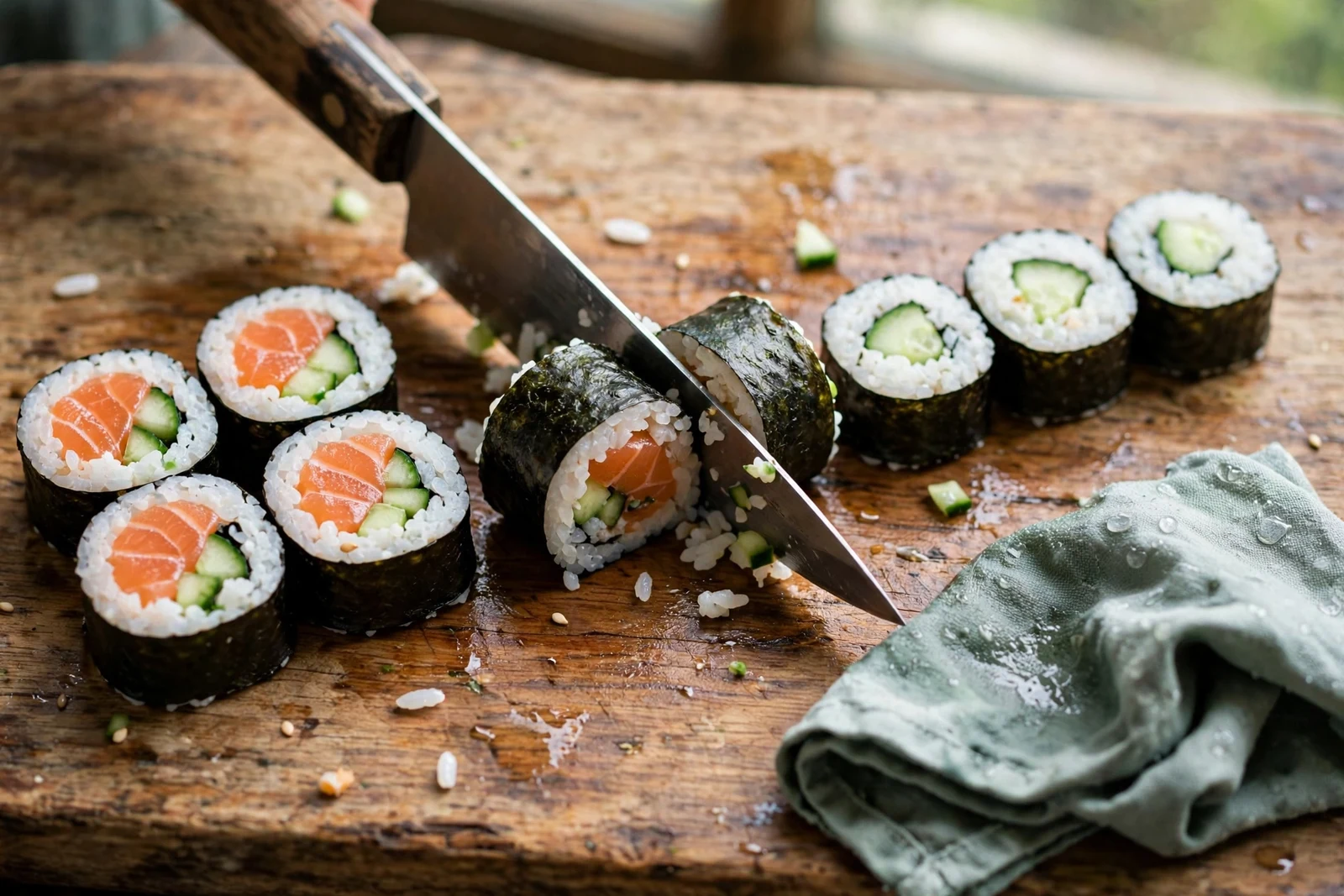
A roll that looks great whole can turn ragged at the knife. Dip the knife in water and wipe it clean before every cut. Cut each roll in half with one long drawing stroke, then cut each half into three pieces, wiping and re-wetting between cuts. A dry knife saws and drags the rice; a wet knife glides. Six pieces per hosomaki is the right size for one bite each.
The three mistakes that break rolls
The first is too much rice. A layer thicker than about 1 centimeter will not let the roll close, and the bare strip runs out of stick before the seam meets. Half a cup of cooked rice per half sheet of nori is the measure that holds.
The second is too much filling. If the filling line is wider than your thumb, the roll splits when you tuck. Two or three fillings at most, and let each one show in the cross-section.
The third is slicing with a dry knife or a sawing motion. Wet the blade, make one stroke per cut, and rinse between cuts. I ruined a whole batch of otherwise good rolls by rushing the slicing, and the difference a wet knife makes is hard to believe until you try it.
More Japanese recipes
If rolling sushi has you in a Japanese cooking mood, these pair well with a plate of maki: How to Make Sushi Rice for the full seasoning recipe, Tamagoyaki: Japanese Rolled Omelet for the classic filling, Japanese Cucumber Sunomono as a crisp side, and How to Make Dashi from Scratch when you want to cook miso soup to serve alongside.
2 thoughts on “How to Roll Sushi at Home”