
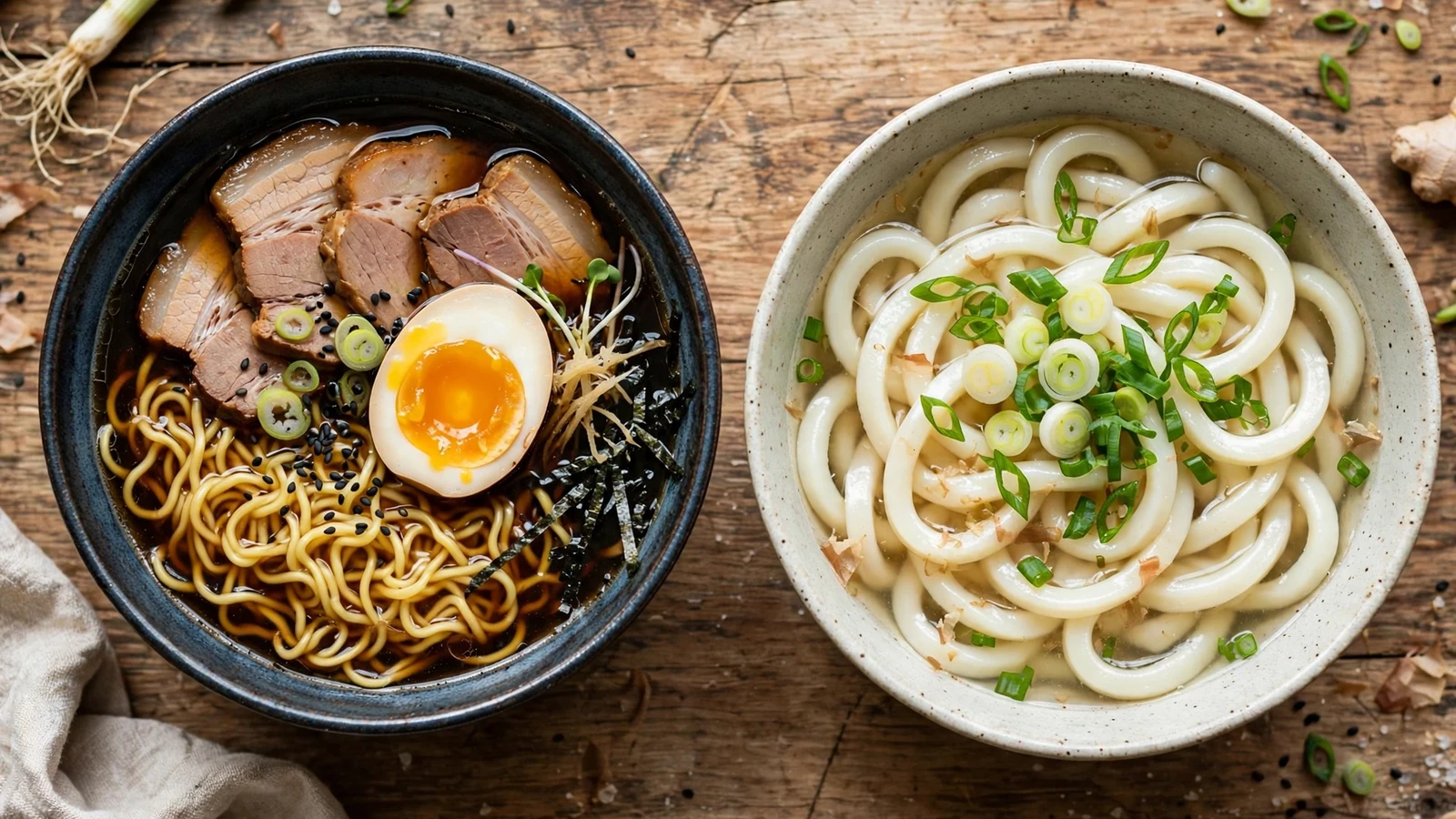
Both bowls start with wheat noodles in broth, and both come from Japan, so it is easy to treat them as the same dinner in a different shape. They are not. Ramen noodles are thin, springy, and built to carry a seasoned broth. Udon noodles are thick, soft, and chewy, and the broth plays a quieter part. Once you know which noodle you are holding, the rest of the bowl falls into place: how long it cooks, how it is served, and what toppings suit it.
The short answer
Ramen is a thin wheat noodle made with kansui, an alkaline water that gives the noodle its spring and its faint yellow color. It is served almost always hot, in a bowl of broth seasoned with tare, and the toppings do a lot of the talking: sliced pork, soft egg, nori, scallions, corn, butter.
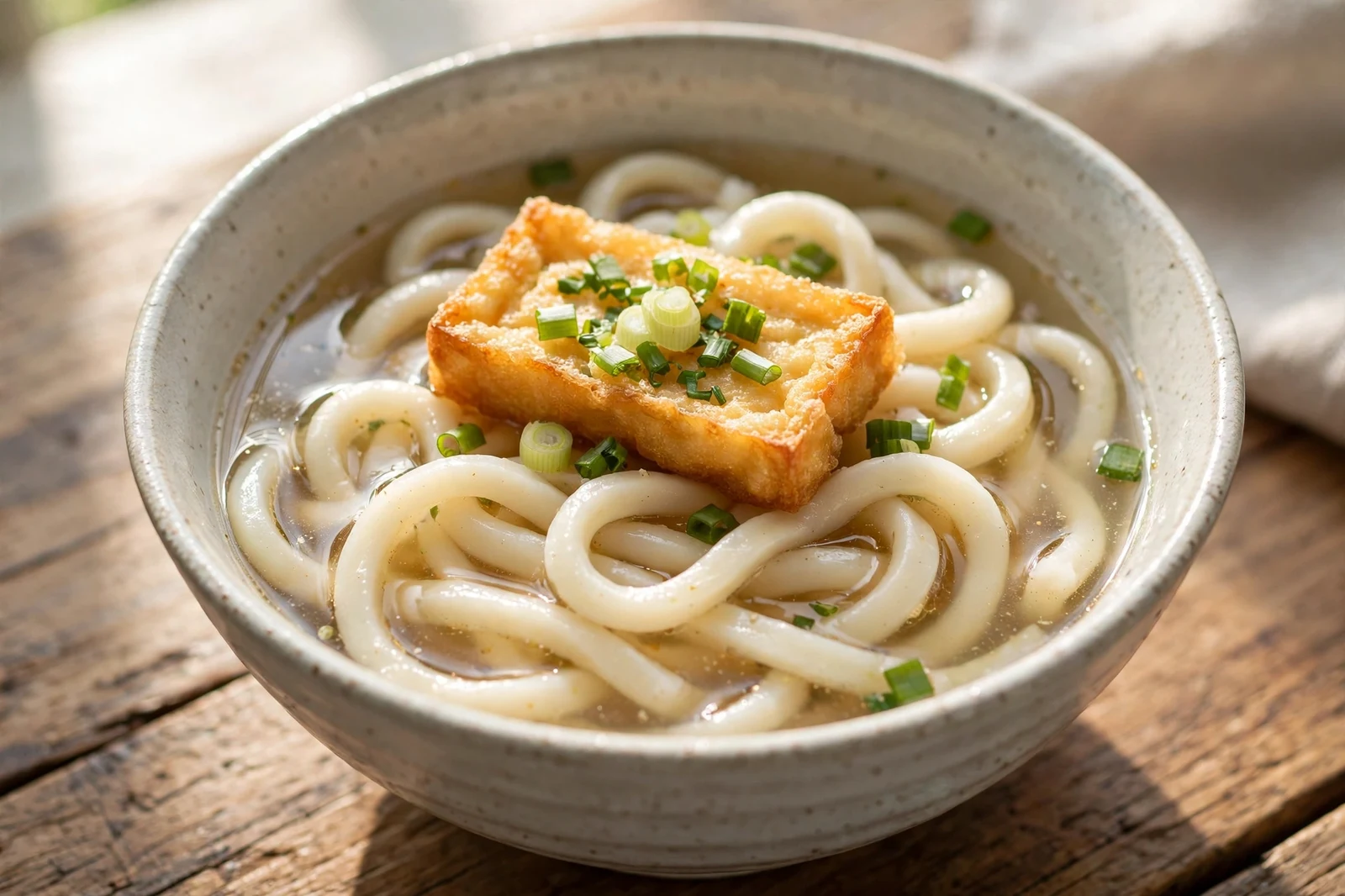
Udon is a thick white wheat noodle made without kansui. It is soft and chewy rather than springy, and it is served hot in a light dashi broth, cold with a dipping sauce, or stir-fried. The noodle itself is the main event, so the toppings stay simpler: tempura shrimp, fried tofu, grated ginger, scallions.
If you want a deep, layered bowl with lots of toppings, order ramen. If you want to taste the noodle itself, slurped thick and soft from a clean broth, order udon.
Noodle: thin and springy against thick and chewy
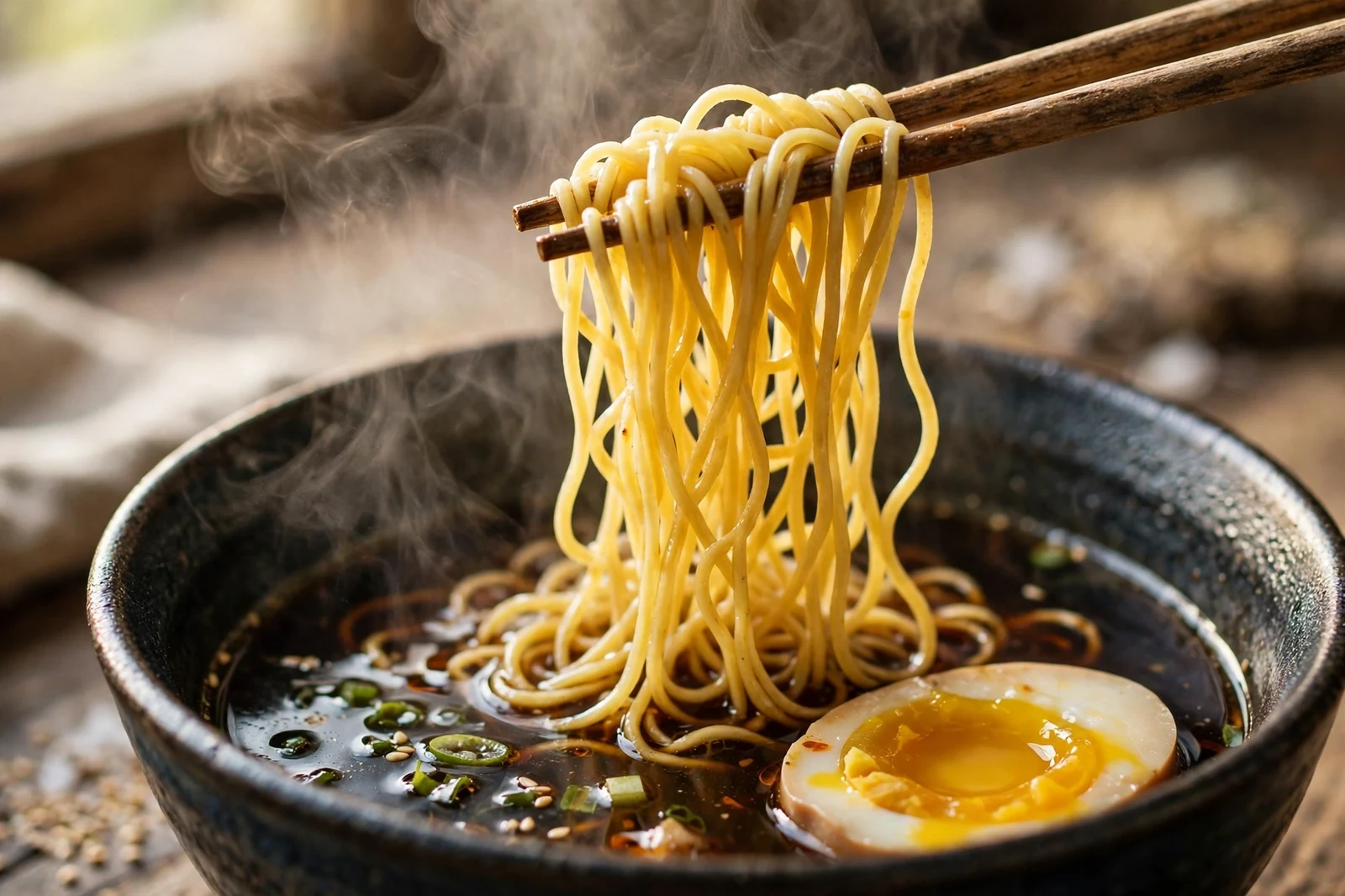
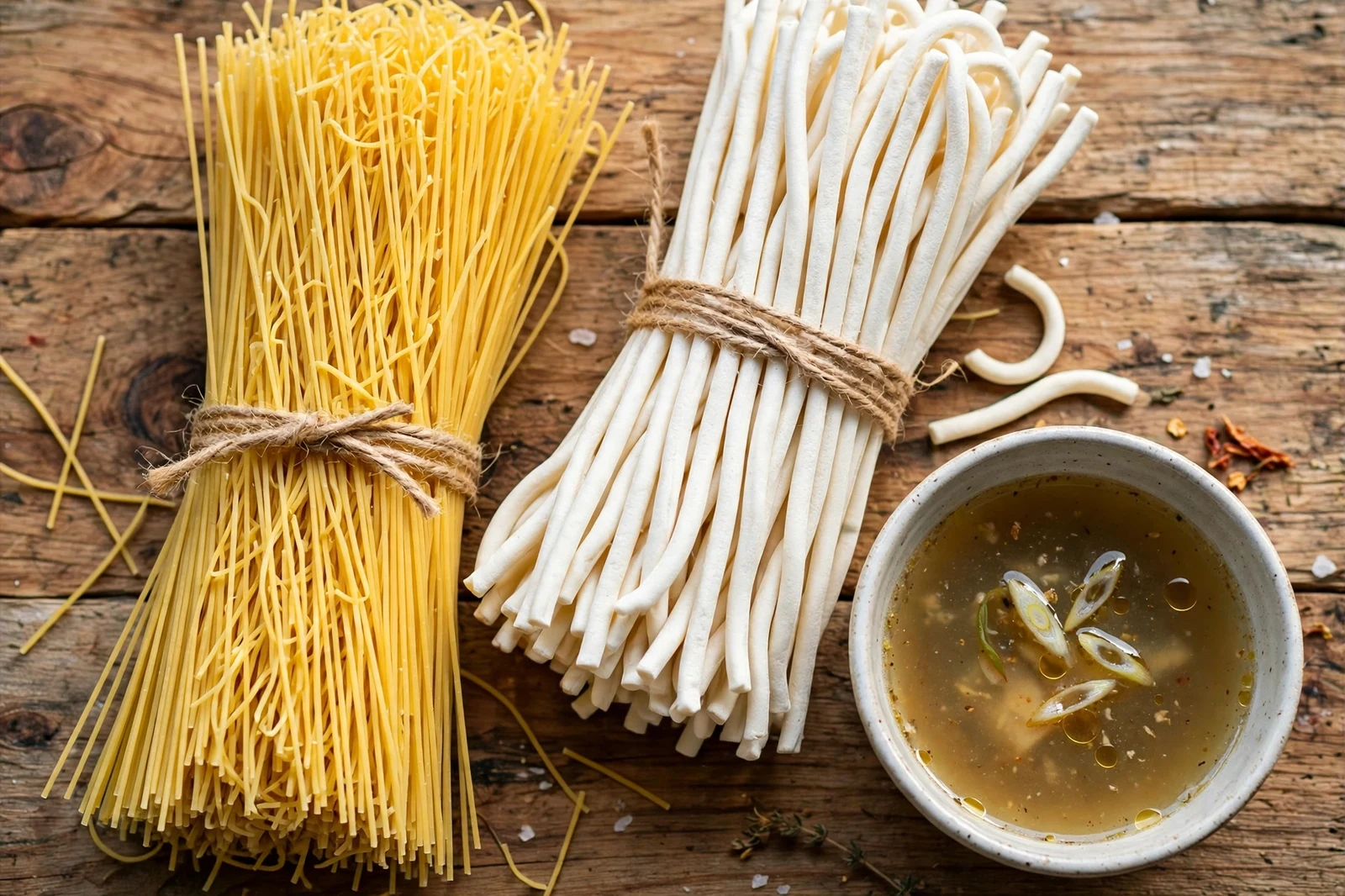
The noodle is where the two bowls part ways. A ramen noodle is usually about 1 to 2 millimeters wide, with a wavy or straight shape that depends on the shop. The kansui in the dough makes it firm and springy, so it bounces back when you bite it and holds up in hot broth without turning soft in the first few minutes. That spring is also why ramen works with chopsticks: thin noodles wrap and lift easily.
An udon noodle is usually about 4 millimeters wide, round or square cut, pale white, and soft all the way through. It has no kansui, so it never gets that ramen bounce. What it gives instead is chew: a thick, smooth bite that takes a second longer to get through. Eating udon is slower by design, and the slurp is part of it.
Thickness changes how each noodle handles sauce and broth. Thin ramen noodles pick up broth on every strand, so each bite carries seasoning with it. Thick udon noodles carry less broth per bite, which is why udon broth stays lighter: a heavy broth would fight the noodle instead of letting it show. For the other white noodle comparison on this site, see Udon vs Soba: What’s the Difference?, where the same thickness question plays out between wheat and buckwheat.
| Ramen | Udon | |
|---|---|---|
| Noodle width | About 1 to 2 mm | About 4 mm |
| Dough | Wheat with kansui (alkaline water) | Wheat without kansui |
| Color | Pale yellow | White |
| Bite | Springy and firm | Soft and chewy |
| Broth | Seasoned with tare, often deep | Light dashi, often clear |
| Served | Hot, almost always | Hot, cold, or stir-fried |
| Typical cook time | 90 seconds to 3 minutes (fresh or instant) | 2 to 3 minutes (frozen) or 10 minutes (dried) |
Broth: seasoned and layered against lighter dashi
Ramen broth gets its flavor from two parts: the stock and the tare. The stock can be pork, chicken, seafood, or a mix, simmered for hours. The tare is the seasoning, usually soy sauce, miso, or salt, added at the bowl. A shoyu ramen tastes of soy sauce first, a miso ramen tastes of fermented soybean paste, and a shio ramen tastes clean and salty. The shop controls the balance by changing the tare, not by remaking the stock each time.
Udon broth is simpler. It is usually dashi made from kombu and bonito flakes, seasoned with soy sauce and mirin, and it stays light enough to drink to the last spoonful. The noodle sits in it rather than swimming in a seasoned soup. That lightness is a choice: a thick noodle in a heavy broth turns into a mouthful of salt and starch, while the same noodle in clear dashi stays clean and easy to finish.
This is also why ramen toppings run heavier. A soft egg, fatty pork slices, corn, and butter all belong in ramen because the seasoned broth can carry them. Udon toppings stay lighter: a piece of tempura shrimp, a block of sweet fried tofu in Kitsune Udon, a pile of grated ginger and scallions. Put ramen toppings on udon and the bowl tips over; put udon toppings on ramen and the bowl feels thin.
Cook time and how each noodle is served
Cook time is the practical difference that shows up on a weeknight. Fresh ramen noodles cook in 90 seconds to 2 minutes, and instant ramen noodles cook in about 3 minutes. They go from the pot straight into the bowl, and they wait for no one: leave ramen sitting in broth for 10 minutes and the noodles turn soft and swollen.
Udon is more forgiving, but the time depends on the form you buy. Frozen udon, the form most home cooks use, cooks in 2 to 3 minutes and comes out close to fresh. Dried udon takes about 10 minutes and needs a rinse after cooking if you serve it cold. Fresh udon from a refrigerated pack cooks in 2 to 4 minutes. Once cooked, udon holds its bite longer than ramen, which is one reason it travels better in a stir-fry like Yaki Udon.
Serving temperature is the other split. Ramen is a hot bowl, full stop, with the steam as part of the meal. Udon goes three ways: hot in broth, cold with a dipping sauce on the side, or stir-fried in a pan. Cold udon with dipping sauce is a summer meal in Japan, and it has no ramen equivalent: cold ramen exists, but it is the exception, not the everyday form. Our Hiyashi Chuka is that exception, chilled ramen noodles with toppings and a cold dressing, and it works because the dressing is tart and light, not a hot broth gone cold.
A side-by-side test in my kitchen
To put numbers on the difference, I cooked both noodles on the same evening with the same pot and the same heat. I used 100 grams of dried ramen noodles and 100 grams of dried udon noodles, each in its own pot of boiling water, no salt in the water for either one.
The ramen noodles took 2 minutes 30 seconds to reach a firm bite, and the cooked weight came to about 210 grams. The udon noodles took 10 minutes, and the cooked weight came to about 235 grams. Same starting weight, different time, different yield: the thicker noodle drinks more water and takes four times as long to get there.
The broth test showed the same gap. One and a half cups of dashi with 1 tablespoon of soy sauce and 1 teaspoon of mirin tasted balanced over the udon. The same amount of seasoning over the ramen noodles tasted flat, since the thin noodles and their larger surface pulled more broth into each bite. The ramen bowl needed 2 tablespoons of soy-based tare for the same cup and a half of stock before the seasoning matched the noodle. That ratio is now my working rule: udon broth seasons at about half the tare of a ramen bowl, because the noodle asks for less.
The leftover test settled the storage question. The ramen noodles left in broth for 15 minutes turned soft and nearly doubled in thickness. The udon noodles left in broth for 15 minutes stayed chewy, with only a slight softening at the edges. If dinner will sit on the table while people gather, udon forgives the wait. Ramen does not.
Which bowl fits which dinner
Buy ramen noodles when:
- You want a deep, seasoned bowl with lots of toppings, like pork, egg, corn, and butter
- Dinner needs to be fast, since fresh or instant ramen cooks in under 3 minutes
- The broth is the point, and you want to taste tare, fat, and stock in every spoonful
- It is cold outside and a hot, steaming bowl is the whole idea
Buy udon noodles when:
- You want to taste the noodle itself, thick and chewy, in a light broth
- Dinner may sit for a few minutes before everyone eats, since udon holds its bite
- You want a cold noodle meal with dipping sauce on a warm day
- You plan to stir-fry noodles in a pan, where thick noodles keep their shape
A cup of cooked noodles of either kind lands in the same rough range for calories, so the choice is about texture, broth, and timing, not about one being a lighter option.
Can you swap one for the other
You can, with a change of expectations, and the swap works better in one direction than the other. Udon noodles in a ramen broth make a filling bowl, but the thick noodles crowd out the toppings and the broth tastes less seasoned than it should, since the noodle-to-broth ratio shifts. If you try it, raise the tare by about half and keep the toppings simple.
Ramen noodles in a light udon broth make a thinner bowl: the springy noodles want more seasoning than dashi alone gives, and they turn soft fast, so serve them the minute they leave the pot. Neither noodle substitutes for soba, which is a buckwheat noodle with its own flavor and cooking rules, covered in the udon and soba comparison linked above.
One swap to avoid: do not use either noodle for a dish that calls for rice noodles. Rice noodles cook by soaking and a quick boil, and they behave nothing like wheat noodles in broth or in a pan.
Buying and storing
Fresh ramen noodles sit in the refrigerated section near tofu, and they keep about a week in the fridge. Dried ramen noodles and instant ramen packets keep for months in the pantry, and they are the version most home cooks start with. Frozen udon is the most useful form of udon to keep on hand: it cooks in 2 to 3 minutes, it tastes close to fresh, and it keeps for months in the freezer. Dried udon keeps just as long in the pantry but needs the full 10-minute cook.
Store dried noodles of either kind in a cool, dry spot, sealed against pantry moths. Once opened, a clip on the bag keeps them fresh for months. Cooked noodles of either kind keep in the fridge for 2 to 3 days in a sealed container, but they are best the day they are cooked: ramen softens fast, and udon firms up cold and needs a quick dip in hot water to loosen again.
More noodle dishes
Put either noodle to work: Udon vs Soba: What’s the Difference? sorts out the other white noodle question, Yaki Udon shows thick noodles in a stir-fry, Kitsune Udon is the sweet fried tofu bowl, and Hiyashi Chuka is the chilled ramen exception.
Two noodles, two jobs. Ramen gives you a seasoned, topping-heavy bowl in minutes. Udon gives you a thick, chewy noodle that can go hot, cold, or stir-fried, and waits a little longer before it softens.
2 thoughts on “Ramen vs Udon: What’s the Difference?”