
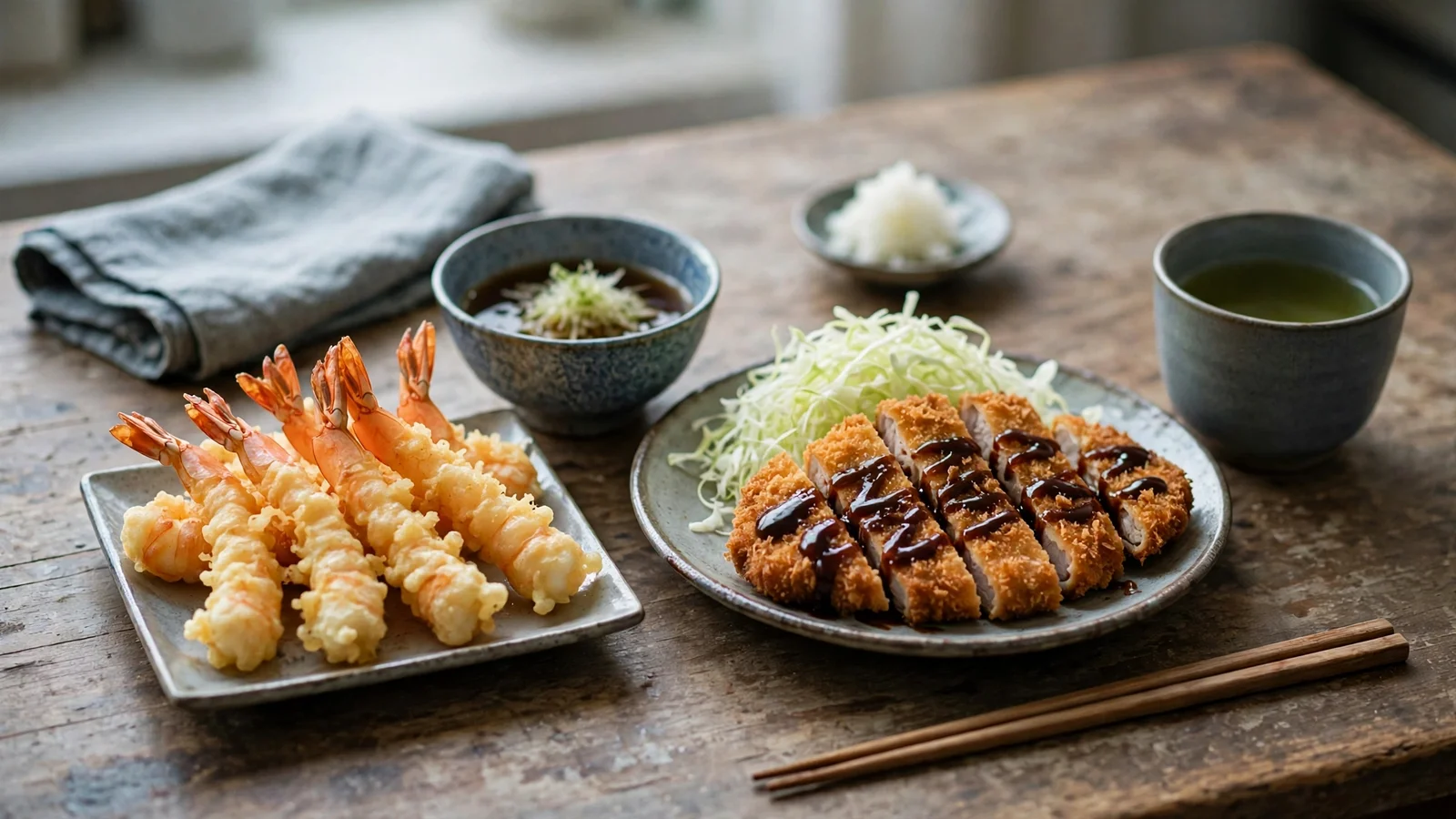
Tempura and tonkatsu both come out of hot oil golden and crisp, and both sit under the Japanese umbrella term agemono, fried things. That shared color is where the likeness ends. Tempura is a wet batter over food that is never marinated: shrimp, fish, and vegetables dipped in flour, egg, and ice-cold water, fried fast, and dipped in sauce at the table. Tonkatsu is a thick pork cutlet coated in flour, egg, and panko, fried until the crust shatters, then sliced into strips and served over shredded cabbage with a dark, tangy sauce. One is a light coating that lets the filling show through; the other is a thick crust built to carry a cutlet. Once you see how each coating is built, the choice between them comes down to what is on the plate.
What tempura is
Tempura starts with the batter, not the filling. The batter is flour, egg, and ice-cold water, mixed only until it comes together, with lumps still showing. A smooth batter builds gluten and fries tough, so the mixing stays short on purpose. My shrimp tempura uses 1 cup flour to 3/4 cup ice water with 1 egg and 2 tablespoons cornstarch for 12 large shrimp, and the bowl sits over ice if the kitchen runs warm. The shrimp get 4 to 5 shallow cuts across the belly so they lie straight, a pat dry, and a thin dusting of flour so the batter has something to grip. Each piece fries at 350°F for about 2 minutes, 3 to 4 pieces at a time so the oil stays hot, then rests on a wire rack. Tempura is served right away, with tentsuyu, a thin dipping sauce of dashi, soy sauce, and mirin, with grated daikon and ginger on the side. A pinch of salt works too.

What tonkatsu is
Tonkatsu starts with the cutlet, not the coating. The word joins “ton” (pork) and “katsu” (from the English “cutlet”). Boneless pork loin, about 2 cm (3/4 inch) thick, gets shallow notches cut into the fat rim so it fries flat instead of curling, then a gentle pounding to an even thickness. My tonkatsu coats each cutlet in flour, then beaten egg, then panko pressed on firmly, and the breaded cutlets rest 5 to 10 minutes before frying so the coating sets into one shell. The oil holds at 170°C (340°F): below about 165°C the crust soaks up oil and turns heavy, above 180°C the panko darkens before the pork cooks through. One or two cutlets fry at a time, never more. Pull them at 63°C (145°F) inside, rest 4 minutes on a wire rack, then slice into strips and serve over finely shredded cabbage with tonkatsu sauce and steamed rice. A good one has a crust you can hear, with pale, juicy pork inside. That contrast is the entire point of the dish.

Tempura vs tonkatsu, side by side
| Tempura | Tonkatsu | |
|---|---|---|
| Main food | Shrimp, fish, vegetables | Boneless pork loin cutlets |
| Coating | Wet batter: flour, egg, ice water | Dry breading: flour, egg, panko |
| Coating ratio | 1 cup flour to 3/4 cup ice water, plus 1 egg | No batter; panko pressed on after flour and egg |
| Marinade | None | None, salt only |
| Oil temperature | 350°F (175°C), one fry | 170°C (340°F), one fry |
| Fry time | About 2 minutes per batch | About 10 minutes per batch |
| Batch size | 3 to 4 pieces at a time | 1 to 2 cutlets at a time |
| Flavor source | Tentsuyu dipping sauce, or salt | Tonkatsu sauce, served on the side |
| How it is eaten | With chopsticks, dipped, right away | Sliced into strips, over cabbage and rice |
| Prep that matters | Belly cuts so shrimp lie straight; batter kept ice-cold | Fat-rim notches so cutlets fry flat; 5 to 10 minute coating rest |
The oil numbers sit close together, 350°F for tempura against 340°F for tonkatsu, but the time in the oil is not close at all: about 2 minutes for a shrimp against about 10 minutes for a 2 cm pork cutlet. That gap is the whole difference between the two coatings. Tempura batter is mostly water, 3/4 cup to 1 cup flour, so it sets in seconds and has to come out before the filling overcooks. Panko is dry crumbs, so it needs the full 10 minutes for heat to reach the center of the pork, and the crust turns deep gold in that time instead of staying pale. The batch sizes tell the same story: 3 to 4 shrimp at a time against 1 to 2 cutlets, because a cold cutlet drops the oil further than a shrimp does. Swap the methods and both fail: panko on a shrimp fries dark before the shrimp is done, and wet batter on a thick cutlet slides off in the oil and never sets into a shell.
Which one to make or order first
Make tempura first if you want something fast and light. The batter mixes in a minute, the shrimp fry in about 2 minutes a batch, and the whole plate is ready in well under half an hour once the shrimp are prepped. It suits a small plate beside miso soup and rice, or a few pieces as part of a larger Japanese meal. It also suits a group with mixed tastes, since the same batter fries shrimp, fish, sweet potato, green beans, and shiso leaves, and everyone dips what they like. If you like the light, lacy bite and want a fried chicken that uses a dry coating instead of a wet batter, my chicken karaage uses a starch dusting and a double fry.

Order tonkatsu first when you want a full meal from one plate. A sliced cutlet over shredded cabbage with rice and tonkatsu sauce is dinner on its own, with no side dishes required. At home, tonkatsu is a weekend cook: the pounding, the three-step breading, the 5 to 10 minute rest, and the thermometer work add up, but none of it is hard. A panko shell also re-crisps in a hot oven, where a lacy tempura batter rarely comes back the same way, so tonkatsu holds up better as leftovers. My guide to reheating fried food so it stays crisp covers the oven method that works for both, and my tonkatsu sauce takes a few minutes to stir together if you do not have a bottle on hand.
The verdict: batter or breading?
Pick tempura for a light, fast fry: a thin batter of flour, egg, and ice water, cooked at 350°F for about 2 minutes, dipped in tentsuyu at the table. Pick tonkatsu for a filling cutlet dinner: pork loin 2 cm thick, coated in flour, egg, and panko, fried at 170°C until the inside hits 63°C, sliced over cabbage with sauce. Both come from the same fryer, but the coating decides the meal. The batter lets the filling show; the breading carries the cutlet.
More Japanese recipes
Four more from the same shelf: Shrimp Tempura is the full batter recipe with the cold-batter ratio and the 2-minute fry; Tonkatsu: Japanese Crispy Pork Cutlet is the full cutlet recipe with the 2 cm loin, the panko rest, and the 170°C oil; Homemade Gyoza with Pork and Cabbage is another pan-cooked favorite that uses the same pork-and-cabbage pairing; and Chicken Katsu Curry is the crisp-cutlet comfort dish for the nights when the fryer stays in the cupboard.
From the garden
Shiso leaves are one of the classic tempura fillings, and the plant grows in a pot on my back step. My perilla growing guide starts from the same pot. A leaf dipped in the same cold batter fries in under a minute, and the plant keeps producing through the warm months as long as it gets sun and water.
From Paul’s kitchen.