
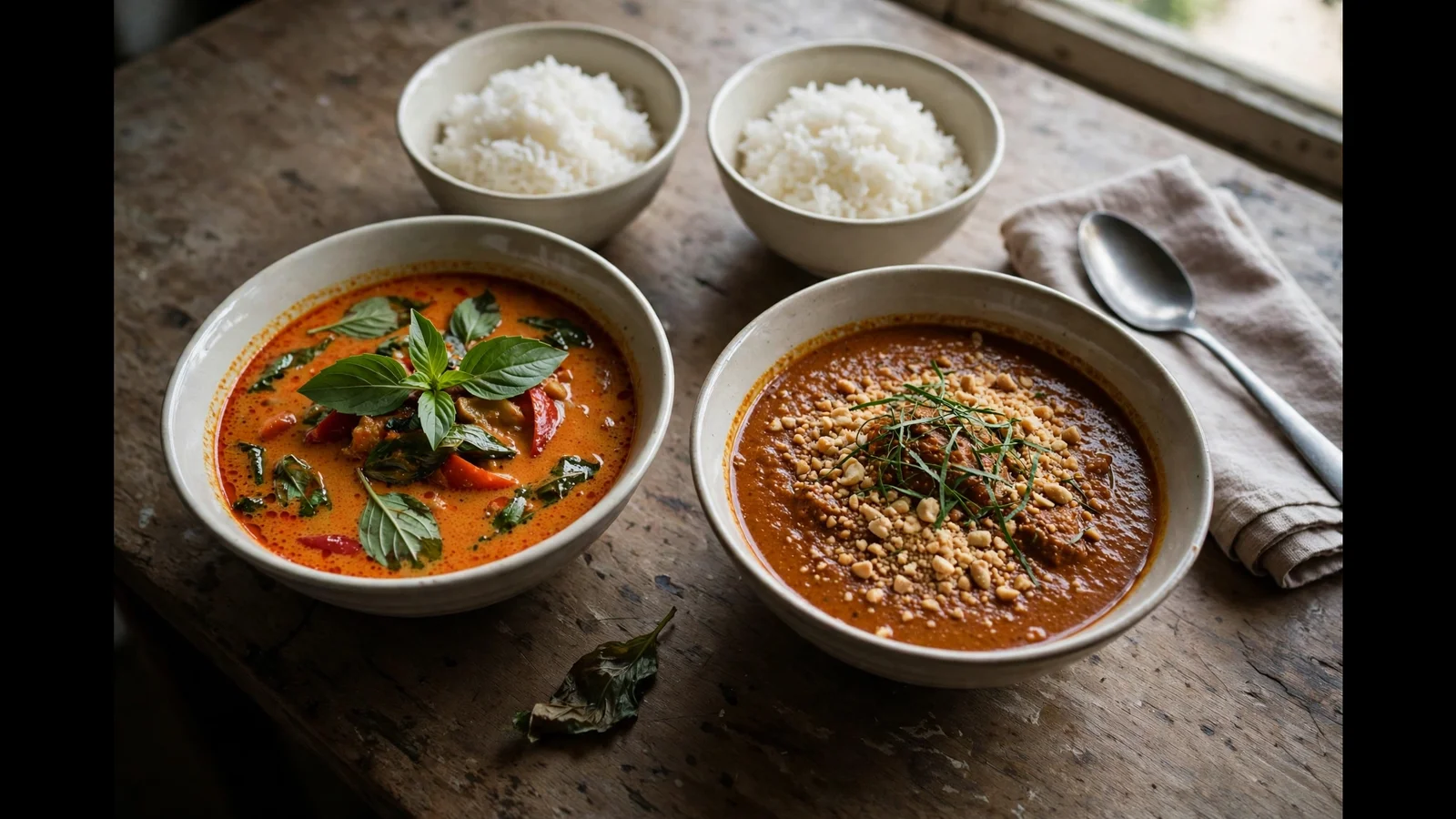
Order red curry at a Thai restaurant and the bowl arrives loose and orange-red, with Thai basil on top and heat that builds as you eat. Order panang curry and the bowl looks different before you taste it: the sauce is darker, it clings to the meat instead of pooling around it, and crushed peanuts and fine shreds of kaffir lime leaf sit on top. Both start from a red chili paste and coconut, and both come from central Thailand, but they are not the same curry with a different name. The paste, the liquid, and the finish all point in different directions.
The short answer
Red curry is the hotter, looser, more herbal curry. Its paste leans on dried red chilies, lemongrass, galangal, and Thai basil, and it cooks in coconut milk, so the sauce stays soupy enough to spoon over rice. Panang curry is the thicker, sweeter, nuttier curry. Its paste starts from a similar base but adds ground peanuts and warm spices like cumin and coriander, and it cooks in coconut cream, so the sauce coats the meat instead of running off it. If you want heat and fresh herbal notes, pick red curry. If you want a mild, sweet, peanut finish, pick panang.
| Red curry | Panang curry | |
|---|---|---|
| Thai name | Gaeng phet | Gaeng phanaeng |
| Paste base | Dried red chilies, lemongrass, galangal, garlic, shallots, shrimp paste | Dried red chilies, lemongrass, galangal, garlic, shallots, plus ground peanuts, cumin, coriander |
| Peanuts | No | Yes, ground into the paste and often scattered on top |
| Liquid | Coconut milk | Coconut cream, sometimes with a little coconut milk |
| Texture | Loose and soupy, it pools around the meat | Thick, it clings to the meat like a sauce |
| Heat | Hot, the chilies lead | Mild to medium, the peanuts and palm sugar soften it |
| Sweetness | A little, from the coconut milk | Noticeable, from palm sugar and peanuts |
| Usual finish | Thai basil leaves, sliced red chili | Crushed peanuts, shredded kaffir lime leaf, a swirl of coconut cream |
| Common proteins | Chicken, duck, shrimp, tofu, eggplant | Beef, chicken, pork, sometimes shrimp |
Red curry, in brief
Red curry, gaeng phet, is one of the oldest curries in central Thailand. Its color comes from dried red chilies ground into the paste, and its flavor comes from the same aromatics that run through most Thai cooking: lemongrass, galangal, garlic, shallots, coriander root, and shrimp paste. The paste fries in coconut cream until the oil splits and turns red, then coconut milk goes in, and the curry simmers for about 20 to 25 minutes with chicken, duck, or shrimp, plus Thai eggplant and bamboo shoots. Thai basil goes in at the end, off the heat, so it stays green and fragrant. My own version with duck is in Thai red curry with duck.
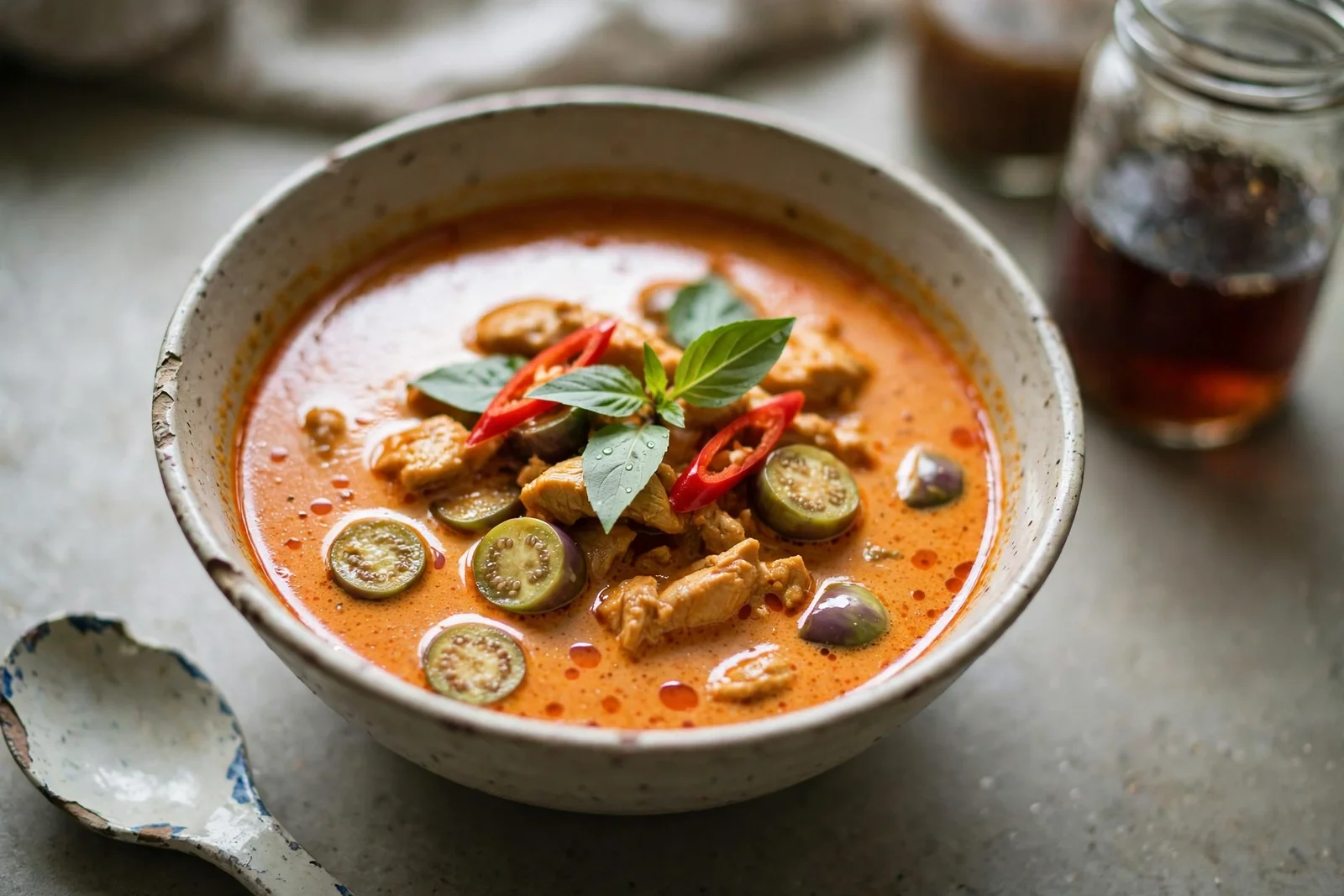
The heat is the point of red curry, and it comes from the chilies in the paste rather than from anything added at the table. A standard pot uses about 3 tablespoons of paste per 400 ml can of coconut milk, and that ratio gives a curry with a clear chili bite. Cooks who want it milder use 2 tablespoons and add a second spoon of coconut milk; cooks who want it hotter add a sliced fresh chili with the basil. The sauce stays loose either way, which is why red curry works so well over rice and, on some nights, over noodles. It also takes vegetables that hold their shape in a soupy sauce, like Thai eggplant, bamboo shoots, and bell pepper.
Panang curry, in brief
Panang curry, gaeng phanaeng, is milder and sweeter, and the name is often traced to Penang, the island off the Malay Peninsula, which fits its flavor: the curry carries warm spices and peanuts in a way red curry does not. The paste shares the same base of dried chilies, lemongrass, galangal, and garlic, but it adds ground peanuts, cumin, and coriander, and it uses fewer chilies. That change alone would make it milder, and the cooking liquid finishes the job: panang simmers in coconut cream, not coconut milk, so the sauce reduces to a thick coat. My own version with chicken is in panang curry with chicken.
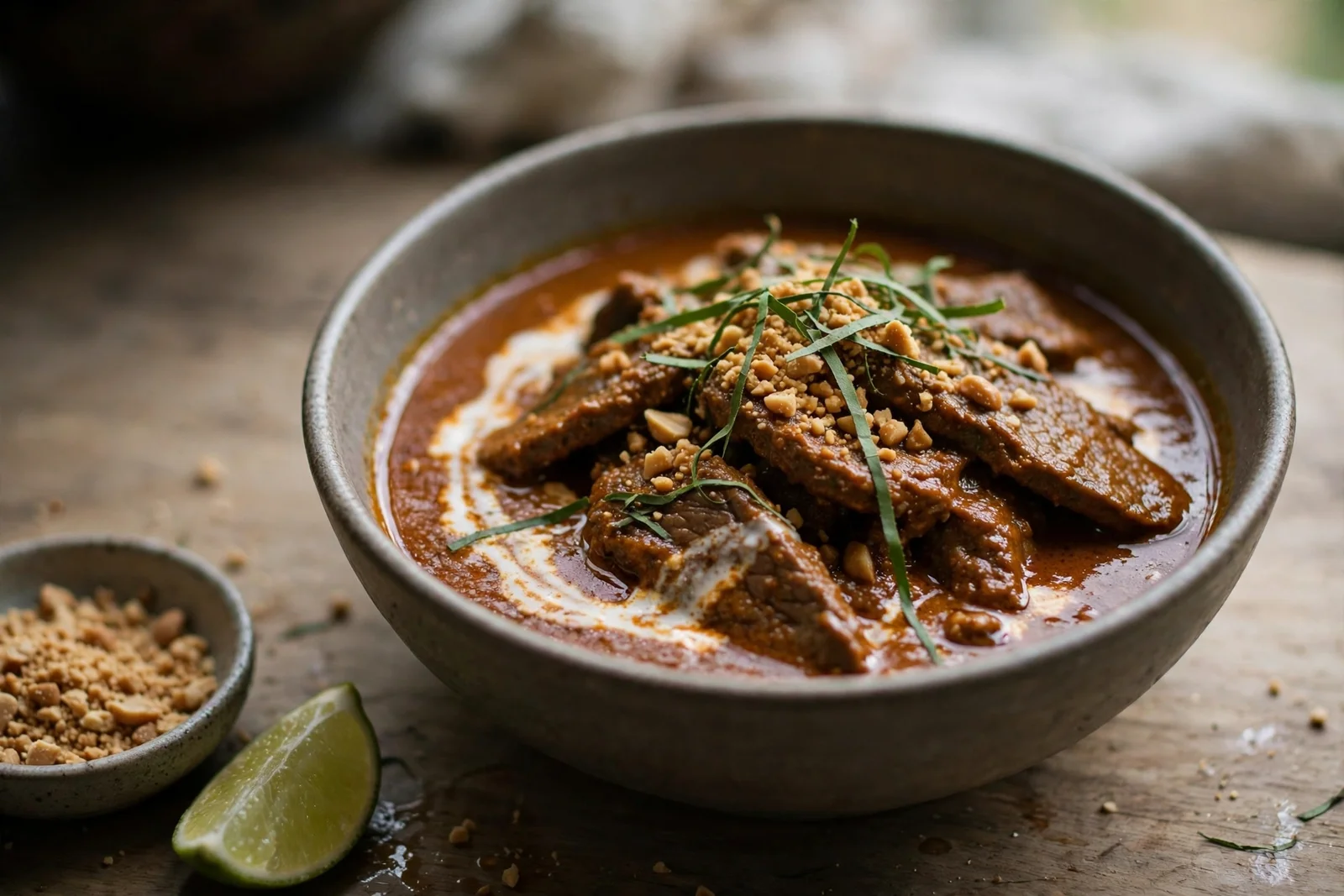
A standard pot uses about 2 tablespoons of panang paste and 2 tablespoons of ground peanuts per cup of coconut cream, plus about 1 teaspoon of palm sugar, and it simmers for 25 to 30 minutes when the protein is beef. The peanuts do two jobs at once: they add a nutty taste and they thicken the sauce, so a panang curry needs less liquid than a red curry to reach the right body. The finish is part of the dish too. Crushed peanuts go on top for crunch, fine shreds of kaffir lime leaf add a citrus edge, and a swirl of coconut cream marks the bowl as panang before anyone takes a bite. Beef is the classic protein because the long, slow simmer suits it, but chicken and pork work the same way.
Where the pastes part ways
The two pastes look alike in the mortar, and that is where most of the confusion starts. Both begin with dried red chilies, lemongrass, galangal, garlic, shallots, and shrimp paste. The split comes from three additions that only panang makes: ground peanuts, cumin, and coriander seed. Red curry paste keeps the focus on chilies and fresh aromatics, so its flavor stays bright and hot. Panang paste trades some of that chili heat for nutty, warm spice notes, so its flavor reads deeper and sweeter. If you taste the two pastes side by side, the red curry paste bites first and the panang paste finishes with peanuts.
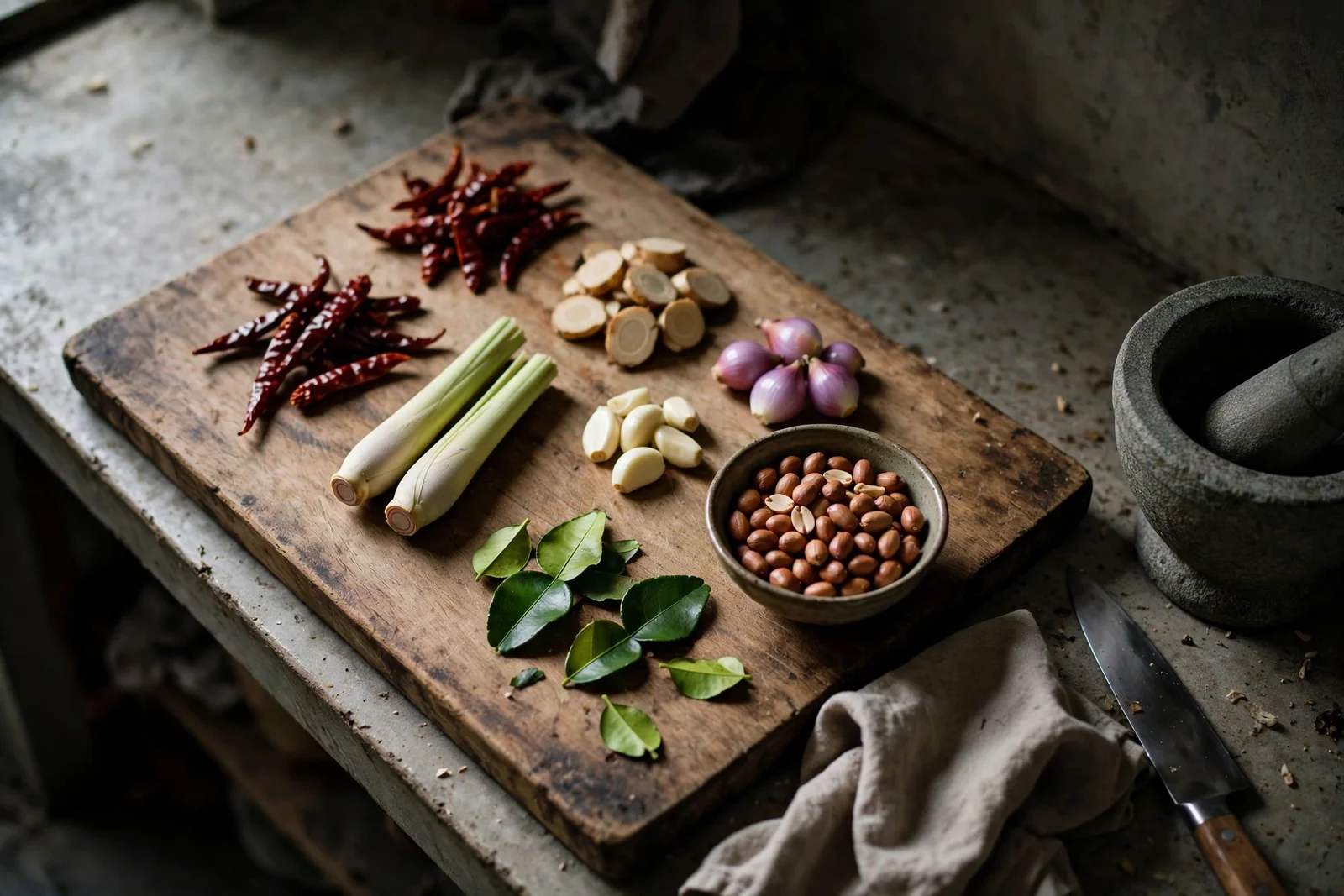
That difference shows up in the jar, too. A tub of red curry paste and a tub of panang paste can sit next to each other on a shelf, and the panang paste is usually the darker, browner one, because the peanuts and toasted spices darken it. The red curry paste stays a brighter red. If you cook with jarred paste, read the label for peanuts: a panang paste without peanuts on the ingredient list is a red curry paste with a different label. My notes on making paste from scratch are in how to make Thai curry paste from scratch.
Heat, thickness, and the coconut question
Heat is the easiest way to tell the two apart at the table. Red curry is hot by design. The chilies lead, the coconut milk softens them a little, and the heat builds across the bowl. Panang curry is mild to medium. The chilies are still there, but the peanuts, the palm sugar, and the coconut cream push them into the background, so the first thing you taste is sweet and nutty, not hot. A cook who finds red curry too hot often likes panang, and a cook who finds panang too sweet often likes red curry.
Thickness follows the same split. Red curry uses coconut milk, which is thinner, and it keeps enough liquid to pool in the bowl. Panang curry uses coconut cream, which is the thick layer that rises to the top of a can, and it cooks down until the sauce clings to the meat. The spoon test settles it: a spoonful of red curry runs off the spoon, and a spoonful of panang curry holds its shape for a second before it drops. That is also why the two pair with rice differently. Red curry needs a full bowl of jasmine rice to catch the sauce, while panang curry needs less rice because the sauce stays on the meat. My notes on handling coconut milk without splitting it are in how to cook with coconut milk without splitting it.
Which one to cook tonight
- You want heat and fresh herbal flavor, and you have chicken, shrimp, or duck: red curry. It cooks in 20 to 25 minutes, it takes vegetables well, and the basil finish makes it taste like the restaurant version.
- You want something mild and sweet, and you have beef: panang curry. Give it 25 to 30 minutes so the beef turns tender and the sauce thickens around it.
- You are cooking for people who do not agree on heat: panang curry, with sliced fresh chili on the side for anyone who wants more fire.
- You have a peanut allergy in the house: red curry, and check the paste label, since some brands add peanut oil. Panang curry is not the dish to serve there.
- You want a curry over noodles instead of rice: red curry, since its loose sauce coats noodles in a way panang sauce does not.
- You are choosing between the two at a restaurant and you like green curry: red curry sits closer to green curry in heat and herbs, while panang sits closer to massaman curry in sweetness and warm spice. The other comparisons in this series are green curry vs red curry, red curry vs yellow curry, and massaman vs red curry.
Can you swap one for the other?
You can move a red curry toward panang, and a panang toward red, but the swap is a one-way street with a limit. To push red curry toward panang, fry the paste as usual, then stir in 2 tablespoons of ground peanuts and 1 teaspoon of palm sugar per can of coconut milk, and hold back a third of the milk so the sauce thickens. The result tastes close to panang, though it keeps a little more chili bite. To push panang toward red, leave the peanuts out of the topping, add a sliced fresh chili with the lime leaf, and thin the sauce with a splash of coconut milk. The result tastes closer to red curry, though the cumin and coriander in the panang paste still show through. Neither swap turns one paste into the other, because the pastes themselves differ, but both swaps rescue a dinner when the shop only has one paste in stock.
More Thai curry posts
- Panang Curry with Chicken
- Thai Red Curry with Duck
- Thai Green Curry with Chicken
- Massaman Curry with Beef
From the garden
Thai chilies and Thai basil are the two ingredients in this comparison that change the most when they come from a pot by the back door. The chilies dry well on the plant, and a small pot gives enough for a season of curry paste. Thai basil grows fast in a warm pot, and cutting it often keeps it leafy instead of woody. My notes on both are in how to grow Thai chili peppers in pots and how to grow Thai basil in pots.