
Fish Sauce for Cooking: Labels, Flavor and Substitutions
Fish sauce is the backbone of Vietnamese cooking — the salty, savory depth behind pho broth, noodle bowls, and the dipping sauce that shows up next to nearly everything. But the bottle wall at the Asian grocery is genuinely confusing: prices from a few dollars to twenty, labels in Vietnamese or Thai, and numbers like “40°N” that mean nothing until someone explains them.
This guide explains what the labels actually mean, how to match a bottle to what you’re cooking, and what to reach for when you can’t use fish sauce. What it doesn’t do: declare a “best brand” or describe tasting results from tests we never ran. Those claims stay out.
What Fish Sauce Actually Is
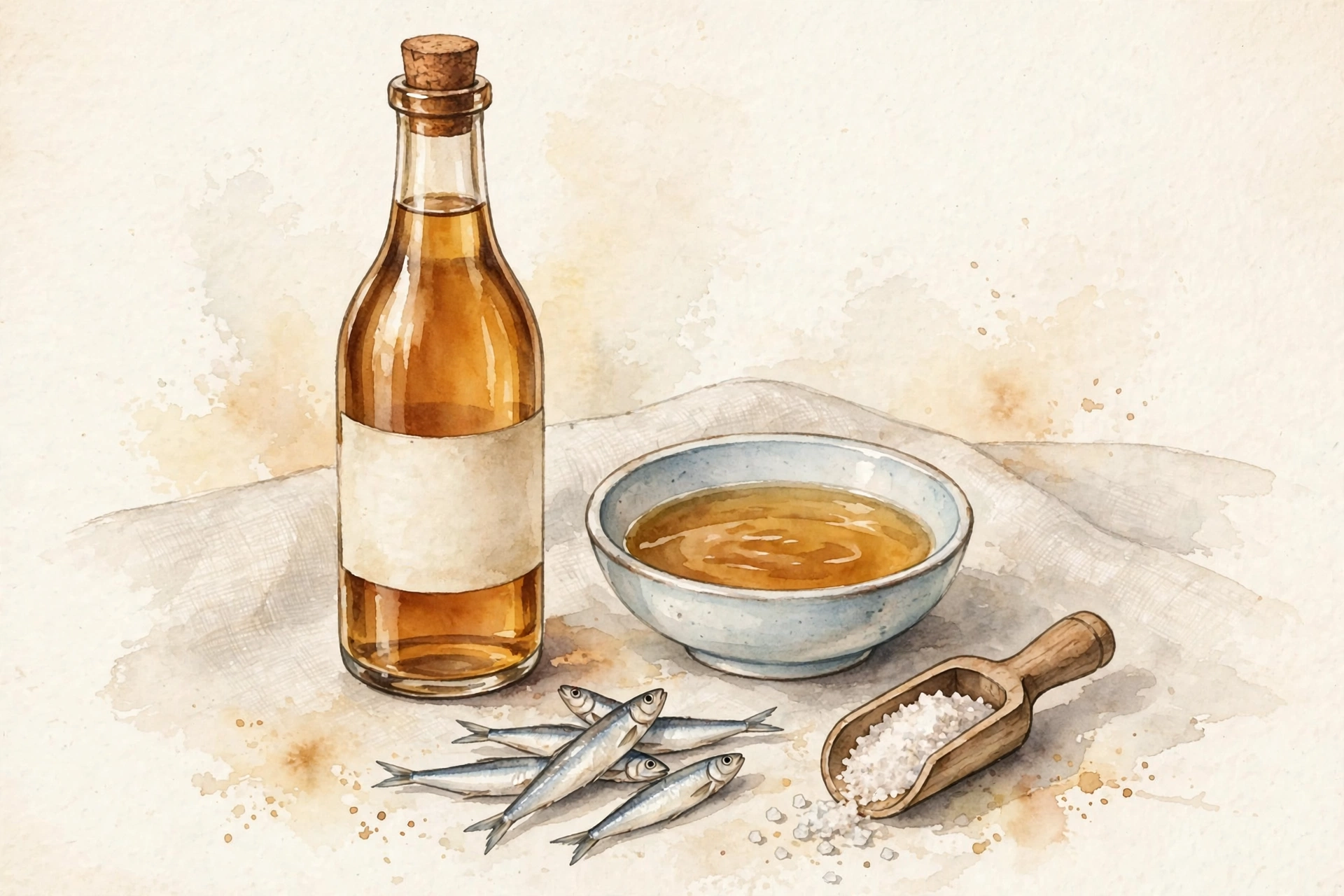
At its simplest, traditional fish sauce is fermented fish and salt. Fresh anchovies (or other small fish) are layered with salt in wooden barrels and left to ferment for months — often six months to a year or more. The liquid that drains out is fish sauce. That’s the whole traditional ingredient list: fish, salt, time.
Cheaper or mass-market bottles may also list water, sugar, hydrolyzed vegetable protein, or preservatives. That’s not automatically a dealbreaker, but it helps to know what you’re buying.
How to Read the Label
The ingredient list comes first
Flip the bottle over. The best signal is a short ingredient list: anchovy extract (or fish extract) and salt. Sometimes you’ll see “cá cơm” on Vietnamese labels — that means anchovy, and it’s a good sign the sauce is anchovy-based rather than made from mixed or lesser fish.
Longer lists with added water, fructose, or flavorings usually mean a more diluted or flavored product. Those are fine for everyday cooking, but they won’t have the same depth.
The °N number: protein grade
Many Vietnamese bottles print a number followed by °N — for example, 30°N or 40°N. This is the nitrogen (protein) content per liter, and it tells you how concentrated the fish protein is. Higher number, more umami, and usually a higher price.
What the grades roughly mean:
- Above ~30°N (“nước mắm nhỉ” / first press): The first draining from the barrel — the most concentrated, most aromatic sauce. Traditionally reserved for table use and dipping sauces, where you’ll taste it directly.
- Around 15–25°N: Later pressings, lighter and less intense. These are the workhorse bottles for everyday cooking — stir-fries, soups, marinades — where the sauce blends into a larger dish.
This is a guide to reading labels, not a buying recommendation: a higher °N isn’t “better” for every job. For a dipping sauce where fish sauce is the star, the first-press bottle earns its price. For seasoning a big pot of soup, a mid-range bottle does the job just fine.
Color and clarity
Good fish sauce is typically clear with an amber to reddish-brown color. Cloudiness or off colors can indicate a poor-quality or spoiled product. After opening, it’s normal for the color to darken a bit with air exposure — that’s oxidation from natural fermentation, not spoilage.
Origin
The famous production regions — Phú Quốc, Phan Thiết, Nha Trang in Vietnam — are known for traditional barrel fermentation. Origin on the label is a useful data point but not a guarantee; the ingredient list and °N tell you more about what’s in the bottle.
Flavor Differences by Use
Here’s how to think about it practically:
- Dipping sauces (nước chấm): Use your best bottle. The sauce is barely diluted and highly seasoned with lime, sugar, and chili, so quality shows. First-press / high-°N sauce gives the deepest flavor.
- Cooking (soups, braises, stir-fries): A mid-range bottle works well. The fish sauce is one seasoning among many, and heat plus other ingredients carry most of the flavor.
- Finishing: A few drops of a good bottle added off the heat can brighten a dish the way a squeeze of lemon would.
One thing worth knowing: fish sauce doesn’t taste fishy in a finished dish. It melts into the background as pure savory depth — the same way anchovies disappear into a Caesar dressing or a puttanesca.
Substitutions (and Their Honest Limits)
Sometimes you can’t use fish sauce — a vegetarian guest, an allergy, or an empty bottle. Here’s what actually works, with the caveats stated plainly:
Vegan/vegetarian fish sauce. Several brands make these from seaweed, mushrooms, and soy. They’re the closest substitute because they’re designed for the job. Flavor varies by brand, so taste and adjust.
Coconut aminos + salt. Coconut aminos are milder and slightly sweet compared to soy sauce, so they need extra salt to stand in for fish sauce’s salinity. This works in dipping sauces and dressings. Limit: it has none of the fermented funk — it’s a pleasant seasoning, not a replica.
Light soy sauce. In a pinch for cooked dishes, a smaller amount of light soy sauce plus a pinch of sugar approximates the salt-umami balance. Limit: the flavor profile is different — beany rather than briny — and it will darken light-colored dishes.
Salt alone. If a recipe uses a small amount of fish sauce purely for seasoning a soup or stir-fry, salt gets you most of the way there. Limit: you lose all the umami depth. It’s a fallback, not a substitute.
What doesn’t work: Worcestershire sauce and oyster sauce are sometimes suggested online, but their flavor profiles (tamarind/vinegar in one, sweet-mollusk in the other) pull the dish in the wrong direction for Vietnamese cooking.
Storage
Fish sauce is extremely shelf-stable thanks to the salt. Store it in a cool, dark cupboard. It doesn’t need refrigeration, even after opening — though some people refrigerate opened bottles to slow color darkening. It keeps for years. If it develops an off smell beyond its normal pungency, or visible mold (rare), replace it.
Recipes That Use Fish Sauce
Our Vietnamese Tofu in Tomato Sauce (Dau Sot Ca Chua) calls for fish sauce as its savory backbone.
Sources
- eGullet Forums, “Fish Sauce” discussion thread — explanation of °N grading (nitrogen content per liter) and first vs. subsequent pressings. https://forums.egullet.org/topic/111260-fish-sauce/page/5/
- Mytour.vn, “Top 5 Grading Levels Based on Protein Content of Fish Sauce” — special grade (>30°N) as “nhỉ” first-press sauce; grade 1 (>15°N) for dipping/cooking uses. https://mytour.vn/en/blog/bai-viet/top-5-grading-levels-based-on-protein-content-of-fish-sauce
- Galatourist, “Complete guide to Vietnamese fish sauce in local cuisine” — label-reading indicators (ingredients, color, °N range 30–43°N, production regions). https://galatourist.com/complete-guide-to-vietnamese-fish-sauce-in-local-cuisine.htm
Editorial note: No product taste tests were conducted for this article, and no brand is recommended or ranked. All label-reading guidance is compiled from the published references above.