
At a Thai market, the mangoes that look the ripest are often the ones to skip. A mango can turn red or gold weeks before the flesh inside sweetens, and a green mango can be fully ripe under the skin. Color is the least reliable sign in the whole pile.
Feel, smell, and weight tell the truth instead, and they work the same way whether you are buying for mango sticky rice or for a salad. Learn the three checks below and you will stop bringing home hard, sour mangoes. The checks take about ten seconds per fruit, and they hold for every variety sold in US markets.

The squeeze test
Hold the mango in your palm and press gently with your whole hand, not your fingertips. A ripe mango gives slightly under pressure, close to a ripe peach, and springs back slowly when you let go. A mango with no give at all is unripe. A mango that dents easily, or feels soft in one spot and hard everywhere else, is overripe or bruised inside.
Check the whole fruit, not one side. Mangoes ripen unevenly, and a mango can feel soft near the stem while the other end stays hard. Turn it over and press the cheeks, the shoulders, and the bottom. Even softness across the fruit is what you want. If one side is mushy and the other is rock hard, skip it: the mushy side tastes fermented while the hard side tastes sour.
The stem-end smell
Smell the stem end, where the mango hung from the tree. A ripe mango smells sweet and fruity there, even through the skin. An unripe mango smells like nothing, or faintly green. An overripe mango smells sour or like alcohol at the stem end, which means the sugars have started to ferment inside.
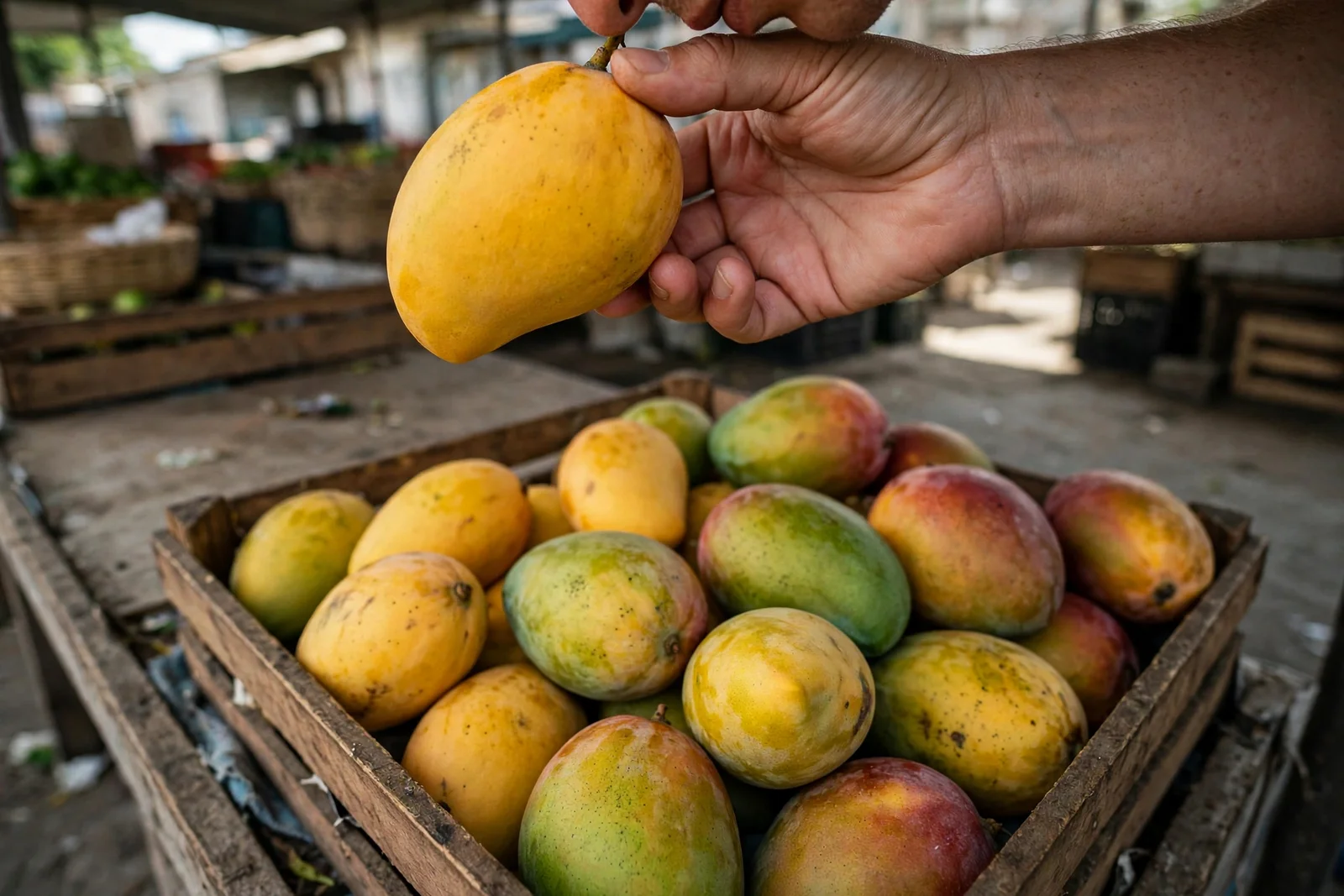
This test works best at room temperature. Cold mangoes from a refrigerated display smell faint, so hold the mango in your hands for a minute to warm it before smelling. If you still smell nothing, the mango needs more time, not a different test.
Weight and skin
A ripe mango feels heavy for its size. Pick up two mangoes of the same size and compare them: the heavier one usually has more juice and denser flesh. A light mango for its size often dried out on the tree or in storage.
Skin tells you about handling, not ripeness. Look for smooth skin without deep cuts, dark sunken spots, or wrinkled patches. Small black speckles are normal on some varieties and do not mean the fruit is bad. Wrinkles across a large area mean the mango lost moisture and will taste dry. A mango with a soft dark spot the size of a coin has likely bruised and rotted underneath, so skip it even if the rest feels fine.
Which mango to buy for Thai cooking
The variety changes what ripe looks like, so match the mango to the dish before you buy.

Nam Dok Mai is the mango Thai cooks reach for first in mango sticky rice. It turns deep gold when ripe, smells strongly sweet at the stem, and has almost no fiber, so the flesh slices clean and melts over the rice. It is hard to find in most US supermarkets, so look for it at Thai or Vietnamese markets in late spring and summer.
Ataulfo, sold as honey mango, is the closest common substitute. It is small, yellow, and kidney-shaped, turns deep gold and wrinkles slightly when ripe, and has the same low-fiber, honey-sweet flesh. For sticky rice, buy Ataulfo a day or two before you need it and let it soften on the counter.
Kent and Keitt stay mild and sweet with flesh that holds its shape, which makes them the better pick for salads. Kent turns green with a red blush and gives evenly when ripe. Keitt stays green even when fully ripe, so color tells you nothing and the squeeze and smell tests do all the work. Tommy Atkins, the large red-and-green mango in most supermarkets, is the most fibrous of the group. It turns red long before it ripens, and its strings show up in sticky rice. Save it for salads, where you cut the flesh into firm cubes, and pick it ripe but still firm so the cubes hold their shape.
For Thai mango salad and goi xoai, you want a mango that is ripe but still firm, or even half-ripe, so the cubes stay crisp against the lime and chili dressing. For mango sticky rice or mango sago, go the other way: a soft, very sweet mango that barely holds together is exactly right.
How ripe is ripe enough? Pick by dish
| Dish | Ripeness to buy | Why |
|---|---|---|
| Mango sticky rice | Fully ripe, soft, very sweet | Sweet flesh soaks into the coconut rice, and fiber would show in every bite |
| Thai mango salad | Ripe but firm | Cubes hold their shape in lime and chili dressing |
| Goi xoai | Half-ripe to ripe, still firm | Crisp bite keeps its texture against the dressing and herbs |
| Mango sago and smoothies | Very ripe, soft is fine | Blended or spooned, texture does not matter |
Ripen a hard mango at home
A hard mango is not a failed purchase if you have a few days. Ripen it on the counter, not in the fridge: cold stops ripening, and a mango chilled while hard may never soften properly.

Set the mango in a paper bag at room temperature. The bag traps ethylene gas, which the fruit gives off as it ripens, and speeds the process. Add a banana or an apple to the bag to speed it further. Check daily: most mangoes ripen in 2 to 4 days this way.
Once the mango gives slightly and smells sweet at the stem, move it to the fridge. It keeps 3 to 5 days refrigerated. Bring it back to room temperature for 30 minutes before eating for the best flavor.
Do not ripen mangoes in a plastic bag. Plastic traps moisture, and the skin can mold before the flesh softens. Paper breathes enough to avoid that while still holding the ripening gas in.
Cutting a mango
Cut a ripe mango by standing it on end, stem side up, and slicing down on either side of the flat pit in the center. You get two cheeks. Score each cheek in a crosshatch pattern, push the skin outward so the cubes stand up, and slice the cubes off. Peel and slice the flesh left around the pit for snacking.
The same weight and smell habits carry over to other fruit at the market. If you want a coconut to go with your Thai cooking, the checks are similar: how to pick a good coconut covers shake, weight, and sound.
More Thai recipes
Buy one extra mango and eat it over the sink while you cook. That is the fastest way to learn what ripe tastes like, and it is the best part of the trip to the market.