
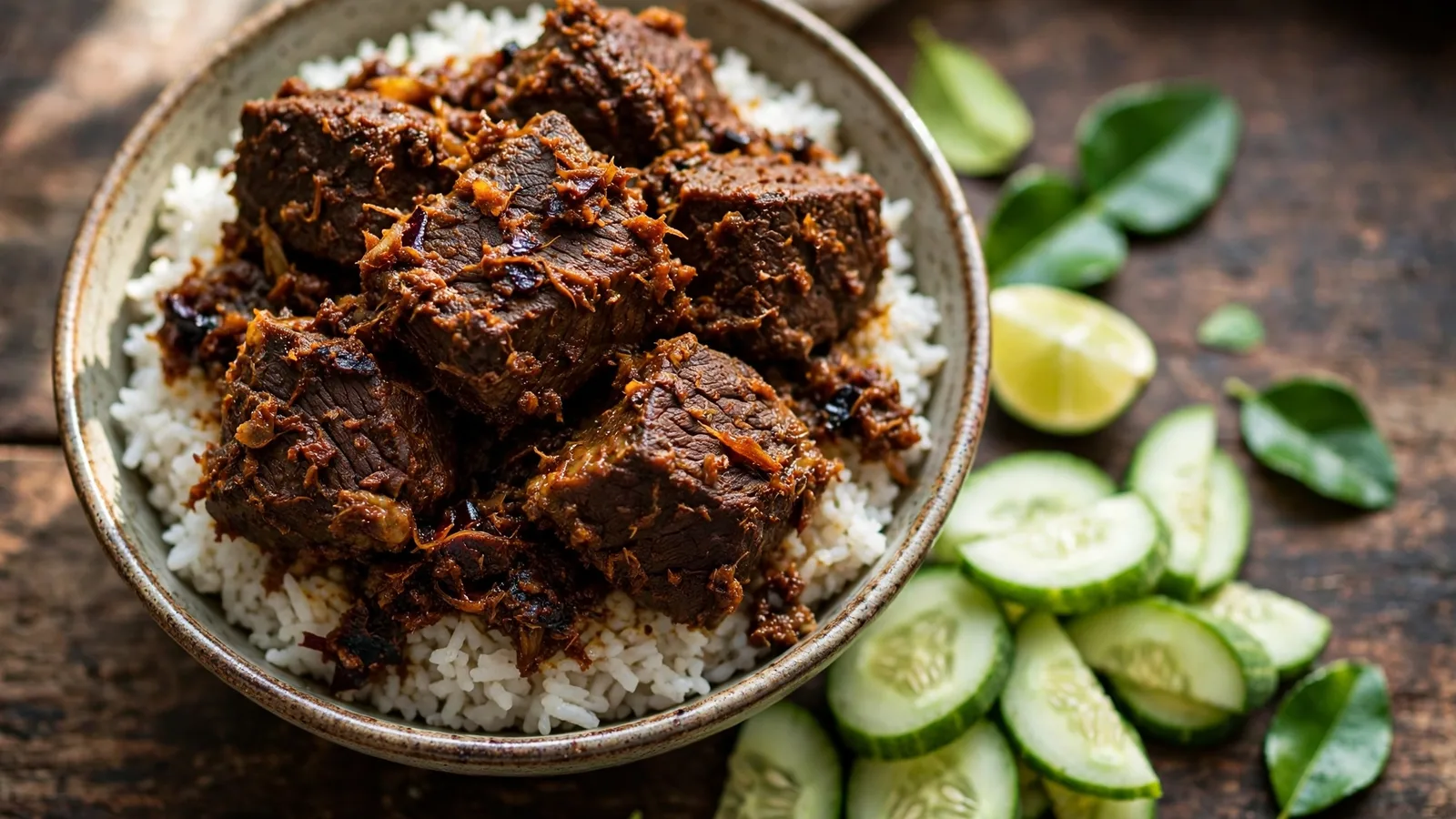
Beef rendang starts as a soupy coconut curry and ends as something else entirely. You simmer beef in coconut milk and a fresh spice paste, keep going long past the point where a curry would normally be done, and let the liquid cook away until the sauce fries in the oil it releases. The beef turns deep brown, the sauce clings instead of pooling, and every piece carries the paste with it.
It comes from the Minangkabau people of West Sumatra and is now cooked across Indonesia, Malaysia, and Singapore. The long, dry finish is the whole point. A rendang is not a bowl of sauce with beef in it. The sauce becomes a coating, and that is what sets it apart at the table.
What Sets Rendang Apart
If you already cook the beef curries on this site, this table places rendang next to them. Our Massaman Curry with Beef stays a mild, pourable coconut gravy with potatoes and peanuts. Rendang goes in the opposite direction: no potatoes in the pot, and the coconut milk cooks down to almost nothing.
| Detail | Beef Rendang | Massaman Curry with Beef | Typical Coconut Curry |
|---|---|---|---|
| Sauce at the end | Very thick, dark, clings to the beef | Pourable gravy | Brothy to lightly thick |
| Coconut milk role | Cooks down and fries the paste in its own oil | Stays as the sauce body | Stays as the sauce body |
| Key extra | Kerisik: toasted coconut, pounded or ground | Roasted peanuts, cinnamon, cardamom | Basil, lime leaf, vegetables |
| Heat | Warm and deep, builds slowly | Mild and sweet | Varies, often chili-forward |
| Cook time | 2 to 3 hours, mostly simmering | About 1 hour | 30 to 45 minutes |
| Beef texture | Fork-tender, edges a little crisped in the sauce | Fork-tender in gravy | Tender slices or chunks |
The short verdict: choose rendang when you want a make-ahead beef dish with very little sauce left in the pot and a flavor that concentrates as it cooks. Choose a wetter curry when you want gravy to spoon over rice. For the base liquid, full-fat coconut milk is the right call here; our guide to Coconut Milk vs Coconut Cream explains how the two behave when a dish simmers this long.
The Paste and the Toasted Coconut
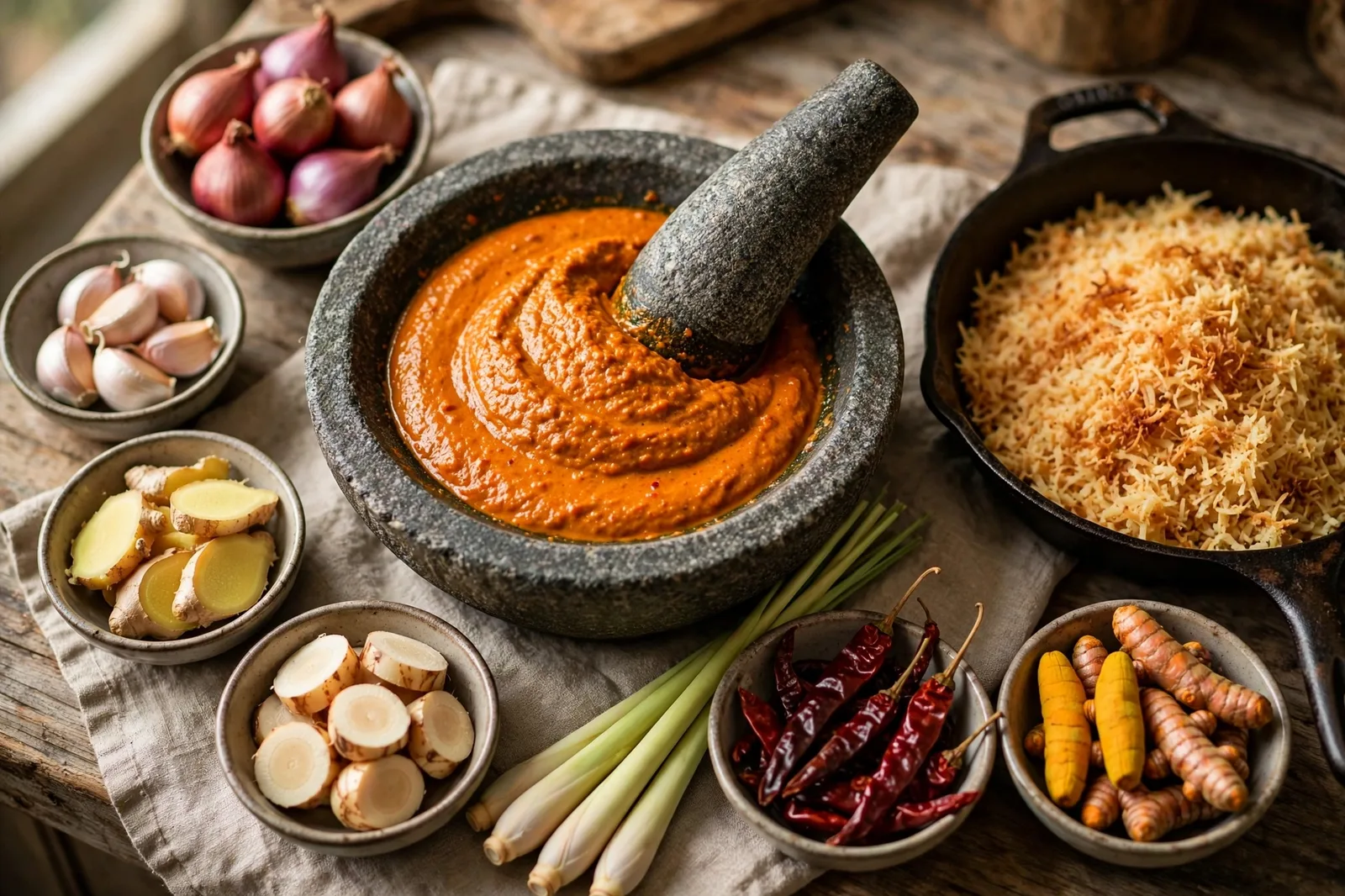
Two parts carry the dish. The first is the wet spice paste: shallots, garlic, ginger, galangal, lemongrass, turmeric, and chilies blended smooth with a splash of water. Galangal looks like ginger but smells piney and sharp, and it is worth picking up if your store carries it. If it does not, add an extra teaspoon of ginger and a strip of lime zest to keep the paste bright.
The second part is kerisik, and it is not optional in a rendang with the classic finish. You toast unsweetened coconut in a dry pan until it turns a deep golden brown, then grind it warm until it gives up its oil and turns into a rough, fragrant paste. Stirred in during the last hour, it thickens the sauce, deepens the color, and gives rendang its toasted backbone.
The ratio to hold onto for a 3-pound batch of beef:
- 2 cans (13.5 oz / 400 ml each) full-fat coconut milk to start, no water added at the beginning
- About 1 1/2 cups fresh spice paste from the blend below
- 1 cup unsweetened shredded coconut, toasted, for the kerisik
- 2 to 2 1/2 hours of low simmering after the pot comes to a boil
Beef Rendang
Beef simmered low and slow in coconut milk and a shallot-chili spice paste, finished with toasted coconut until the sauce turns dark and clings.
Prep time: 30 minutes Cook time: 150 minutes Total time: 180 minutes Servings: 6 servings
Ingredients
For the spice paste:
- 8 small shallots (about 8 oz / 225 g), roughly chopped
- 6 cloves garlic
- 2 oz (55 g) fresh ginger, peeled and sliced
- 2 oz (55 g) fresh galangal, peeled and sliced (or extra ginger plus 1 strip lime zest)
- 3 stalks lemongrass, pale parts only, sliced
- 8 dried red chilies, soaked in warm water 20 minutes and drained
- 4 fresh red chilies (Fresno or similar), roughly chopped
- 1 tablespoon ground turmeric
- 1/4 cup (60 ml) water, for blending
For the curry:
- 3 lb (1.4 kg) beef chuck, cut into 2-inch (5 cm) cubes
- 2 cans (13.5 oz / 400 ml each) full-fat coconut milk
- 1 cinnamon stick (about 3 inches)
- 3 star anise
- 4 green cardamom pods, lightly cracked
- 4 whole cloves
- 6 kaffir lime leaves, torn
- 1 tablespoon tamarind paste, or 2 teaspoons lime juice added at the end
- 1 tablespoon palm sugar or brown sugar
- 1 1/2 teaspoons kosher salt, plus more to taste
- 2 tablespoons neutral oil
For the kerisik (toasted coconut):
- 1 cup (80 g) unsweetened shredded coconut
For serving:
- Steamed jasmine rice
- 1 small cucumber, sliced (optional)
Instructions
1. Make the kerisik first so it is ready. Put the shredded coconut in a dry skillet over medium-low heat and stir often for 6 to 9 minutes, until it turns a deep, even golden brown and smells nutty. Move it to a mortar or small food processor while still warm and pound or process until it turns rough and oily, like a coarse paste. Set aside.
2. Blend the spice paste. Add the shallots, garlic, ginger, galangal, lemongrass, soaked dried chilies, fresh chilies, turmeric, and water to a blender or food processor. Blend until smooth, stopping to scrape down the sides. It will be thick; that is right.
3. Start the paste in oil. Heat the neutral oil in a heavy pot or Dutch oven over medium heat. Add the spice paste and cook, stirring often, for 8 to 10 minutes, until it darkens a shade, thickens, and the oil begins to separate at the edges.
4. Add the beef and whole spices. Stir the beef cubes through the paste to coat them, then add the cinnamon, star anise, cardamom, cloves, and lime leaves. Cook 3 to 4 minutes, stirring, so the beef picks up the paste on all sides.
5. Pour in the coconut milk. Stir in both cans of coconut milk, the tamarind paste, palm sugar, and salt. Bring the pot to a gentle boil over medium-high heat, stirring so the bottom does not catch, then lower the heat to a bare simmer.
6. Simmer low and uncovered. Cook for about 1 hour with the lid off, stirring every 15 minutes. The sauce will be soupy at this stage and the beef still firm. Keep the simmer gentle; a hard boil toughens the beef and can split the sauce too early.
7. Stir in the kerisik. Add the toasted coconut paste and stir well. Keep simmering another 60 to 90 minutes, stirring more often as the sauce thickens, every 8 to 10 minutes near the end.
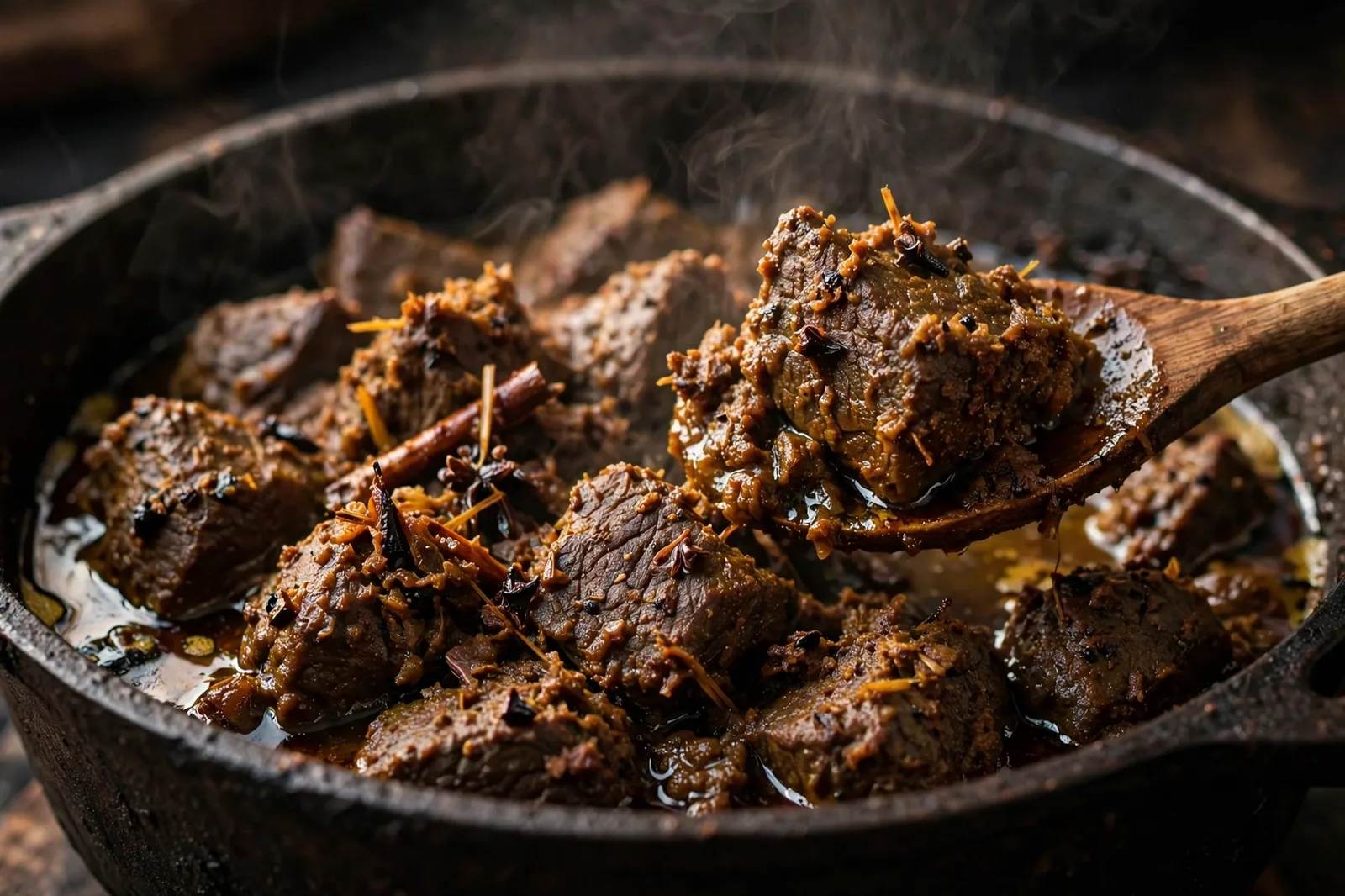
8. Watch for the turn. The sauce will pass through a thick, gravy-like stage (that stage is called kaliyo) and then keep reducing. It is done when it turns a deep mahogany brown, the oil pools and separates around the beef, and the sauce coats each piece instead of running off. The beef should pull apart with a spoon. Total cook time is about 2 1/2 hours.
9. Rest and adjust. Take the pot off the heat and rest 15 minutes. Pull out the cinnamon stick, star anise, and lime leaves if you can find them. Taste for salt and add the lime juice now if you used it in place of tamarind. Serve over rice with cucumber on the side.
Notes
- Chuck is the right cut for this cook. Lean stewing beef dries out over 2 1/2 hours; you want a cut with fat and connective tissue that softens as it simmers.
- Stirring matters more at the end than at the start. In the last 30 minutes the reduced sauce can scorch on the bottom, so keep the heat low and scrape the pot floor with a flat spoon.
- If the sauce splits into oil before the beef is tender, add 1/4 cup (60 ml) hot water, stir, and keep simmering. The sauce comes back together as it reduces again.
How You Know It Is Done
Rendang gives you clear stages, and reading them is easier than watching the clock.
| Stage | What you see | What it means |
|---|---|---|
| Soup stage | Thin coconut liquid covers the beef, pale orange | First 45 to 60 minutes; keep simmering |
| Kaliyo stage | Sauce thick like gravy, beef tender, still spoonable | Fine to serve as a wetter curry, but it is not rendang yet |
| Rendang stage | Sauce dark brown and dry, oil separates, paste clings to the beef | Done; take it off the heat after 10 more careful minutes |
That last stage is where the flavor concentrates. The paste fries gently in the coconut oil, the edges of the beef darken, and the sauce loses its raw coconut taste. Stop when the beef is coated and the pot looks almost dry, not when the bottom starts to catch.
What to Serve With It
Rendang is rich and the portion of sauce is small, so the sides should be plain and fresh. A pot of How to Cook Perfect Jasmine Rice Every Time is the standard base, and the rice takes up what little sauce there is. Sliced cucumber, a quick pickled onion, or a crisp cabbage slaw with lime all cut the richness between bites.
If you are building a wider spread, keep the other dishes lighter and wetter: a clear soup or a stir-fried green vegetable balances a table where rendang is the dense centerpiece.
Variations Worth Trying
- Chicken rendang: Use 3 lb (1.4 kg) bone-in chicken thighs and cut the simmer to 45 to 60 minutes total. Add the kerisik after 20 minutes and stop as soon as the sauce turns dark and clings; chicken dries out if you push it to the full beef timing.
- Wetter kaliyo style: Stop the cook at the gravy stage, after about 1 hour and 45 minutes, with the beef tender and the sauce still spoonable. Serve it with more rice, since there is more sauce to go around.
- More heat: Raise the fresh chilies to 6 and leave some seeds in. The dried chilies set the warm base note, so add fresh chili when you want the sharper bite.
- Extra toasted depth: Toast the coconut a shade darker and add a second small handful, untoasted, in the last 10 minutes for a little texture against the soft beef.
Storing and Reheating
Rendang keeps well, and the flavor settles and deepens after a night in the fridge. Cool it, move it to a sealed container, and refrigerate up to 4 days, or freeze up to 3 months. Thaw overnight in the fridge before reheating.
To reheat, warm it in a pot over low heat with a splash of water, stirring often, until the sauce loosens and turns glossy again and the beef is heated through. The microwave works for a single portion; stir once halfway so the thick sauce heats evenly.
Beef Rendang
Ingredients
Method
- Make the kerisik first. Put the shredded coconut in a dry skillet over medium-low heat and stir often for 6 to 9 minutes, until deep golden brown. While warm, pound or process until rough and oily, like a coarse paste. Set aside.
- Blend the spice paste: shallots, garlic, ginger, galangal, lemongrass, soaked dried chilies, fresh chilies, turmeric, and water. Blend until smooth, scraping down the sides. It will be thick.
- Heat the neutral oil in a heavy pot over medium heat. Add the spice paste and cook, stirring often, for 8 to 10 minutes, until it darkens a shade, thickens, and oil separates at the edges.
- Add the beef cubes and the cinnamon, star anise, cardamom, cloves, and lime leaves. Cook 3 to 4 minutes, stirring, to coat the beef on all sides.
- Pour in both cans of coconut milk with the tamarind paste, palm sugar, and salt. Bring to a gentle boil, stirring, then lower to a bare simmer.
- Simmer low and uncovered for about 1 hour, stirring every 15 minutes. Keep the simmer gentle.
- Stir in the kerisik. Keep simmering another 60 to 90 minutes, stirring more often as the sauce thickens, every 8 to 10 minutes near the end.
- Cook until the sauce turns deep mahogany brown, oil pools and separates around the beef, and the sauce coats each piece. The beef should pull apart with a spoon. Total cook time is about 2 1/2 hours.
- Rest 15 minutes off the heat. Remove the cinnamon stick, star anise, and lime leaves. Taste for salt, add lime juice now if used in place of tamarind, and serve over rice with cucumber.