
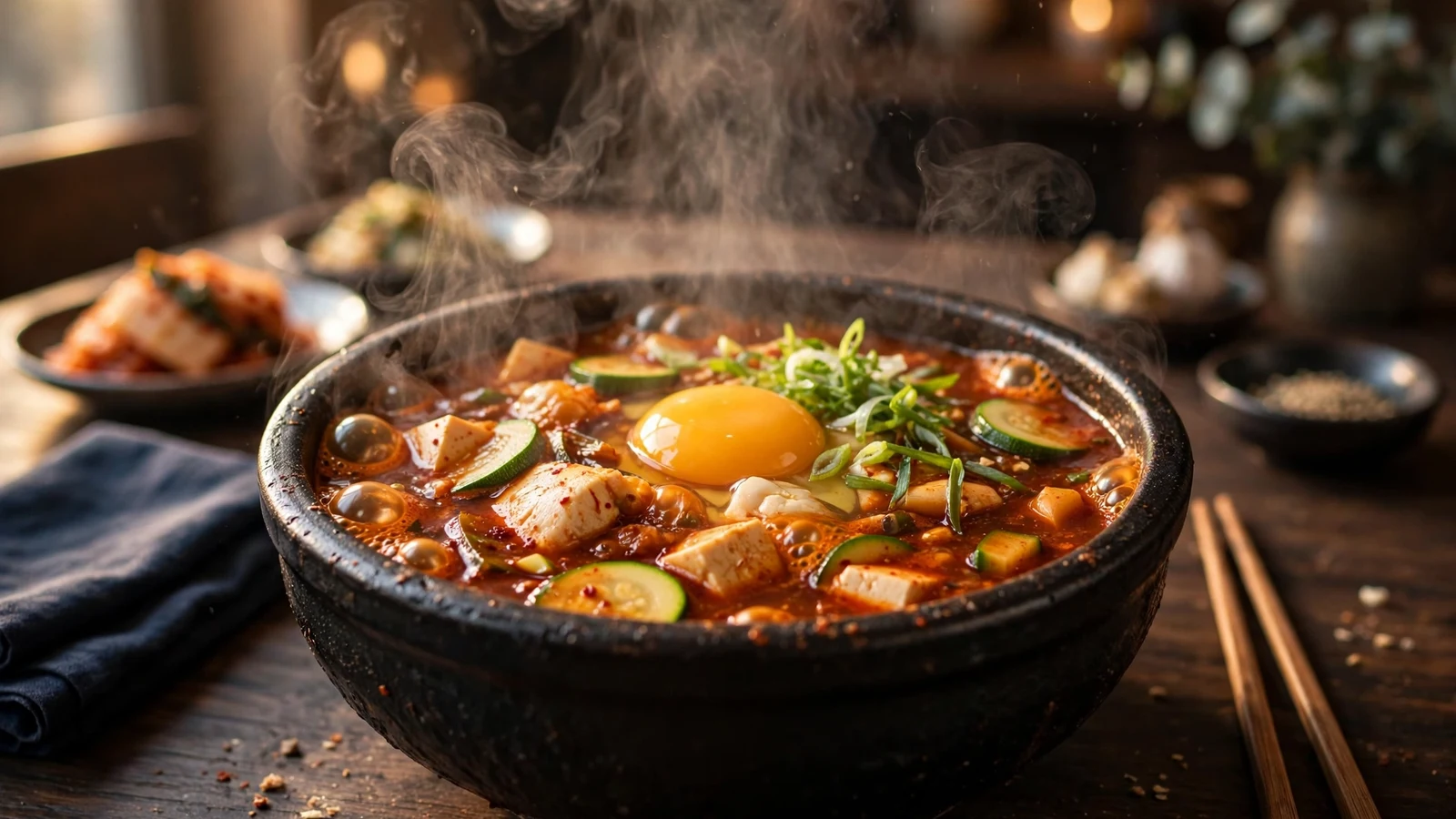
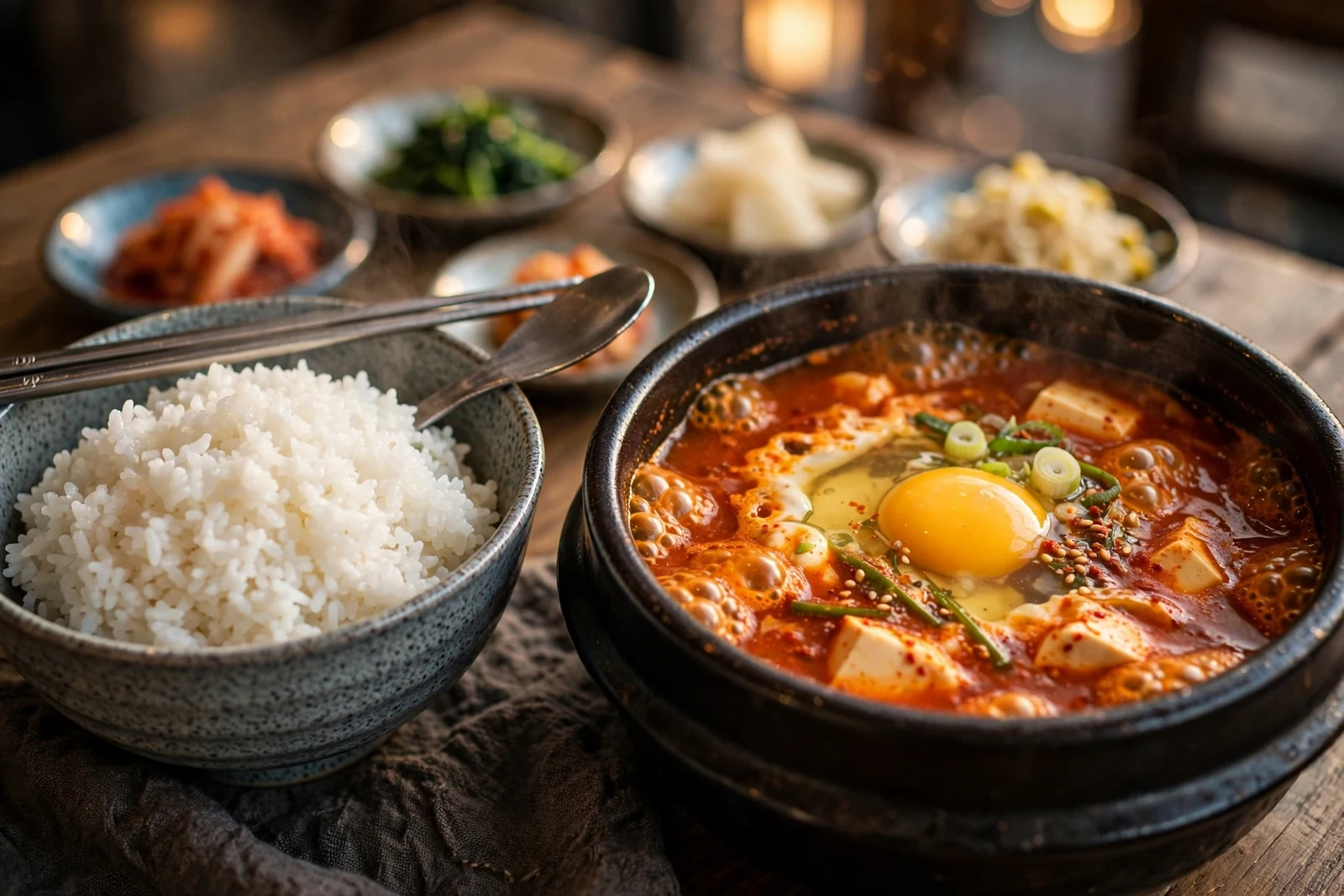
Sundubu jjigae arrives at the table still boiling, which is the whole point: a deep-red, chili-flecked broth carrying clouds of the softest tofu you'll ever eat, beef, zucchini, and mushrooms, with a raw egg cracked in at the last second so it sets into silk. This version works because of two small disciplines: blooming the gochugaru in oil for under a minute (it scorches in seconds if you rush it), and adding the tofu only in the final three minutes so it heats through without falling apart.
What Is Sundubu Jjigae?
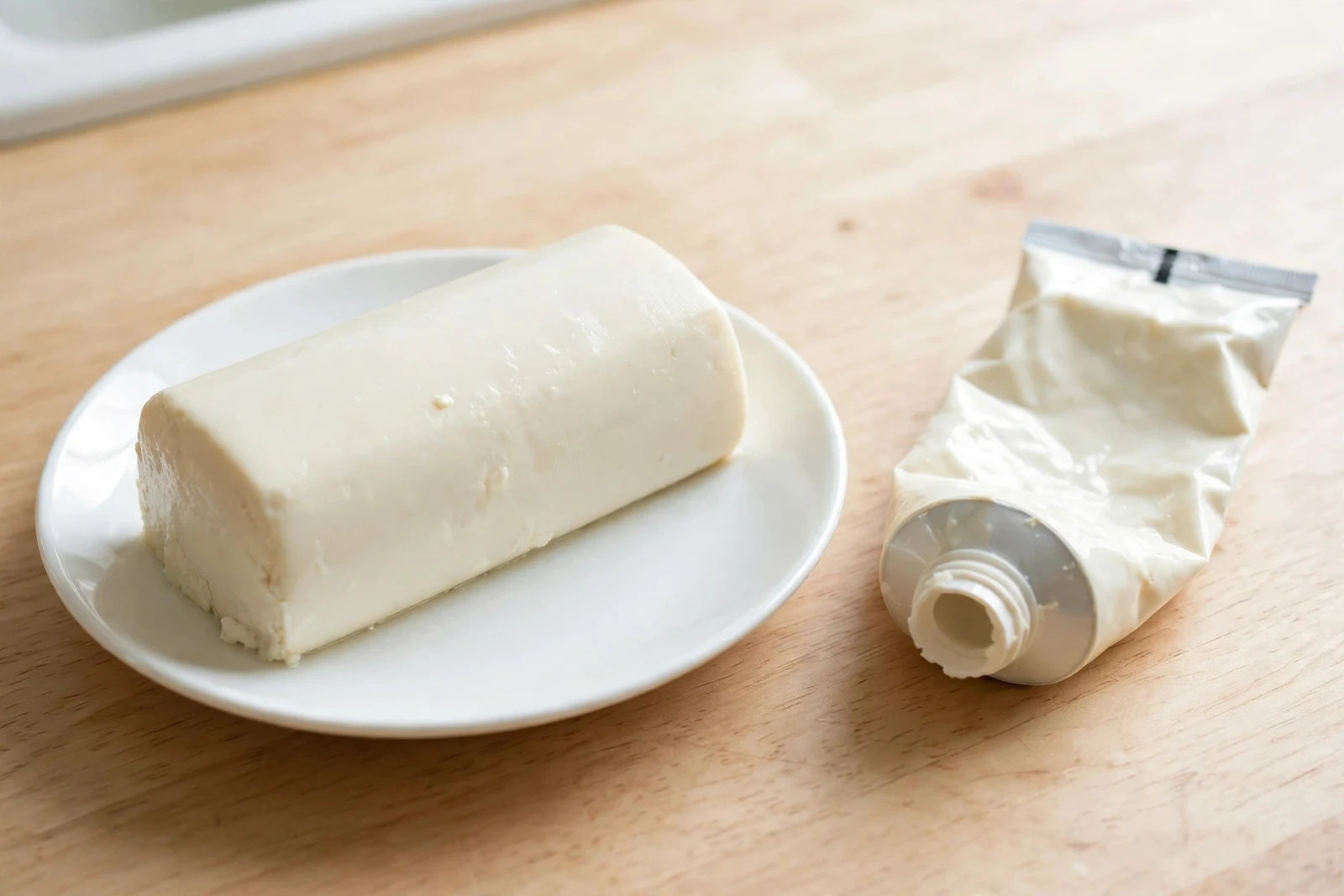
Sundubu jjigae (순두부찌개) is a Korean stew built around sundubu, extra-soft tofu that never gets pressed or curdled the way firm tofu does. It comes in tubes or tubs at Korean grocery stores, custard-soft and ready to eat. The stew itself is a spicy, savory broth made by blooming gochugaru (Korean chili flakes) in sesame oil, then simmering with anchovy-kelp stock, beef or seafood, and vegetables. At the table, the pot is still bubbling hard enough to cook a cracked egg on contact, and you eat it with rice to cool each spoonful down. The texture contrast is the draw: broth that bites back, tofu that barely holds together.
The Chili Bloom and the Three-Minute Tofu Rule
Two moments decide whether this stew sings or fails, and both are about timing.
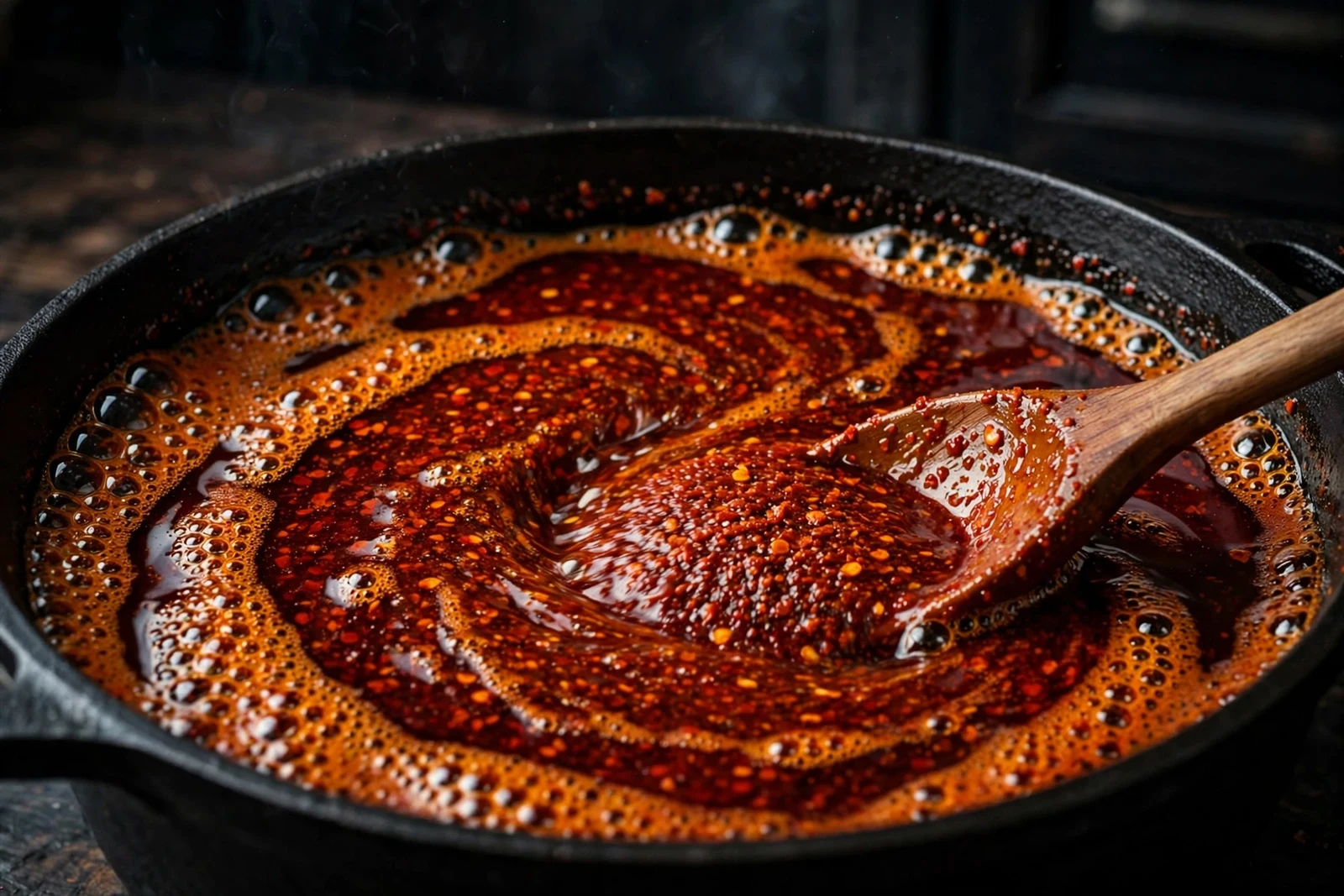
First, the chili bloom. Gochugaru goes into warm sesame oil over medium heat, and you stir it for 30 to 60 seconds until the flakes turn pasty and the oil glows red. Korean Bapsang warns that the flakes burn easily and tells you not to preheat the pot dry, and that warning is the recipe: a scorched bloom turns the whole broth bitter, and no amount of seasoning fixes it later. Maangchi's beef version mixes the flakes with sesame oil and pepper into a paste first, which gives you the same insurance. Either way, the rule is the same: flakes and oil go into the pot together, never flakes into a ripping-hot dry pot.
Second, the tofu. Sundubu is fragile. It goes in during the last 3 to 4 minutes, in big scoops, and the pot stays at a bare simmer after that, never a hard boil. Stir once or twice, gently, at the bottom of the pot so nothing catches, then stop. My baseline heat is 2 tablespoons of gochugaru per 2 cups of broth for a solid medium; adjust from there, but adjust the flakes, not the cooking time. The tofu is done when it trembles in the bubbling broth and a spoon slides through it like custard.
Ingredients
For the chili seasoning
- 2 tablespoons gochugaru (Korean chili flakes)
- 2 tablespoons toasted sesame oil
- 2 garlic cloves, minced
- 1/4 teaspoon ground black pepper
For the stew
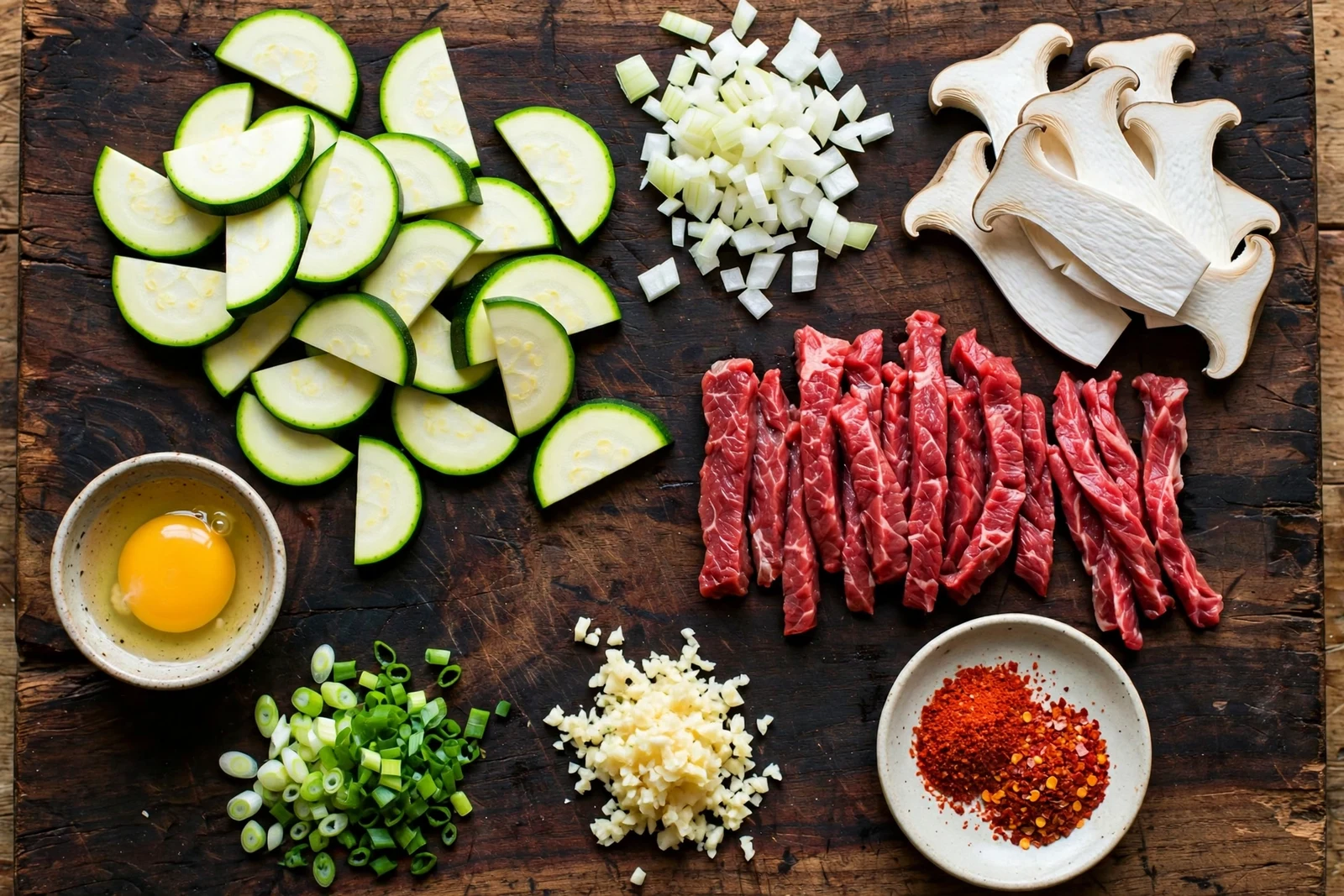
- 200 g (7 oz) thinly sliced beef (ribeye or sirloin)
- 1/2 small onion, diced
- 1/2 medium zucchini (about 150 g), cut into half-moons
- 100 g king oyster or oyster mushrooms, sliced
- 2 cups anchovy-kelp stock (or low-sodium chicken broth)
- 1 tablespoon fish sauce
- 1 teaspoon salt, plus more to taste
- 1/2 teaspoon sugar
For serving
- 2 large eggs
- 2 green onions, thinly sliced
- Cooked short-grain rice
How to Make Sundubu Jjigae
- Bloom the chili. Put the gochugaru, sesame oil, garlic, and black pepper in a small heavy pot over medium heat. Stir for 30 to 60 seconds until the flakes turn pasty and the oil glows red. Do not let the pot get ahead of you; scorched flakes taste bitter and there's no rescue.
- Brown the beef. Add the beef and onion to the pot. Stir-fry 2 to 3 minutes until the beef is mostly cooked and the onion softens at the edges, coating everything in the chili oil.
- Build the broth. Pour in the stock, fish sauce, salt, and sugar. Bring to a boil, then cover and cook 6 to 7 minutes over medium heat so the beef finishes and the broth picks up the chili color. Taste: it should be spicy, salty, and savory in balance, with the salt doing quiet work underneath.
- Add the vegetables. Stir in the zucchini and mushrooms. Boil 2 to 3 minutes until the zucchini turns translucent at the edges.
- Slide in the tofu. Cut the tofu tube in half and squeeze the sundubu into the pot in big scoops, or spoon it out of a tub. Lower the heat to a bare simmer. Give one or two gentle stirs at the bottom of the pot so nothing sticks, then leave it alone for 3 to 4 minutes until the broth is bubbling around the tofu again.
- Crack the eggs. Crack one egg per serving directly into the bubbling stew. Do not stir. Cook 1 to 2 minutes until the whites turn opaque and the yolks are still soft. Scatter the green onions over the top.
- Serve boiling. Bring the whole pot to the table on a trivet, or divide into heated earthenware bowls first and let them come back to a bubble before adding the eggs. Eat with rice and kimchi, and give every spoonful a few seconds to cool.
Troubleshooting: Fix My Sundubu Jjigae
Tofu that fell apart, a broth that tastes flat, chili that turned bitter, or an egg that came out rubbery: each one has a cause and a fix. Tell the tool what went wrong:
HERB & LIME · KITCHEN HELP
Fix My Sundubu Jjigae
Choose what went wrong to see a practical next step.
Possible cause
What to try next
For next time
From Paul's kitchen. Results vary with tofu brand, broth, and stove heat — adjust timing to your setup.
Quick reference (also works without JavaScript)
The tofu fell apart into mush
Cause: Sundubu is uncurdled and fragile — boiling it hard or stirring it around shreds it.
Try: For this pot, accept the texture and serve it as a rustic stew. Next time, add the tofu in big scoops during the last 3–4 minutes at a bare simmer.
Prevent: Never add tofu at a rolling boil. One or two gentle stirs at the bottom of the pot, then leave it alone.
The broth tastes flat
Cause: Plain water plus chili flakes that never bloomed in oil gives a thin, one-note broth.
Try: Stir in 1 teaspoon fish sauce and a pinch of sugar, then simmer 5 more minutes and taste again.
Prevent: Bloom the gochugaru in sesame oil first, and use anchovy-kelp stock instead of water for a deeper base.
The chili tastes bitter or scorched
Cause: Gochugaru burns in seconds when it hits a dry, preheated pot — the bitterness spreads through the whole broth.
Try: A badly scorched bloom cannot be saved: strain out the solids, start a fresh bloom in a clean pot, and rebuild the stew on it.
Prevent: Add the flakes and oil to the pot together over medium heat and stir 30–60 seconds. Never add flakes to a dry hot pot.
The bottom of the pot scorched
Cause: Sediment and tofu settle and catch on the hot bottom, especially in a dolsot, when the pot is never stirred underneath.
Try: If the broth tastes scorched, move everything to a clean pot — scorched flavor keeps spreading if you leave it.
Prevent: After the tofu goes in, give one or two gentle stirs along the bottom of the pot so nothing sticks.
The egg came out rubbery
Cause: The egg went in too early and boiled hard, overcooking the white and filming over the yolk.
Try: Fish out the overcooked egg. The stew is still fine — crack a fresh egg in at serving while it bubbles.
Prevent: Eggs go in last, into a barely simmering stew, and are never stirred. One to two minutes sets the white and keeps the yolk soft.
Sundubu Jjigae: Korean Soft Tofu Stew
Ingredients
Method
- Bloom the chili. Put the gochugaru, sesame oil, garlic, and black pepper in a small heavy pot over medium heat. Stir 30–60 seconds until the flakes turn pasty and the oil glows red. Do not let the pot get ahead of you — scorched flakes taste bitter and there is no rescue.
- Brown the beef. Add the beef and onion to the pot. Stir-fry 2–3 minutes until the beef is mostly cooked and the onion softens at the edges, coating everything in the chili oil.
- Build the broth. Pour in the stock, fish sauce, salt, and sugar. Bring to a boil, then cover and cook 6–7 minutes over medium heat so the beef finishes and the broth picks up the chili color. Taste: it should be spicy, salty, and savory in balance.
- Add the vegetables. Stir in the zucchini and mushrooms. Boil 2–3 minutes until the zucchini turns translucent at the edges.
- Slide in the tofu. Cut the tofu tube in half and squeeze the sundubu into the pot in big scoops. Lower the heat to a bare simmer. Give one or two gentle stirs at the bottom of the pot so nothing sticks, then leave it alone 3–4 minutes until the broth bubbles around the tofu again.
- Crack the eggs. Crack one egg per serving directly into the bubbling stew. Do not stir. Cook 1–2 minutes until the whites turn opaque and the yolks are still soft. Scatter the green onions over the top.
- Serve boiling. Bring the whole pot to the table on a trivet, or divide into heated earthenware bowls first and let them come back to a bubble before adding the eggs. Eat with rice and kimchi, giving every spoonful a few seconds to cool.
Notes
Paul’s Notes
- Real sundubu. Boxed silken tofu works in a pinch. The tube or tub labeled sundubu stays silkier because it was never pressed or fully curdled. If you only have silken, handle it even more gently and cut the final simmer to 2 minutes.
- The egg is a thermometer. If the whites take more than 2 minutes to set, your stew isn't hot enough; if the yolk films over in under a minute, the boil is too hard and the tofu is suffering too.
- Salt at the end, not the start. Broth reduces as it bubbles, and fish sauce plus salted stock can stack up fast. I season at step 3, then taste again right before the eggs go in.
- No anchovy stock? Low-sodium chicken broth plus a strip of kombu simmered for 10 minutes gets you most of the way there. Plain water works, but the stew will taste noticeably thinner; add half a teaspoon more fish sauce to compensate.
- Seafood swap: replace the beef with shrimp and clams, added with the vegetables; they're done when the clams open, about 3 minutes.
Variations
- Pork sundubu: swap the beef for thinly sliced pork shoulder; brown it a minute longer to render the fat.
- Kimchi sundubu: add 1/3 cup chopped sour kimchi with the beef for a tangier, deeper broth.
- Mushroom sundubu (vegetarian): skip the beef and fish sauce; double the mushrooms and use kombu-shiitake stock, seasoning with soup soy sauce instead.
- Milder: drop to 1 tablespoon of gochugaru and add it in two passes, tasting between them; the sugar stays the same since it rounds the heat rather than feeding it.
More Korean Recipes
If the bubbling pot won you over, the Korean shelf here runs deep: Kimchi Jjigae: Korean Kimchi Stew for the older, funkier cousin of this stew, Doenjang Jjigae: Korean Soybean Paste Stew for a mellow fermented-soybean pot, Pajeon: Korean Scallion Pancakes for the crisp pancake that belongs beside any jjigae, and Korean Bulgogi Chicken when you want the sweet-savory marinade instead of the chili heat. For the pantry behind all of it, my Gochujang vs Doubanjiang chili-paste guide sorts out which fermented heat goes where, and the Tofu Guide explains exactly what makes sundubu different from the silken block in the regular tofu aisle.