
Every October, my Thai basil dies outside and I start buying those sad supermarket bunches again, the ones with bruised leaves and no smell. A few years ago I kept one plant alive on the kitchen windowsill through the whole winter instead, and it changed how I cooked at home: fresh basil for pad thai, pho garnish, and summer rolls without a trip to the store.
Growing Thai basil indoors is not hard, but it is different from growing it in a summer garden. This plant is tropical. It wants heat and strong light, and it will tell you quickly when it is not getting enough. Give it light that actually reaches it, room for its roots, water when it asks for it, and a weekly pinch, and it will produce all winter.

Why indoor Thai basil fails (and it is almost always light)
Almost every indoor Thai basil death comes down to light. This is a plant that grows in full Southeast Asian sun, and a dim kitchen counter is about as far from that as it gets. In weak light, Thai basil does not simply grow slowly. It stretches. The stems get long and pale, the gaps between leaf pairs widen, and the leaves stay small. Gardeners call this getting leggy, and once a basil plant is fully leggy you cannot shrink it back. You can only cut it back and regrow it under better light.
Thai basil is not holy basil, and the difference matters when you buy a starter plant. Thai basil (Ocimum basilicum var. thyrsiflora) has purple stems and an anise-clove scent. Holy basil (O. tenuiflorum, the kaphrao of true pad kra pao) is peppery and completely different in the pan. In U.S. nurseries Thai basil is the one you will find, and it is exactly what our Thai basil chicken calls for. If a tag only says “basil,” smell it: anise means Thai. And if your plant is still small when a recipe calls for a big handful, our guide to Thai basil substitutes covers what to use instead.
Light: the whole game
A south- or west-facing window with at least six hours of direct sun is the simplest setup. Park the pot right on the sill, not a few feet away on the counter, because light falls off fast with distance. Turn the pot a quarter turn every few days so it grows evenly instead of leaning hard toward the glass.
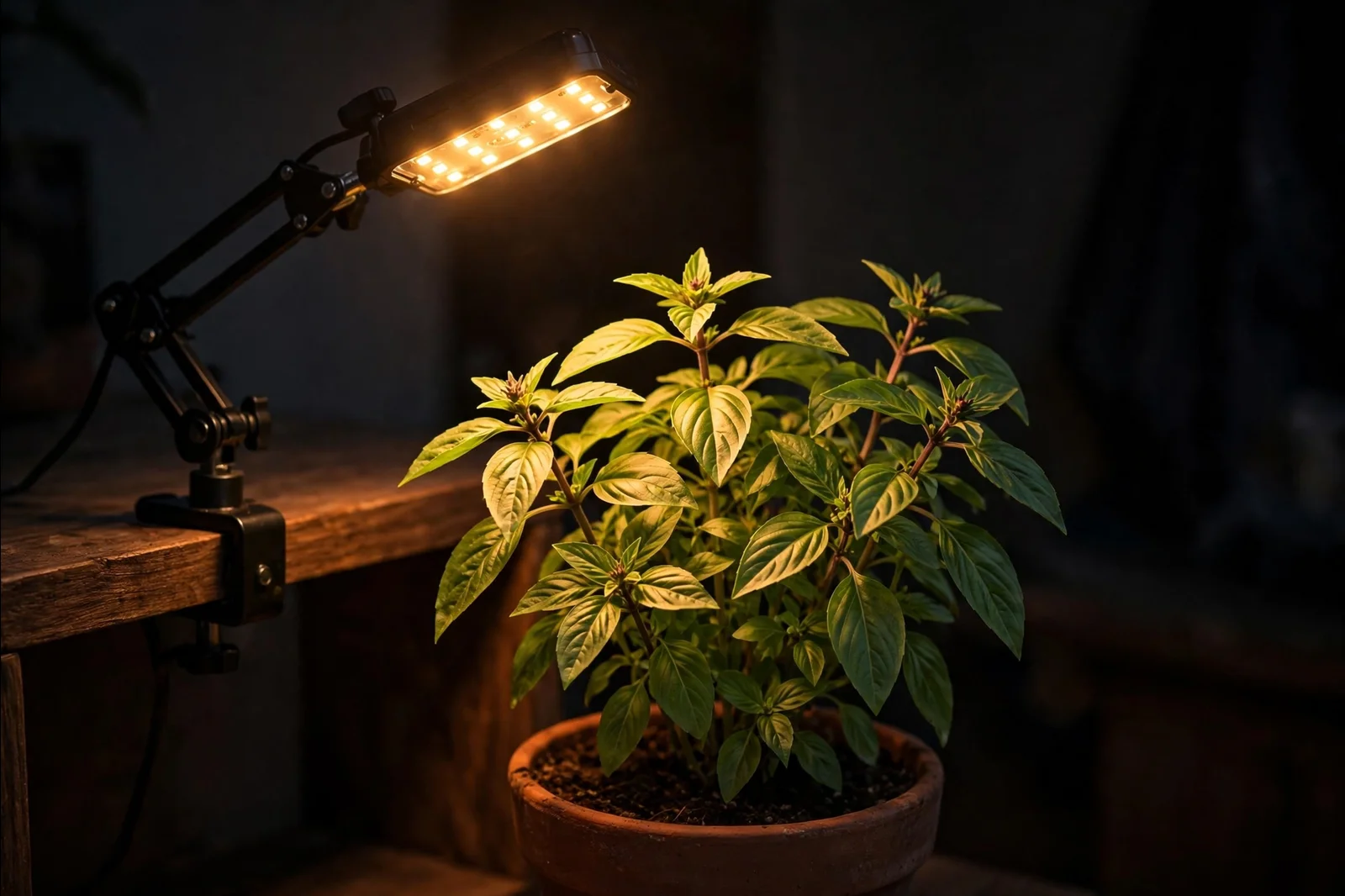
If your windows are small or face north, get a grow light. You do not need anything fancy: a basic full-spectrum LED grow bulb in a desk lamp, or a small LED panel, is enough for one herb. Run it 14 to 16 hours a day and keep it 6 to 12 inches above the top leaves, raising it as the plant grows. A cheap outlet timer takes the remembering out of it.
The plant tells you whether the light is enough. If the gaps between leaf pairs stretch past about two inches, the light is too weak or too far away. Move the lamp closer or add hours before the plant gets tall and floppy, because cutting a leggy stem back to the bottom pair of leaves is the only fix, and you lose weeks of growth that way.
The pot, the soil, and how to start
Give one plant an 8-inch pot or bigger with drainage holes. Thai basil grows 18 to 24 inches tall outdoors and it still wants root room indoors. In a cramped pot the roots circle, the leaves come in small, and no amount of fertilizer fixes it. Fill the pot with bagged potting mix, never garden soil. Garden soil compacts in a pot and drowns the roots.
The easy start is a nursery plant. The cheaper start is a cutting. Snip a healthy 4-inch stem just below a leaf node, strip off the lower leaves, and stand it in a glass of water on the sill. Roots show up in 7 to 10 days. When they are an inch long, pot the cutting up and water it in well. Two or three cuttings in one pot give you a fuller plant faster than a single stem.
Water and food, indoor rules
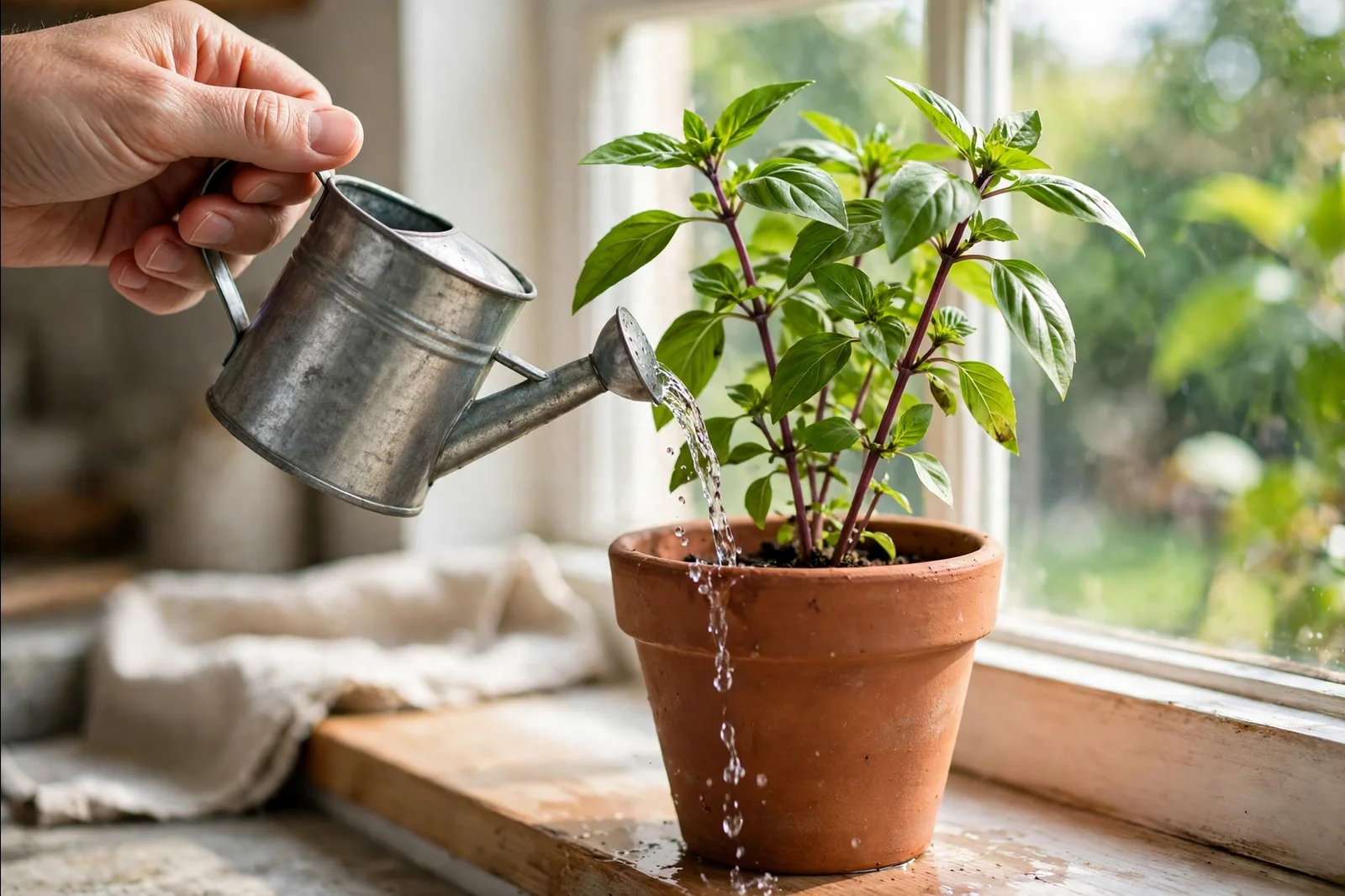
Indoor pots dry out slower than outdoor ones, so forget the calendar and check with a finger. Water when the top inch of soil feels dry, and water until it runs out the drainage holes. Little sips every day keep the surface wet while the roots stay dry, and that wet surface is what invites fungus gnats, the tiny flies that live in damp soil and are the classic complaint of indoor herb growers. If you see them, let the top of the soil dry out fully, water from the bottom for a while, and set out a yellow sticky trap. The gnats fade within a couple of weeks once the soil stops staying soggy.
Feed the plant once a month with half-strength balanced liquid fertilizer while it is actively growing. Full-strength fertilizer in a small indoor pot burns leaf edges, and a plant already dealing with low winter light does not need the extra push.
Pinch it every week or watch it bolt
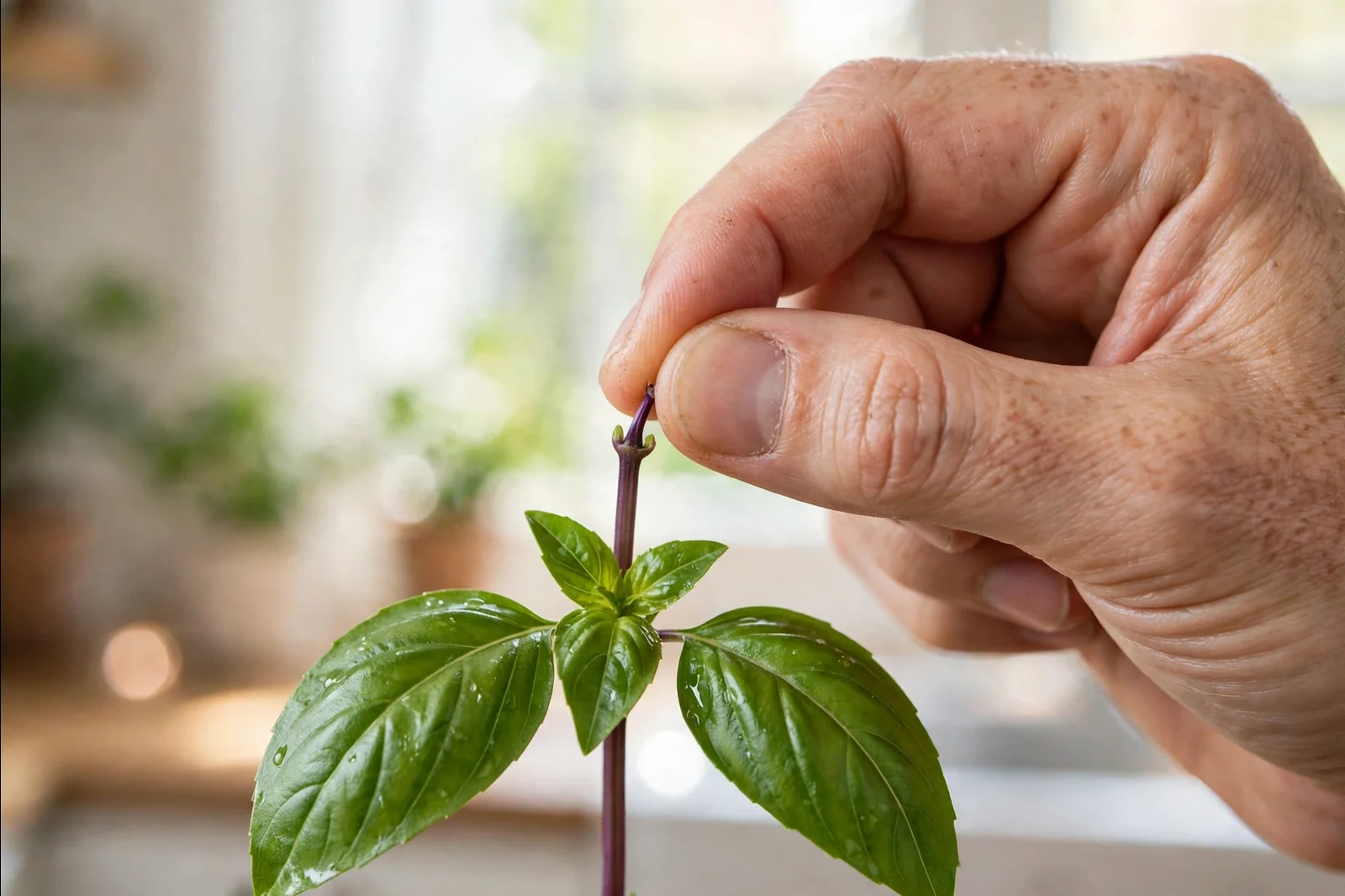
This is the weekly habit that makes or breaks an indoor plant. Pinch the tip of each stem just above a pair of leaves. Every pinch tells the plant to split into two stems, so a pinched plant turns into a bush and an unpinched one turns into a tall stick with leaves only at the top. Never take more than a third of the plant at once. It needs its leaves to keep making energy.
Pinch flower buds off the moment they appear. When Thai basil flowers, the leaves turn bitter and the plant puts its energy into seed instead of leaves. A plant that has fully flowered can be cut back hard and will usually regrow from lower nodes, but it is easier to never let the buds open.
Use what you pinch. The trimmings go straight into dinner: scattered over pad thai, tucked into summer rolls, or floated on pho. Fresh leaves lose their perfume fast in the fridge, so pick them at the last minute.
Heat and dry air
Thai basil likes the same temperatures you do. Sixty-five to 75 degrees is its happy range. The danger spot is a cold windowsill on winter nights: leaves that touch freezing glass turn black, and anything below about 50 degrees stalls the plant. On the coldest nights, pull the pot a few inches back from the glass. Keep it away from heat vents too. A blast of hot dry air dries the soil out in a day and crisps the leaf edges.
Dry indoor air also shows up as brown leaf edges. Group the basil with your other houseplants, or set the pot on a tray of pebbles with water in it, the pot sitting above the water and not in it, to lift the humidity right around the leaves.
Three mistakes that kill indoor Thai basil
The dark corner: keeping the pot on the kitchen counter a few feet from the window seems close enough, but it is not. Within two weeks the stems stretch and the leaves shrink. Fix it with a real windowsill or a grow light before you try anything else.
The daily sip: a little water every day keeps the top wet, the roots dry, and the gnats happy. Water deeply until it drains, then leave it alone until the top inch is dry again.
The open flower: one flower spike tells the plant it is done growing leaves. Pinch buds off early and the plant keeps making the part you actually want.
From the garden
After a winter of growing basil inside, the habit that sticks is the pinching. Once a week you walk past the plant with your fingers and come back with a handful of leaves, and the plant just gets bushier. It is the closest thing to a free ingredient a windowsill can give you.
More growing guides
When this plant is producing more than you can eat, the Vietnamese herb container garden plan shows how Thai basil fits into a full balcony lineup. For its indoor cousins, try growing pandan in pots, growing culantro at home, and growing perilla in pots.