
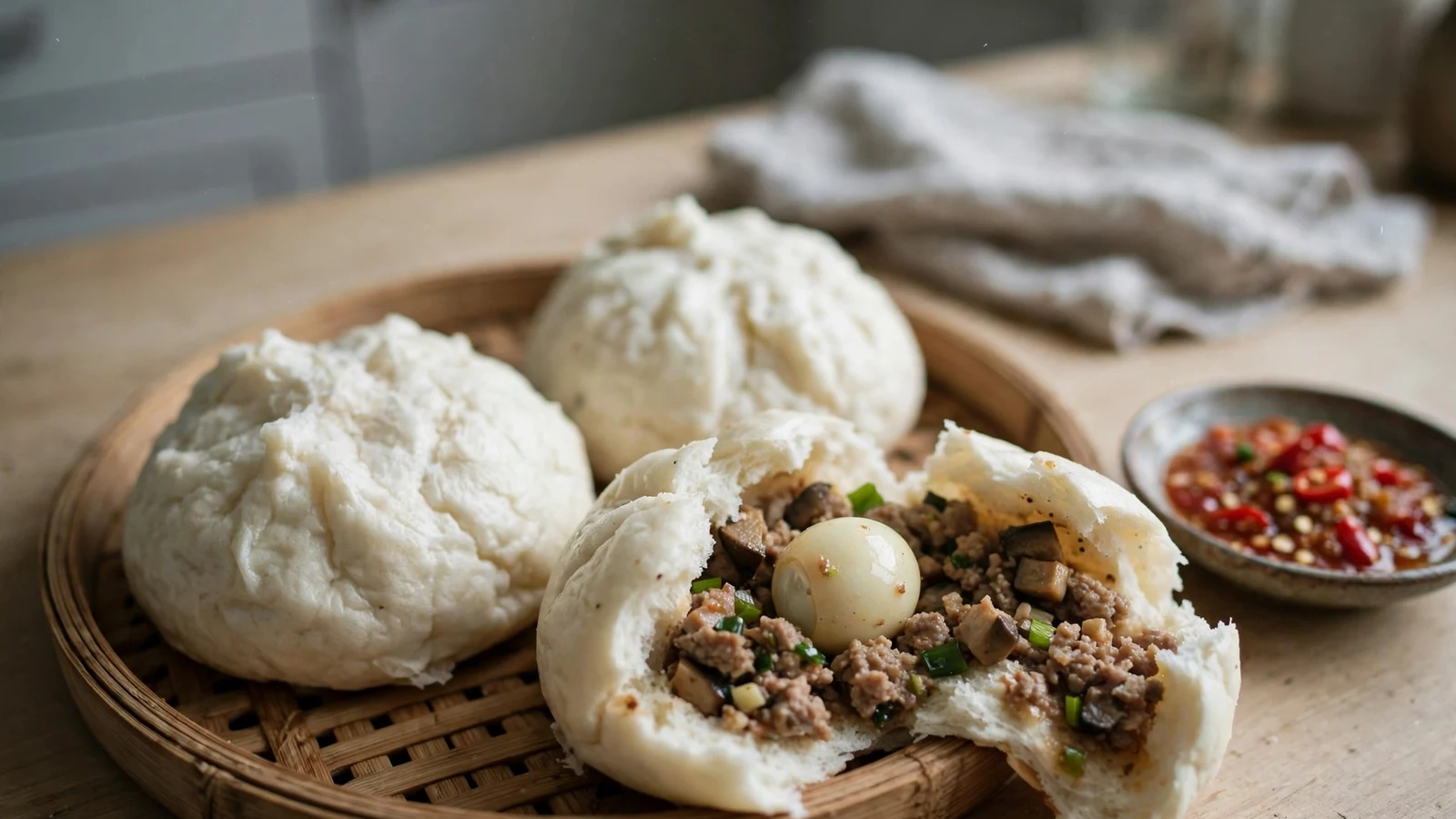
Banh bao is the bun Paul makes when a weekend afternoon can stretch around the dough: white steamed buns with a slightly sweet crumb, each one hiding a ball of seasoned pork, a slice of Chinese sausage, and a whole quail egg. The numbers are measured: 400 grams of flour to 50 grams of cornstarch, 180 ml of warm milk plus 60 ml of warm water, 7 grams of instant yeast, and 400 grams of ground pork for the filling. The recipe makes 8 buns, two to a serving for four people, and it takes about 65 minutes of active work plus a 90-minute rise.
What is banh bao?
Banh bao is a Vietnamese steamed bun with a savory filling sealed inside a soft yeast dough. The dough is lightly sweet and steams to a pale, tender crumb, and the filling is ground pork mixed with wood ear mushrooms, onion, and scallions, seasoned with fish sauce and soy sauce, with a whole quail egg and slices of lap xuong, Chinese sausage, tucked into the center. It is the bun you find at Vietnamese bakeries and street stalls, sold warm from a steamer and eaten by hand, often as breakfast or a midday snack. The closest cousin is the Chinese baozi, and our recipe for Chinese Steamed Pork Buns (Baozi) covers that version, but the two are not the same dish: banh bao uses fish sauce in the filling, adds the quail egg and Chinese sausage as a matter of course, and is usually made larger, one bun to a meal rather than several to a basket. The dough here also carries cornstarch, which keeps the crumb soft instead of bready. Our guide to How to Use a Bamboo Steamer covers the steamer setup this recipe uses, and why bamboo beats a metal lid for steamed buns.
Ingredients
For the dough
- 3 1/4 cups all-purpose flour (400 g), plus a little extra for dusting
- 6 tablespoons cornstarch (50 g)
- 1/4 cup sugar (50 g)
- 2 1/4 teaspoons instant yeast (7 g)
- 1 teaspoon baking powder
- 1/2 teaspoon sea salt
- 3/4 cup warm whole milk (180 ml), about 40°C (105°F)
- 1/4 cup warm water (60 ml)
- 1 tablespoon neutral oil, plus a little more for the bowl
For the filling
- 14 ounces ground pork (400 g)
- 8 quail eggs, boiled and peeled
- 1 Chinese sausage (lap xuong, about 60 g), thinly sliced
- 1 ounce dried wood ear mushrooms (25 g), soaked 20 minutes and finely chopped
- 1 small onion, finely chopped
- 2 scallions, finely chopped
- 1 tablespoon fish sauce
- 1 tablespoon soy sauce
- 1 teaspoon sugar
- 1/2 teaspoon ground black pepper
- 1 teaspoon cornstarch
- 1 teaspoon toasted sesame oil
For steaming
- 8 small squares of parchment paper
- Chili sauce, for serving (optional)
How to make it
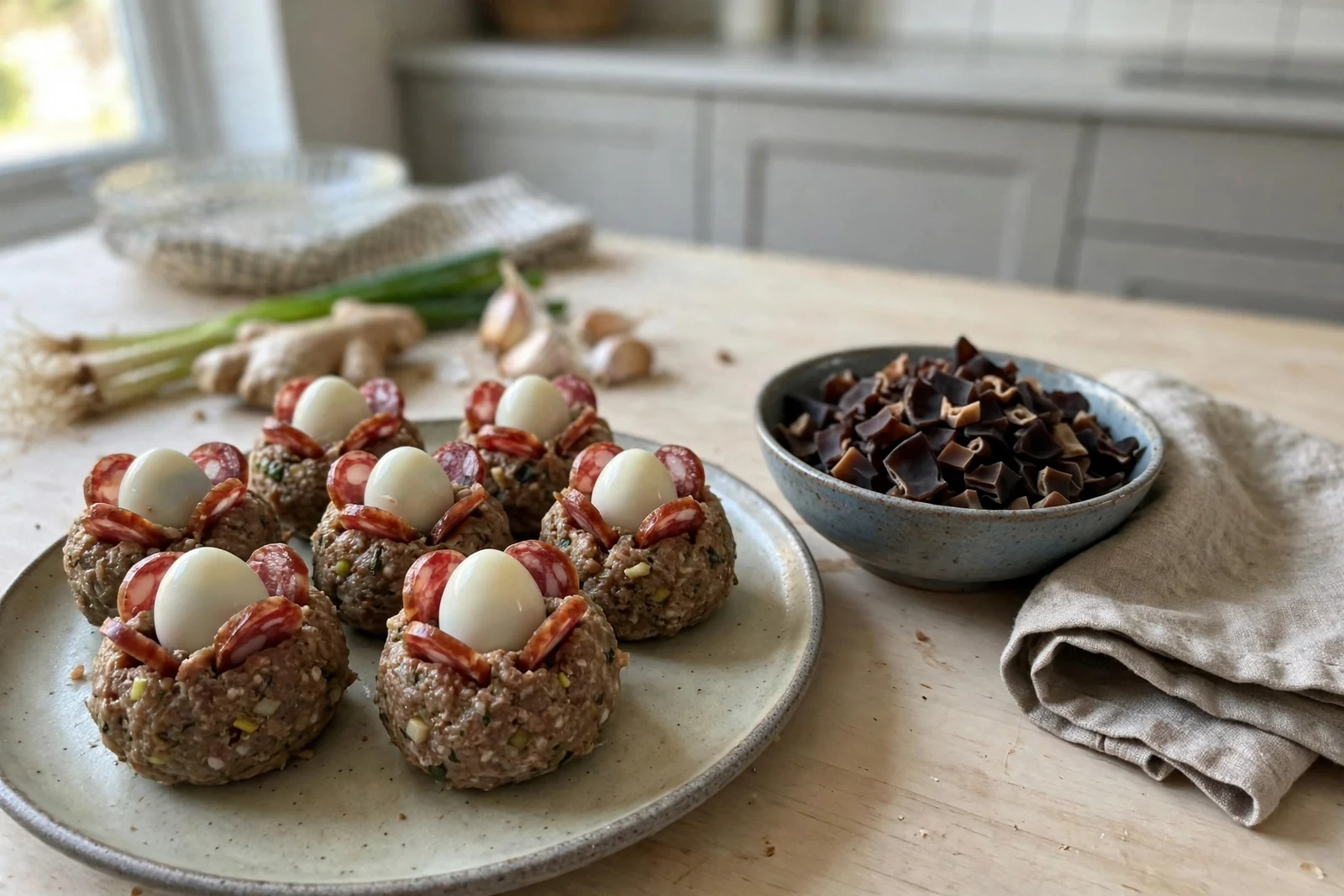
Start with the quail eggs and the filling. Boil the quail eggs for 4 minutes, cool them under running water, and peel them. Soak the wood ear mushrooms in warm water for 20 minutes, until soft, then drain and chop them fine. Put the ground pork in a bowl with the onion, scallions, wood ear mushrooms, fish sauce, soy sauce, sugar, black pepper, cornstarch, and sesame oil, and mix with your hands until the mixture turns pasty and holds together. Divide it into 8 balls, about 80 grams each, flatten each one in your palm, set a quail egg in the center with a few slices of sausage, and fold the pork around them. Roll each ball smooth and chill them in the fridge while you make the dough, so the filling holds its shape when you wrap it.
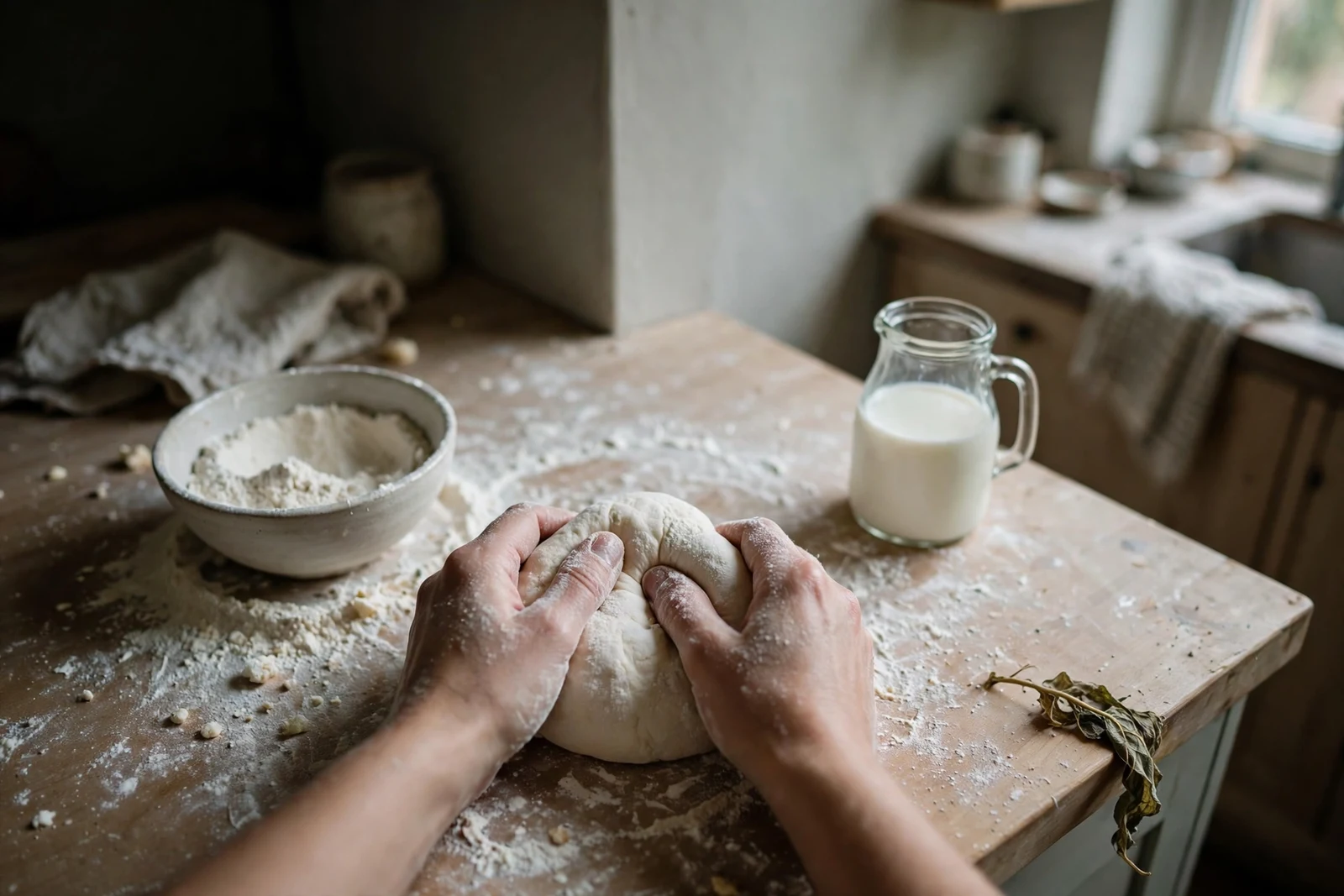
Make the dough next. Stir the yeast and a pinch of the sugar into the warm milk and water, and wait 5 to 10 minutes, until the surface turns foamy. If it does not foam, the yeast is dead or the milk was too hot, and you need fresh yeast before you go on. In a large bowl, whisk the flour, cornstarch, remaining sugar, baking powder, and salt together, then pour in the yeast mixture and the oil. Stir until a shaggy dough forms, turn it out, and knead for 8 to 10 minutes, until it is smooth, soft, and springs back when you press it. The dough should feel like a soft earlobe, not sticky and not stiff. Put it in a lightly oiled bowl, cover with a damp cloth, and let it rise in a warm spot for 1 to 1 1/2 hours, until it has doubled in size.
Shape the buns one at a time. Punch the dough down and knead it for 1 to 2 minutes to push out the large air bubbles, which is what leaves the finished buns smooth instead of pocked. Divide the dough into 8 pieces, about 95 grams each, and roll each one into a ball. Flatten a ball into a disc in your palm, keeping the center a little thicker than the edges, and set a filling ball in the middle. Gather the edges up around the filling, pinch the seam shut, and twist it closed, then roll the bun gently between your palms until it is smooth. Set each bun seam side down on a square of parchment paper, and keep the shaped buns covered with a damp cloth while you work, or the surface dries out before they reach the steamer.
Give the buns a second rise of 20 to 30 minutes, until they look puffy and feel light, about 1 1/2 times their shaped size. Do not let them double: over-proofed buns spread wide in the steamer and wrinkle as they cool. The poke test tells you when they are ready: press a floured finger gently into the dough, and if the dent springs back slowly and only partway, the bun is ready to steam. If it springs back fast and fully, give it more time. If it does not spring back at all, the dough has gone too far, and the batch will still steam, but the buns will come out flat.
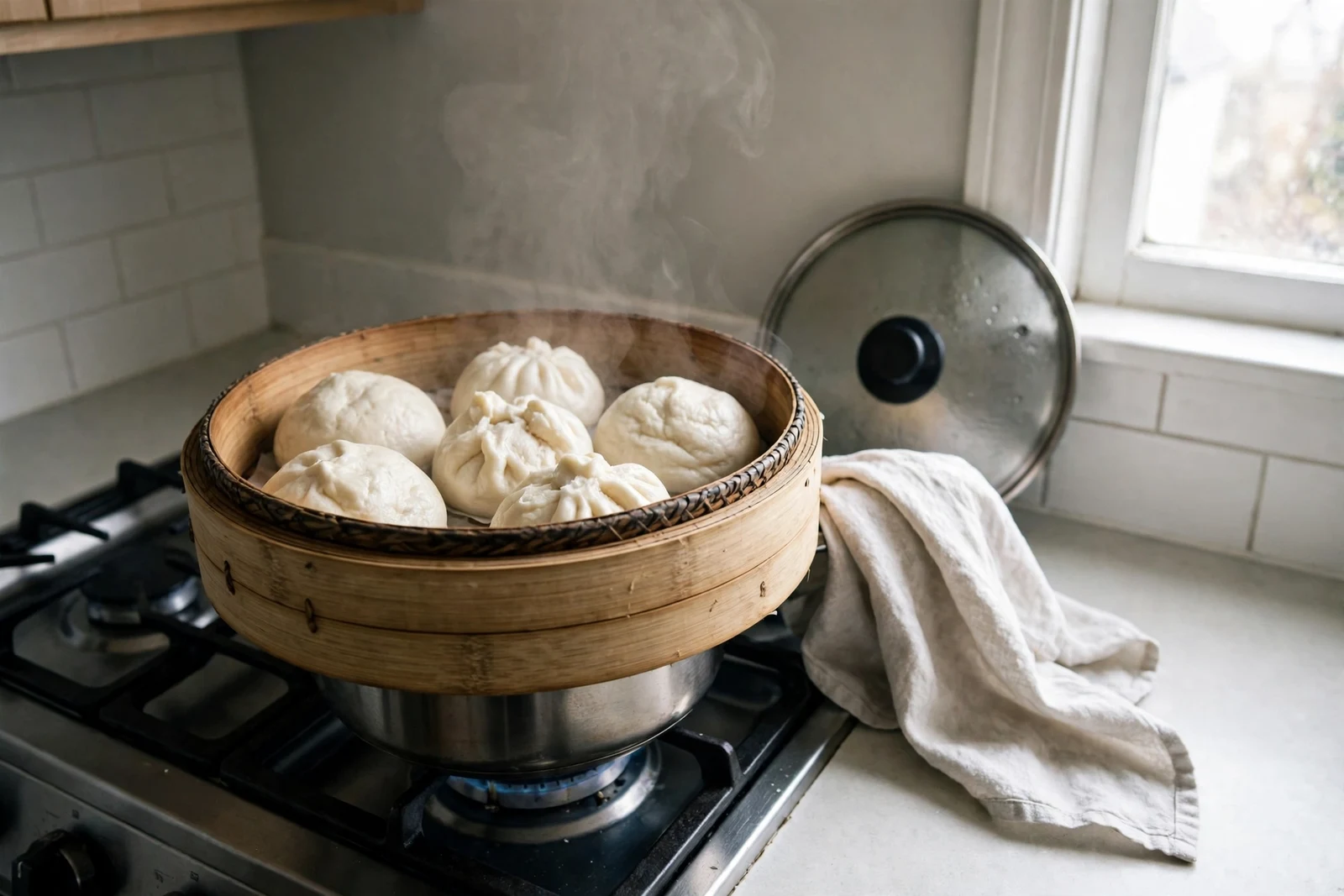
Set up the steamer with the water at a boil, load the buns with room to grow, and steam over medium heat for 25 minutes. Do not lift the lid to peek: the rush of cool air drops the buns, and they do not recover. High heat throws rough steam and water drops at the buns and wrinkles the skin, so keep the heat steady at medium, with the steam flowing evenly. When the time is up, turn off the heat and leave the lid on for 5 minutes, so the buns cool a little in the steamer and hold their shape. Lift the lid slowly, away from your face, and serve the buns warm, with chili sauce on the side if you like. Leftover buns keep in the fridge for 2 days and re-steam in 8 minutes, and they freeze well for a month: steam from frozen for 15 minutes.
Troubleshooting: Fix My Banh Bao
Most banh bao problems come from the yeast, the proof, or the steam. Pick the problem that matches your batch below for a practical next step.
HERB & LIME · KITCHEN HELP
Fix My Banh Bao
Choose what went wrong to see a practical next step.
Possible cause
What to try next
For next time
From Paul's kitchen. Results vary with flour, yeast, and stove heat, adjust timing to your setup.
Quick reference (also works without JavaScript)
The dough did not rise
Cause: The yeast was dead, or the milk was too hot and killed it, or the room was too cold for the dough to grow.
Try: Bloom the yeast first in warm milk with a pinch of sugar, and if it does not foam in 10 minutes, throw it out and start over with fresh yeast.
Prevent: Keep the milk at 40 to 46C, warm enough to hold your finger in comfortably, and let the dough rise in a warm spot until it doubles.
The buns collapsed or wrinkled after steaming
Cause: The lid came off too soon and cold air hit the hot buns, or the dough was over-proofed before steaming.
Try: There is no fix for a collapsed batch, but the buns are still fine to eat, so serve them warm and use the rest below on the next batch.
Prevent: Let the shaped buns rise only until they are about 1 1/2 times their size, steam on medium heat, and leave the lid on for 5 minutes after turning off the heat.
The buns came out dense and tough
Cause: The flour had too much protein, the dough was over-kneaded, or it was under-proofed and never fully doubled.
Try: Give the next batch the full first rise until the dough doubles, and use the poke test before shaping.
Prevent: Use all-purpose flour under 11 percent protein mixed with cornstarch, and knead only until the dough is smooth and springs back.
The buns turned yellow or got yellow spots
Cause: Too much baking powder went in, or the baking powder was not mixed evenly into the flour.
Try: Nothing fixes a yellow batch, but the buns are still safe to eat, so serve them and measure carefully next time.
Prevent: Measure the baking powder level, whisk it into the flour before adding any liquid, and never use self-raising flour in its place.
Wet patches or dimples on the bun surface
Cause: Condensation from a metal steamer lid dripped onto the buns while they steamed.
Try: Blot a wet patch gently with a clean cloth and serve the buns anyway, the flavor is unchanged.
Prevent: Wrap a metal lid in a clean tea towel tied well away from the flame, or steam in a bamboo steamer, which absorbs the drips.
Banh Bao: Vietnamese Steamed Pork Buns
Ingredients
Method
- Boil the quail eggs for 4 minutes, cool them under running water, and peel them. Soak the wood ear mushrooms in warm water for 20 minutes, until soft, then drain and chop them fine.
- Put the ground pork in a bowl with the onion, scallions, wood ear mushrooms, fish sauce, soy sauce, sugar, black pepper, cornstarch, and sesame oil, and mix with your hands until the mixture turns pasty and holds together. Divide it into 8 balls, about 80 grams each, flatten each one in your palm, set a quail egg in the center with a few slices of sausage, and fold the pork around them. Roll each ball smooth and chill them in the fridge while you make the dough.
- Stir the yeast and a pinch of the sugar into the warm milk and water, and wait 5 to 10 minutes, until the surface turns foamy. If it does not foam, the yeast is dead or the milk was too hot, so start over with fresh yeast.
- In a large bowl, whisk the flour, cornstarch, remaining sugar, baking powder, and salt together, then pour in the yeast mixture and the oil. Stir until a shaggy dough forms, turn it out, and knead for 8 to 10 minutes, until it is smooth, soft, and springs back when you press it. Put it in a lightly oiled bowl, cover with a damp cloth, and let it rise in a warm spot for 1 to 1 1/2 hours, until it has doubled in size.
- Punch the dough down and knead it for 1 to 2 minutes to push out the large air bubbles. Divide the dough into 8 pieces, about 95 grams each, and roll each one into a ball. Flatten a ball into a disc in your palm, keeping the center a little thicker than the edges, and set a filling ball in the middle. Gather the edges up around the filling, pinch the seam shut, and twist it closed, then roll the bun gently between your palms until it is smooth. Set each bun seam side down on a square of parchment paper, and keep the shaped buns covered with a damp cloth while you work.
- Give the buns a second rise of 20 to 30 minutes, until they look puffy and feel light, about 1 1/2 times their shaped size. Do not let them double. The poke test tells you when they are ready: press a floured finger gently into the dough, and if the dent springs back slowly and only partway, the bun is ready to steam.
- Set up the steamer with the water at a boil, load the buns with room to grow, and steam over medium heat for 25 minutes. Do not lift the lid to peek. When the time is up, turn off the heat and leave the lid on for 5 minutes, so the buns cool a little in the steamer and hold their shape. Lift the lid slowly and serve the buns warm, with chili sauce on the side if you like.
Notes
More Vietnamese recipes
Four more from the same shelf: Banh Xeo: Vietnamese Crispy Crepes with Shrimp and Pork is the crisp crepe to make when you want something fried and folded at the table; Com Tam: Vietnamese Broken Rice with Grilled Pork is the rice plate to make when you want grilled pork and nuoc cham; Pho Ga: Vietnamese Chicken Noodle Soup is the soup to make when you want a clear broth and shredded chicken; and Cha Gio: Crispy Vietnamese Fried Spring Rolls is the fried roll to make when you want crunch with the same pork filling family. For the rice on the side, our guide to How to Cook Perfect Jasmine Rice Every Time covers the pot that goes with all of them.
From the garden
The scallions in the filling come from a pot by the back door, cut fresh the morning the buns are made, and that matters more than it sounds: a scallion cut an hour before cooking is still crisp and bright, while one that has sat in the fridge for a week goes limp and dull in the filling. Our guide to growing green onions in pots covers how to keep a pot going so there is always a bunch to cut.
From Paul’s kitchen.