
Salt and pepper pork chops are a dry dish, not a sauced one. The pork is cut small, fried until crisp, and tossed while hot with garlic, chili, and scallions, so the seasoning clings to the crust instead of pooling under it. The whole trick is timing: a first fry to cook the pork through, a short second fry to drive off surface oil, and a fast toss that stops before the garlic turns.

What is salt and pepper pork chops?
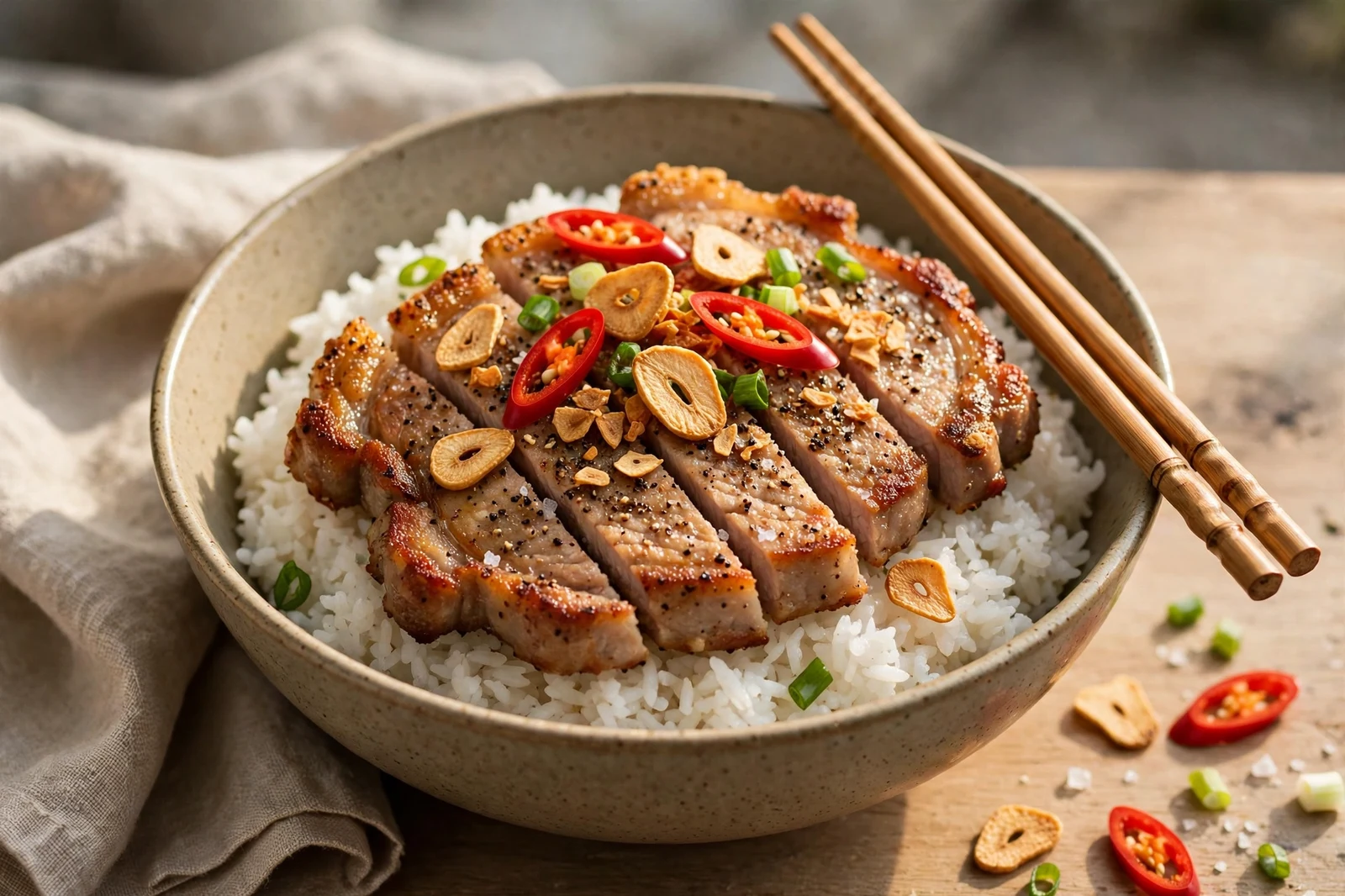
Salt and pepper pork chops are a Cantonese restaurant dish built on a simple seasoning mix of salt, white pepper, and a pinch of sugar. The pork is cut into bite-size pieces, coated in cornstarch, and fried, then tossed in a wok with sliced garlic, red chili, and scallions. There is no sauce to hide behind, so the fry has to be right: the crust stays dry and crisp, the pork inside stays juicy, and the aromatics stay fragrant instead of burnt.
Cut the chops into 1-inch pieces
Start with 2 pounds of bone-in pork chops, about 1 inch thick. Use a heavy knife or a cleaver and cut each chop into pieces about 1 inch across, cutting between the bones where you can. Pieces this size fry evenly in 4 to 5 minutes, and they are small enough to eat with chopsticks without a knife at the table.

Cutting small also fixes the most common problem with this dish, uneven cooking. A whole chop fried in a wok cooks fast on the outside and slow near the bone. Cut pieces have no thick center to lag behind, so every piece reaches the same point at the same time.
Marinate, then coat in cornstarch
Toss the pork pieces with 1 tablespoon soy sauce, 1 tablespoon Shaoxing wine, 1 teaspoon sugar, 1/2 teaspoon white pepper, 1 egg white, and 1 tablespoon cornstarch. Let the bowl sit for 20 minutes. The egg white and cornstarch form a thin coat that holds the seasoning on the meat and gives the outer starch something to grip.
After the marinade, dredge the pieces in 1 cup cornstarch and shake off the excess. The ratio I use is 1 cup cornstarch for 2 pounds of pork. Less starch leaves bare spots that fry up soft. More starch, or starch left thick on the pieces, turns pasty in the oil. Shake each piece well, and let the coated pork sit for 5 minutes before frying so the coat sets.
Fry twice, in batches
Heat 4 cups neutral oil in a wok or deep pot to 350 degrees F. Fry the pork in batches, with room between the pieces, for 4 to 5 minutes per batch, until golden. Lift each batch out with a spider strainer and drain it on a wire rack, not on paper towels, so steam does not soften the underside.

Once all the pork is fried, raise the oil heat and fry the pieces a second time for 30 seconds. The second fry is the step that keeps the crust crisp after tossing. On the first fry the surface still holds moisture. On the second fry, with the surface already dry, the crust firms up and shakes off extra oil. Drain the pork again on the rack.
Toss with garlic, chili, and scallions
Heat 1 tablespoon oil in a clean wok over medium heat. Add 4 sliced garlic cloves and 2 sliced red chilies and stir-fry for 30 seconds only, until the garlic smells fragrant. Garlic goes from fragrant to bitter fast in a hot wok, and 30 seconds is the line I use. Past that point it browns, and browned garlic will flavor the whole plate.
Add the fried pork and 4 scallions cut into 1-inch pieces. Sprinkle over 1 teaspoon salt, 3/4 teaspoon white pepper, and 1/2 teaspoon sugar, a little at a time, tossing between additions so the seasoning lands evenly. Toss for 30 seconds more, then take the wok off the heat. The pork should come out dry, speckled with garlic and chili, and ready to eat at once.
What to serve with it
Steamed rice is the partner that makes sense here. Our guide to cooking jasmine rice gives the plain, steamed pot that lets the salty, peppery pork stand out. For a second dish in the same seasoning family, our salt and pepper shrimp uses the same garlic and chili toss on shrimp, and Sichuan dry-fried green beans add a green, savory side to the same table.
Tips and variations
- Boneless chops work, but cut the first fry to 3 to 4 minutes, since boneless pieces cook faster and dry out sooner.
- Potato starch can replace half the cornstarch for a slightly harder crust. Use 1/2 cup cornstarch and 1/2 cup potato starch for the coating.
- For a milder plate, use 1 chili instead of 2, and leave the seeds out. The garlic and white pepper still carry the dish.
- Leftovers keep in the fridge for 2 days. Reheat them on a wire rack in a 350 degree F oven for about 10 minutes. A microwave turns the crust soft, so skip it.
- If the pork is done but the crust looks pale, the oil was too cool. Let the oil come back to 350 degrees F between batches, and fry fewer pieces at a time.
Troubleshooting: Fix My Salt and Pepper Pork Chops
Even a short fry has a few ways to go wrong. The section below covers the most common ones, with a practical fix for each.
HERB & LIME · KITCHEN HELP
Fix My Salt and Pepper Pork Chops
Choose what went wrong to see a practical next step.
Possible cause
What to try next
For next time
From Paul's kitchen. Results vary with pork size, oil, and stove heat, adjust timing to your setup.
Quick reference (also works without JavaScript)
The coating came out soggy
Cause: The oil was too cool, the pan was crowded, or the pork went in wet, so the coating steamed instead of crisping.
Try: Fry the pieces a second time for 30 seconds at higher heat, drain them on a wire rack, and serve at once.
Prevent: Pat the pork dry before coating, hold the oil at 350 degrees F, and fry in batches with room between pieces.
The pork turned dry and tough
Cause: The pork cooked past its done point, and lean pork dries out fast once it passes 145 degrees F.
Try: Slice the cooked pork thin across the grain and serve it over rice with the pan aromatics, which softens each bite.
Prevent: Use 1-inch pieces, pull the pork at 4 to 5 minutes per batch, and check the thickest piece with a thermometer instead of frying longer to be safe.
The coating fell off in the oil
Cause: Loose starch or a coat that had no time to set washed off as soon as the pork hit the oil.
Try: For the next batch, shake off all excess starch and let the coated pork sit for 5 minutes before frying.
Prevent: Dredge each piece once, shake it well, and let the coat set before the pork goes into the oil.
The garlic tastes bitter
Cause: The garlic stayed in the hot wok too long and browned, which turns its flavor bitter.
Try: Start the toss again with fresh sliced garlic, stir-fried for 30 seconds only, and toss the pork through it off the heat.
Prevent: Add the garlic and chilies to medium heat oil for 30 seconds only, and have the pork and seasoning ready before the garlic goes in.
The seasoning tastes bland or uneven
Cause: The salt and pepper went on in one dump, so some pieces got most of it and others got almost none.
Try: Sprinkle the remaining seasoning over the hot pork a little at a time, tossing between additions, and taste one piece before serving.
Prevent: Season in layers, salt in the marinade and again in the toss, and sprinkle the toss seasoning gradually while tossing.
Salt and Pepper Pork Chops
Ingredients
Method
- Cut the pork: cut the bone-in pork chops into pieces about 1 inch across, cutting between the bones where you can. Pat the pieces dry.
- Marinate: toss the pork with the soy sauce, Shaoxing wine, sugar, white pepper, egg white, and 1 tablespoon cornstarch. Let the bowl sit for 20 minutes.
- Coat: dredge the pork pieces in 1 cup cornstarch and shake off the excess. Let the coated pork sit for 5 minutes so the coat sets.
- Fry twice: heat 4 cups neutral oil to 350 degrees F. Fry the pork in batches for 4 to 5 minutes per batch, until golden, and drain on a wire rack. Raise the oil heat and fry all the pieces a second time for 30 seconds, then drain again on the rack.
- Toss: heat 1 tablespoon oil in a clean wok over medium heat. Add the garlic and chilies and stir-fry for 30 seconds only, until fragrant. Add the fried pork and scallions, sprinkle over the salt, white pepper, and sugar a little at a time, and toss for 30 seconds more.
- Serve: spoon the pork over steamed white rice and serve right away.
Notes
More Chinese recipes
Salt and Pepper Shrimp, Salt and Pepper Squid, Salt and Pepper Tofu, and Cantonese Soy Sauce Chow Mein.
From the garden
Scallions are the one ingredient here that can come from a pot by the kitchen door, and they go in last, so a fresh-cut bunch stays bright and sharp against the fried pork. Our guide to growing green onions in pots covers starting from store-bought bases, which is the fastest way to keep a steady supply for tosses like this one.