
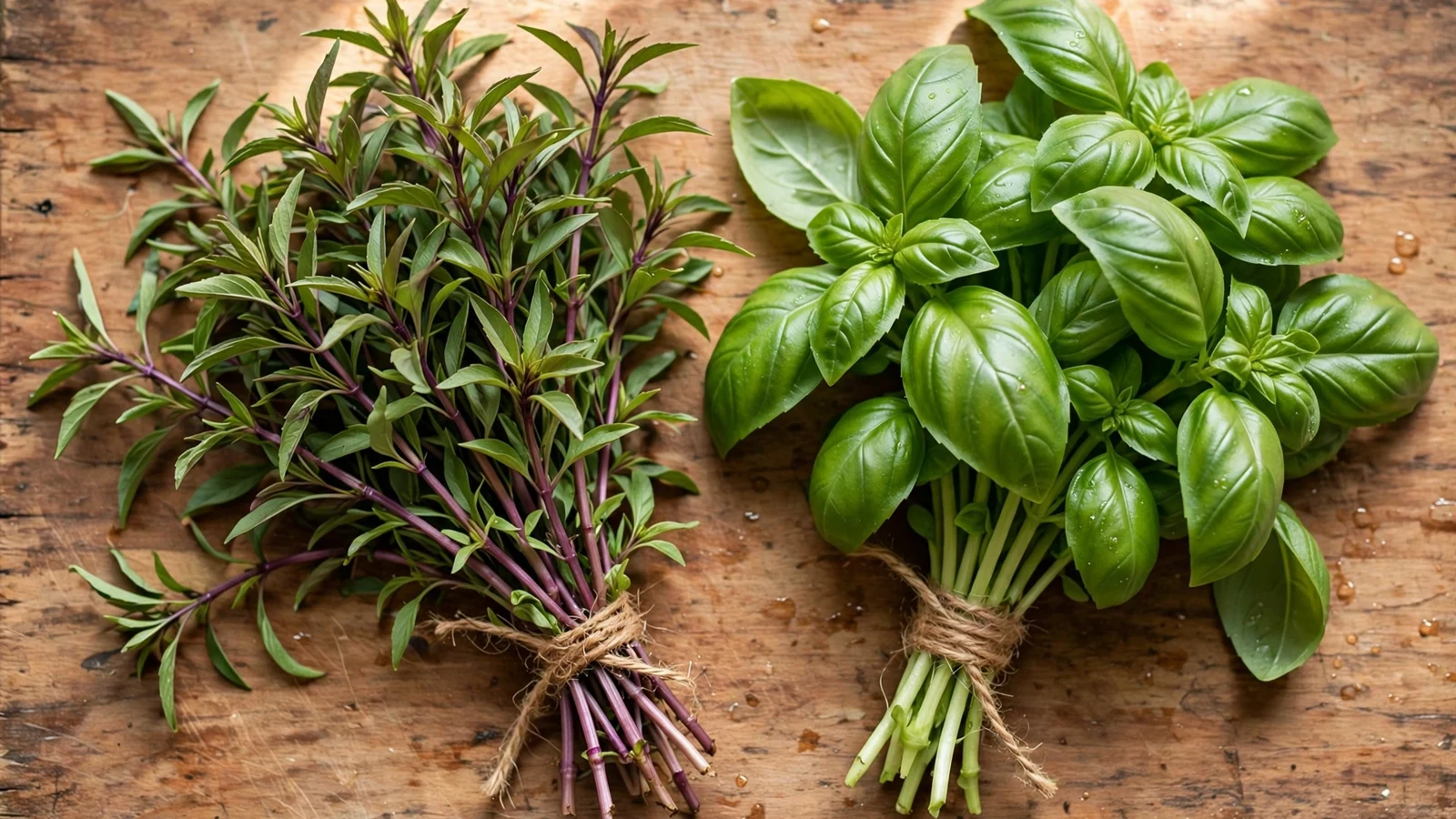
Two basils sit side by side at the market, and they look like cousins who grew up in different countries. One has purple stems and narrow, pointed leaves. The other is all soft green, with broad leaves that cup upward. They share a genus and almost nothing else at the table.
Getting the right one matters more than most herb swaps, because each basil carries a different set of aromatic compounds, handles heat differently, and belongs to a different group of dishes. This guide compares them head to head, then gives a straight verdict for the dishes where people actually swap them.
The Quick Verdict
- Reach for Thai basil when the dish is Southeast Asian, cooked hot, or built on coconut milk, chili, fish sauce, or lime. Its anise edge stands up to all of them.
- Reach for Italian (Genovese) basil when the dish is Mediterranean, tomato-based, or finished raw. Its sweet clove flavor is the whole point of pesto and caprese.
- Swap only with adjustments. Cup for cup the amounts translate, but the flavor direction changes, and one small addition (a pinch of anise character on one side, a squeeze of lemon on the other) closes most of the gap.
Thai Basil vs Italian Basil at a Glance
| Detail | Thai Basil | Italian (Genovese) Basil |
|---|---|---|
| Botanical name | Ocimum basilicum var. thyrsiflora | Ocimum basilicum 'Genovese' |
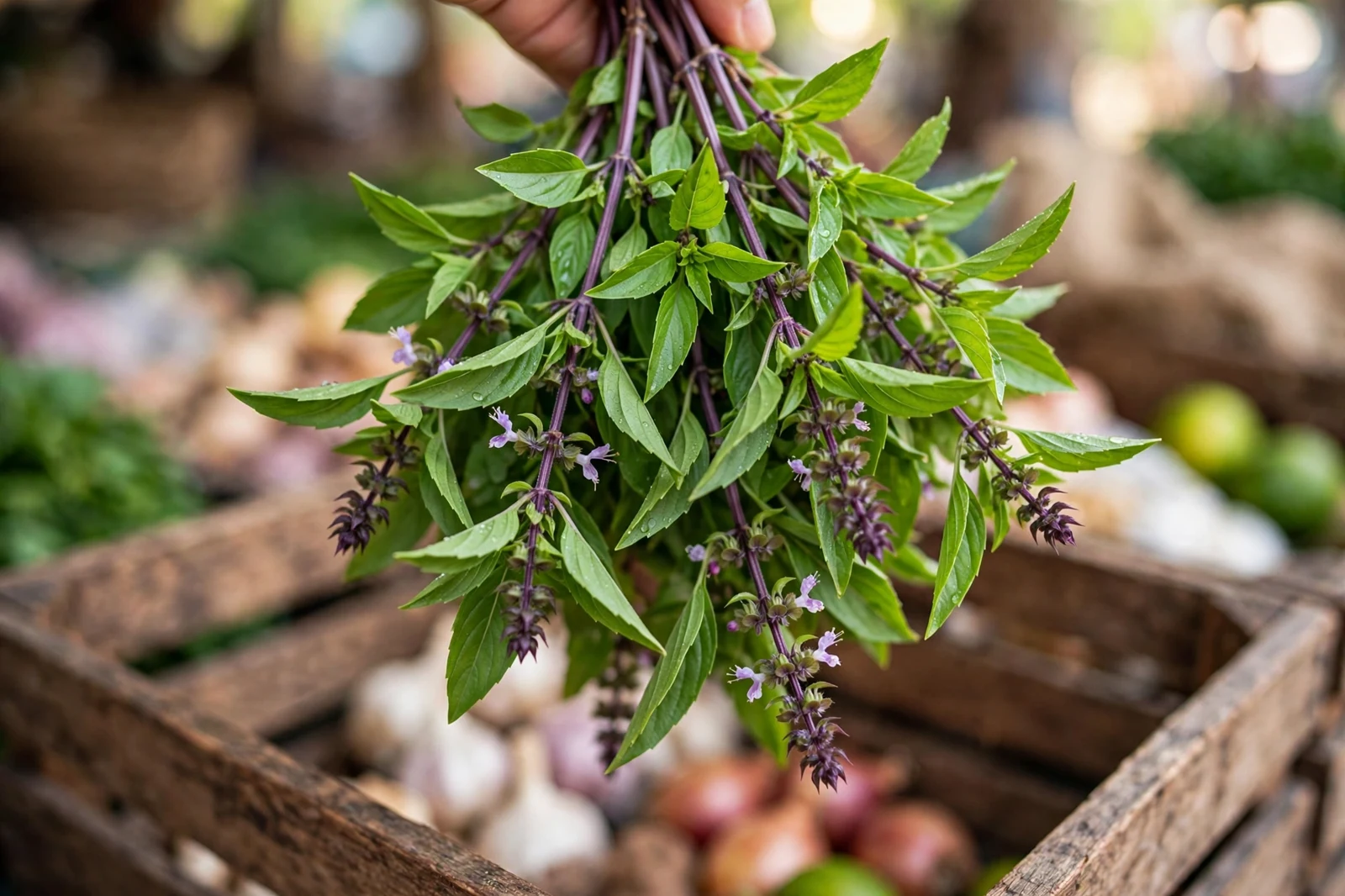
| Look | Narrow pointed leaves, purple stems, purple flower buds | Broad cupped leaves, green stems, white flowers |
| Main aromatics | Anise and licorice notes from estragole, warm spice | Sweet clove from eugenol, fresh green and mild pepper |
| Raw flavor | Assertive, warm, slightly spicy | Sweet, bright, delicate |
| In hot dishes | Holds up; wilts into curries and stir-fries without vanishing | Fades fast; long cooking turns it flat and dark |
| Signature dishes | Pho garnish, Thai green curry, drunken noodles, Taiwanese three-cup chicken | Pesto, caprese, margherita pizza, tomato sauces |
| Storage quirk | Blackens in the cold faster; happiest in a jar of water on the counter | Also cold-sensitive; same counter treatment works |
The short version: Thai basil is a seasoning that happens to be a leaf. Italian basil is a fresh finishing herb. That one difference explains almost every row above.
Flavor, Up Close
Rub a Thai basil leaf between your fingers and the first smell is anise, close to fennel seed or a mild licorice, with warm spice behind it. That comes from estragole, the same compound that gives tarragon and fennel their character. The leaf itself is sturdier, a little glossy, and the flavor stays put after ten minutes in a simmering curry.
Italian Genovese basil leads with eugenol, the clove-sweet compound, plus linalool for a floral lift. Crushed raw, it smells like summer tomatoes even before any tomato shows up. The leaves are thinner and bruise dark within minutes of chopping, which is why pesto gets made fast and sauces get their basil at the end.
One naming trap worth clearing up: Thai basil is not holy basil. Holy basil (bai kra pao) is a different plant again, peppery and clove-heavy, and it is the traditional leaf for pad kra pao. Thai basil is the sweeter anise one served with pho and folded into Thai curries. Supermarkets mix the labels up often; the purple stem is the tell.
How Each One Handles Heat
This is where the two herbs split for good.
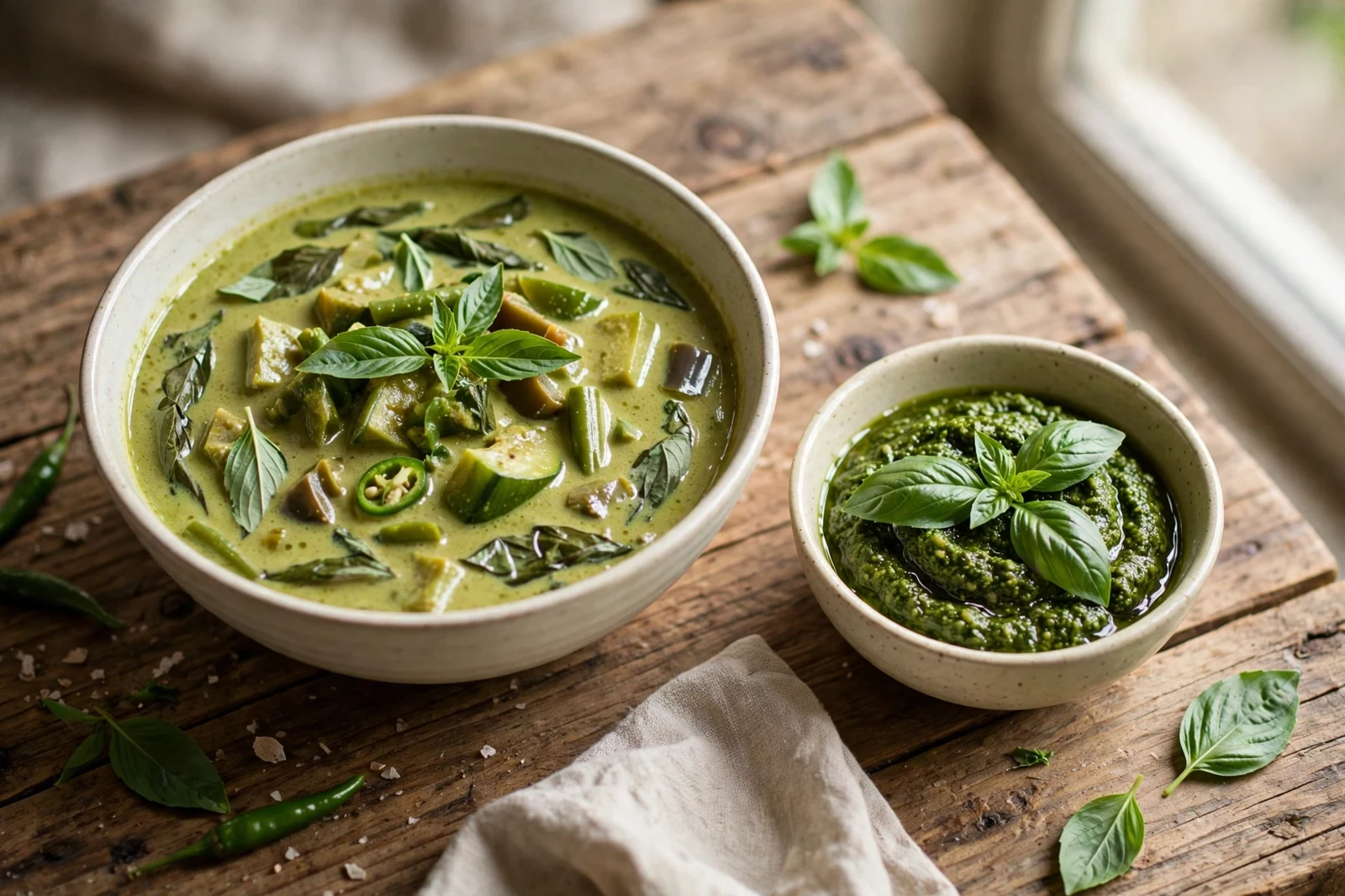
Thai basil goes into the dish. In a Thai Green Curry with Chicken, leaves get stirred through in the last two minutes and keep their identity against coconut milk and green chili. In a wok, Thai basil wilts in about 30 seconds and perfumes the whole pan. It can take a brief simmer and come out still tasting like itself.
Italian basil goes on top of the dish. Stirred into a tomato sauce at the start, it gives up its aroma to the steam and leaves a dull sweetness. Torn over the finished sauce, scattered on pizza out of the oven, or blended raw into pesto, every bit of it reads clearly. If a recipe says to cook Italian basil for more than a minute or two, treat that as a hard simmer at most, and add a little fresh at the end to replace what the heat took.
Swapping One for the Other, Dish by Dish
Cup for cup is the right starting amount — both are used in loose handfuls of about 1 cup of leaves per four servings in curries and stir-fries, and about 2 packed cups for a batch of pesto. The verdicts below assume that starting point.
| Dish | Swap verdict | Adjustment that makes it work |
|---|---|---|
| Thai green or red curry | Italian basil works in a pinch | Add it off the heat, plus a tiny pinch of ground star anise or fennel seed to fake the anise note |
| Pho | Italian basil changes the bowl, still pleasant | Serve it raw on the herb plate; skip any substitute spice — the other herbs carry the bowl |
| Drunken noodles (pad kee mao) | Italian basil is acceptable | Add at the very end, off the wok's highest heat, and use a generous handful |
| Pesto | Thai basil makes a different, warmer pesto | Cut it with half Italian basil or flat-leaf parsley, and keep the lemon — tasters tend to split on the full-Thai version |
| Caprese and raw salads | Do not swap | Thai basil's anise fights raw tomato; keep Italian basil here |
| Margherita pizza | Do not swap | Same reason — the classic pairing depends on the sweet clove note |
| Tomato sauce | Thai basil is a fair twist | Add late, and expect a warmer, spiced sauce rather than a classic one |
The pattern: cooked Southeast Asian dishes forgive the swap with a spice assist. Raw Mediterranean dishes do not forgive it at all, because the basil is the dish.
Buying and Storing Each One
Thai basil shows up in Asian markets year-round, usually in bunches with the purple flowers still on. Pinch the flowers off before cooking; they are edible but bitter. Italian Genovese basil is the default supermarket basil, sold in clamshells or as living plants.
Both herbs hate the refrigerator's cold, dry air and blacken quickly in it. The counter method beats it for both: trim the stems, stand the bunch in a jar with an inch of water, and drape a loose bag over the leaves. Stored that way, either bunch keeps for the better part of a week. For the full walkthrough, including freezing in oil, see How to Store Fresh Herbs So They Last Longer.
If you grow your own, Thai basil is one of the easiest herbs to keep going from seed. Harvesting flower heads before they open keeps the leaves coming, and saving seed from one plant covers next year's pots — the steps are in How to Save Seeds from Thai Basil. Both basils fit a sunny windowsill or a small balcony plan, as long as nights stay warm.
So Which Should You Keep on Hand?
Keep the one that matches the food you cook most.
If your week runs through curries, noodle soups, and stir-fries, Thai basil is the house herb, and Italian basil is the occasional buy for a tomato night. If your cooking leans Mediterranean, reverse it. When cupboard space or a single garden pot forces a choice, Thai basil is the more flexible of the two in cooked food, while Italian basil owns raw food outright and has no real stand-in there.
The cleanest rule to remember: anise warmth for the wok and the curry pot, sweet clove brightness for the tomato and the cheese. Pick by dish, not by habit, and both herbs will taste like they belong.