Thai food tastes bright because four tastes share every plate: sweet, sour, salty, and spicy. None of them runs the dish alone. A spoonful of pad thai has palm sugar next to lime and fish sauce, with chili heat sitting behind them, and the pleasure comes from all four arriving at once. Thai cooks call the leading taste rot chad naam, the flavor in front, and the rest rot chad rong, the flavors that support it. Which taste leads changes from dish to dish, but the four are always there. This post explains what carries each taste, a starting ratio that works for most dishes, the order to taste in, and how to pull a dish back when one taste runs ahead.
The four tastes, and what carries each one
Sweet comes from palm sugar first, then white sugar, then coconut milk and sweet chili sauce. Palm sugar melts slower than white sugar and brings a caramel note, so add it early enough to dissolve. Sour comes from lime juice, tamarind paste, and rice vinegar. Lime juice goes in last, since heat dulls it and long boiling turns it bitter; tamarind gives a deeper sour that holds up in soups and curries, and our guide to tamarind paste substitutes covers what to use when the paste jar runs out. Salty comes from fish sauce first, then light soy sauce, then plain salt. Fish sauce adds salt plus a savory depth that soy sauce does not match; a teaspoon too much is the most common way a Thai dish goes wrong, and our fish sauce vs soy sauce comparison explains when each one earns its place. Spicy comes from fresh Thai chilies, dried chilies, chili paste, and white pepper. Fresh chilies give a sharp, quick heat, while dried chilies and paste give a slower heat that builds. A Thai bird’s eye chili runs 50,000 to 100,000 Scoville units against a jalapeno at 2,500 to 8,000, so when a recipe says one chili, start with half if you have not cooked with them before.

| Taste | Main sources | Start with, per 2 servings |
|---|---|---|
| Sweet | Palm sugar, white sugar, coconut milk | 1 teaspoon palm sugar |
| Sour | Lime juice, tamarind paste, rice vinegar | 1 tablespoon lime juice |
| Salty | Fish sauce, light soy sauce, salt | 1 tablespoon fish sauce |
| Spicy | Fresh Thai chili, dried chili, chili paste | 1 fresh chili, sliced |
A starting ratio that works for most dishes
For a stir-fry sauce for two servings, start with 1 tablespoon fish sauce, 1 tablespoon lime juice, 1 teaspoon palm sugar, and 1 fresh Thai chili, sliced. That 1 to 1 sour-to-salty ratio, with the sugar measured in teaspoons rather than tablespoons, is the base I start from for pad thai, stir-fried noodles, and most wok dishes, then adjust by dish. The same 1 to 1 to 1 idea shows up in Thai dipping sauces, where 3 tablespoons fish sauce, 3 tablespoons lime juice, and 1 tablespoon palm sugar make a nam jim that takes grilled seafood or chicken without overpowering it. For a soup like tom yum, the ratio stretches to 2 tablespoons fish sauce and 2 tablespoons lime juice per liter of broth, with 1 teaspoon palm sugar and chili to taste. For a salad dressing like som tum, pound the garlic and chili first, then add 1 tablespoon fish sauce, 1 tablespoon lime juice, and 1 teaspoon palm sugar per single papaya. For curry, the coconut milk softens the salt and the heat, so a green curry for four starts at 2 tablespoons fish sauce and 1 tablespoon palm sugar, with lime added at the end only if the curry needs lift. These numbers are starting points, not fixed rules. The point is to have a place to start instead of pouring from the bottle and hoping.
Taste in this order: salty, sour, sweet, then heat
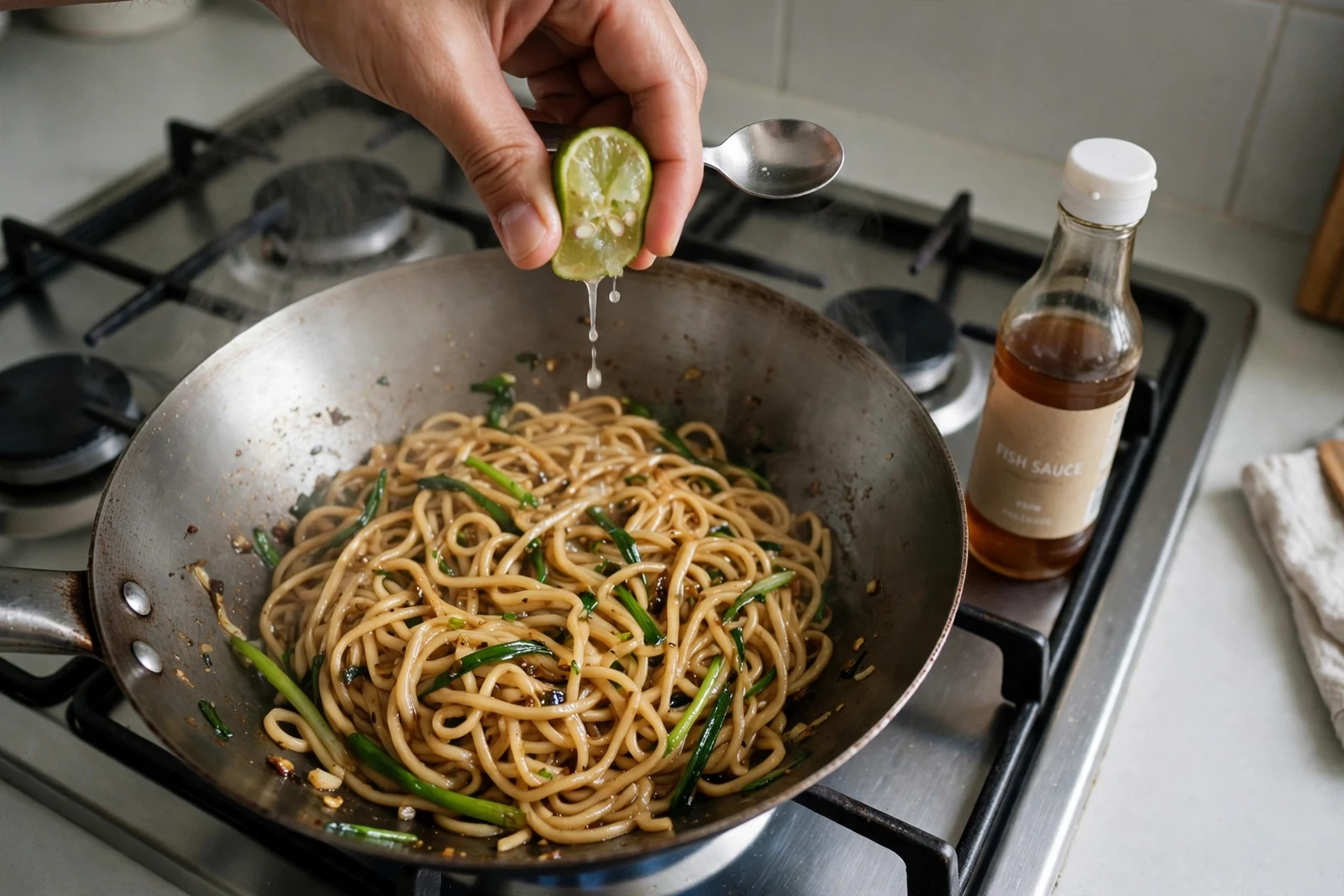
Season with fish sauce first, then sour, then sweet, then chili last. Salt sets the base, sour and sweet sit on top of it, and heat builds and masks the other tastes, so chili added early makes it hard to judge salt and sour. Add half the planned fish sauce, taste, then add the rest. Add lime juice a teaspoon at a time. Add palm sugar next, and chili last. Wait about 30 seconds after each addition before tasting again: palm sugar needs time to dissolve, and chili needs time to spread through the sauce. Taste from a clean spoon each time, not from the cooking spoon, and pull the pan off the heat for a few seconds first, since steam and high heat numb the tongue. The habit that fixes the most dishes is the simplest one: taste, adjust one thing, taste again.
How the balance shifts from dish to dish
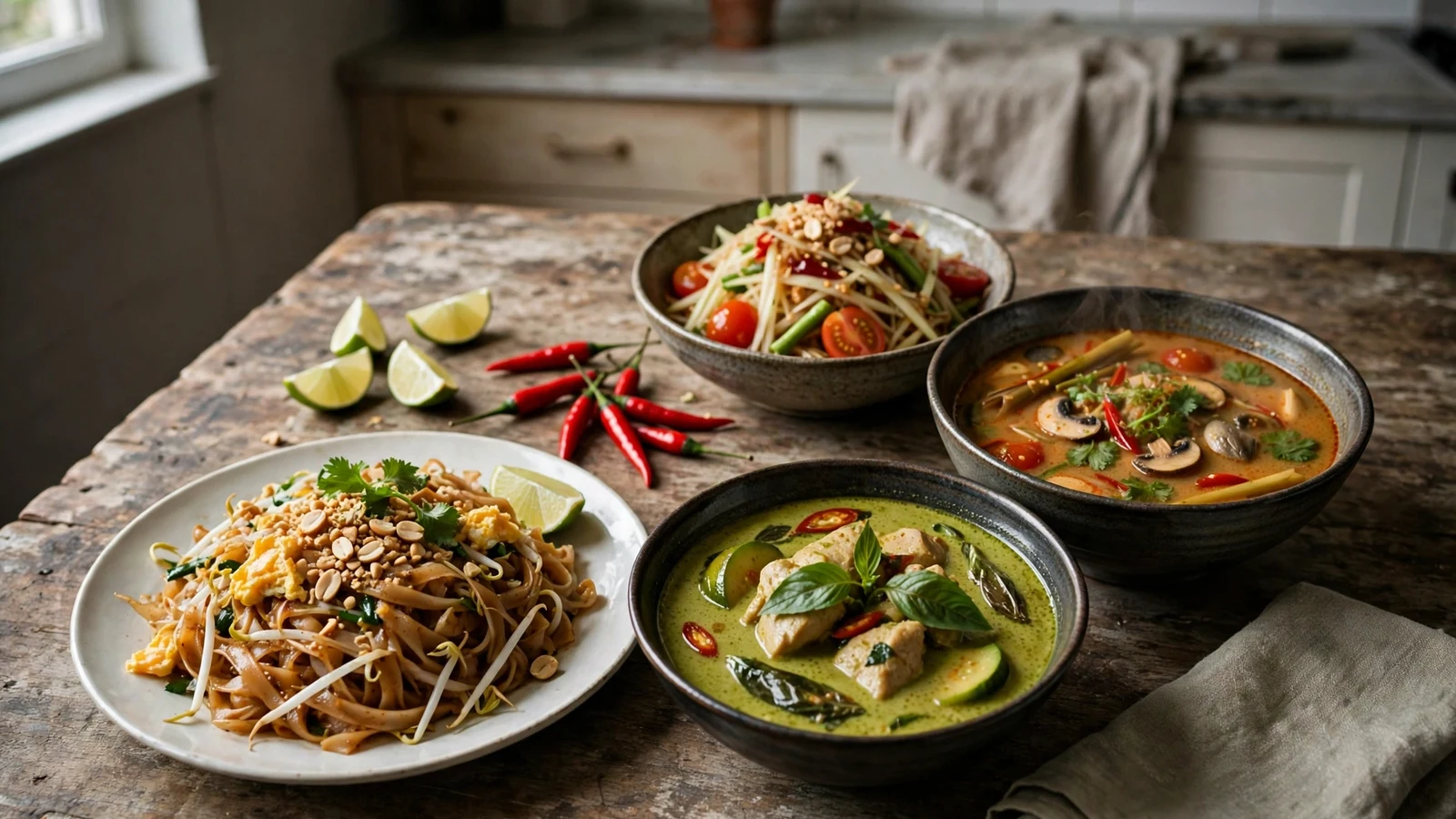
Pad thai leads with sweet and sour, with salty following and heat optional at the table. Our pad thai with shrimp uses tamarind for the sour side, which is why lime alone never quite matches it. Tom yum goong leads with sour and salty, heat close behind, and sweet only a pinch to round the edges; our tom yum goong shows how little sugar a hot and sour soup needs. Green curry leads with salty and sweet, heat from the paste, and sour barely present; lime goes in at the end, if at all, and our Thai green curry with chicken keeps it that way. Our green curry vs red curry comparison covers how the balance moves between the two pastes. Som tum leads with sour and salty, sweet a teaspoon, and heat to the eater’s taste; our som tum dresses the papaya rather than drowning it. Gai yang gets its salty-sweet note from the marinade on the chicken, and the jaew dipping sauce carries the sour and heat on the side; our gai yang with jaew keeps the two apart for a reason. Panang curry leans sweeter than green curry, with peanuts adding body, and our panang curry with chicken shows how far one extra teaspoon of palm sugar moves it.
Fixing a dish that leans too far one way
Too salty: add 1 teaspoon lime juice and 1/2 teaspoon palm sugar per cup of sauce, then a splash of water or stock if it still tastes sharp. Acid is the fix here; sugar alone turns salty-sweet instead of balanced. Too sour: add 1/2 teaspoon palm sugar and 1/2 teaspoon fish sauce at a time, tasting between additions. In a curry, coconut milk also softens sour. Too sweet: add lime juice a teaspoon at a time and a little fish sauce. Acid cuts sweetness faster than salt does. Too spicy: add 2 to 3 tablespoons coconut milk, a teaspoon of palm sugar, and a squeeze of lime, and serve with rice, which absorbs heat. Do not add water; it spreads the heat without cutting it. Flat, with nothing wrong but dull: it usually needs salt or acid. Start with 1/2 teaspoon fish sauce, then a teaspoon of lime juice. If it still tastes flat, it needs heat: one sliced chili. Season for the plate, not the pot: a curry served with plain rice needs more salt than one eaten alone, since the rice dilutes each bite.
Mistakes that throw the balance off
Pouring fish sauce straight from the bottle without measuring is the first one. Measure into a spoon first; a free pour is often twice what the dish needs. Adding all the lime juice at the start of cooking is the second. In soups, half the lime goes in early to mellow, and the rest goes in at the end; in a stir-fry, it all goes in during the last 30 seconds. Swapping white sugar for palm sugar one to one is the third. White sugar tastes sweeter by volume, so use 3/4 teaspoon white sugar per teaspoon of palm sugar, and expect a cleaner taste without the caramel note. Tasting while the pan sits on high heat is the fourth; pull it off the burner, wait a few seconds, then taste from a clean spoon. Cooking for a table that eats at different heat levels is the fifth: keep the chili out of the pot and put it on the table as flakes or a small bowl of sliced chilies in fish sauce, so each person seasons their own plate.
More Thai recipes
Pad Thai with Shrimp, Thai Green Curry with Chicken, Tom Yum Goong: Thai Hot and Sour Shrimp Soup, and Gai Yang: Thai Grilled Chicken.
From the garden
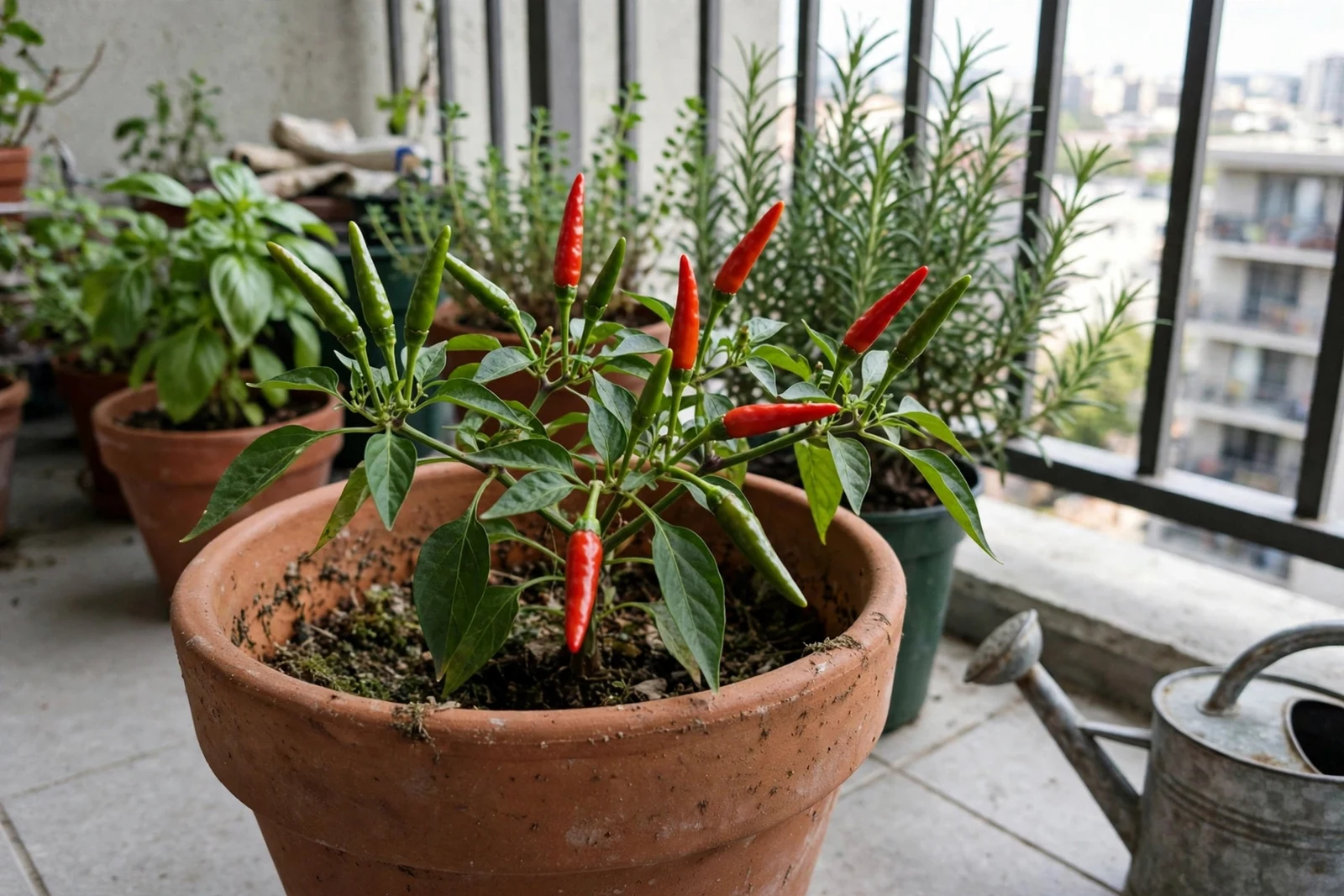
Thai chilies grow well in pots. One plant in a 5-gallon pot gives more chilies than a household uses in a season, and the plant keeps producing from summer into fall. Our guide to how to grow Thai chili peppers in pots covers the pot size, the watering, and when to pick. Fresh chilies from the pot go straight into the wok, and the habit of tasting one before it goes in teaches the heat of each batch better than any chart.