
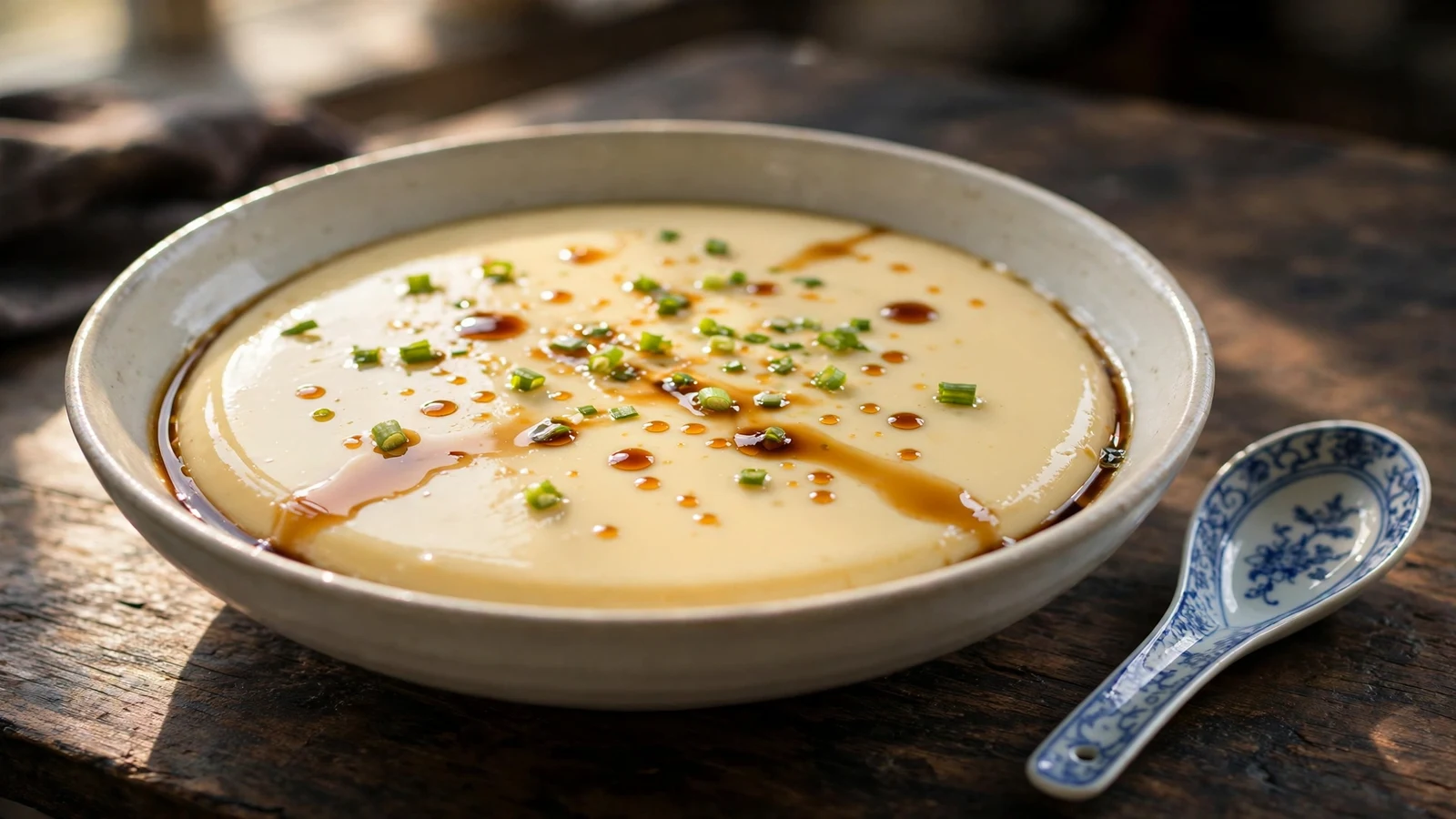
Cantonese steamed egg custard is three ingredients, one bowl, and about twenty minutes. Eggs thinned with warm water go into a steamer and come out as something between tofu and pudding: a pale-gold custard that trembles when you shake the bowl and cuts with the edge of a spoon. Light soy sauce, a few drops of sesame oil, and chopped scallions go on top, and it is done. It is the side dish Cantonese families eat with plain rice several nights a week, and once the ratio and the steam are right, it asks nothing more of you.
What is Cantonese steamed egg custard?
Zheng shui dan means “steamed water egg,” and the name tells you the whole method: eggs loosened with water, steamed gently in a shallow bowl until just set. It is savory, not sweet, and the flavor is clean and mild, which is why it works next to strongly seasoned dishes rather than competing with them. This is home cooking, not restaurant theater.
Two lookalikes you may know are not the same dish. Chawanmushi is the Japanese version, built on dashi instead of water and steamed in small cups, usually with fillings like shrimp or shiitake inside. Gyeran jjim is the Korean version, whisked to be airy and served in a bubbling pot with a fluffy, almost souffle-like top. This Cantonese one sits between them: no dashi, no fillings, no froth. Water, salt, gentle steam, and a surface as flat as a mirror.
The ratio that decides everything
Three large eggs weigh out to about 150 ml of beaten egg. Add 300 ml of water and you land at a 1:2 egg-to-water ratio by volume, which gives the softest custard that still holds its shape when spooned. That is the ratio in the card below, and it is the one to memorize.
If you want a firmer custard that you can slice, drop to 1:1.5, or 225 ml of water for those same three eggs. Go past 1:2 and the custard stops setting: you get sweet, eggy water instead of tofu. The honest way to measure is to crack the eggs into a measuring cup, note the volume, and pour the matching water. Eyeballing it is how most watery batches happen.
Warm water, not cold
Cold tap water holds more dissolved air than warm water, and that air has to go somewhere when the custard steams. It goes out as tiny holes through the surface. Warm the water to about 40C (104F), skin-warm to the touch, and the bubbles stop before they start. Boiling water goes too far the other way: it cooks the eggs on contact and you get egg drop soup. One more detail worth knowing, since the center of the custard never reaches a full boil: use boiled water that has cooled to warm, not raw tap water, especially if your tap water is not drinking-clean.
Stir, do not beat
Whisk the eggs like you mean it and you fold in exactly the air you just tried to keep out. Keep a pair of chopsticks submerged and stir in one direction until the yolks and whites blend, then add the warm salted water and stir again. Pour the mixture through a fine-mesh sieve into the shallow heatproof bowl you will steam it in. The sieve catches the chalazae, the white stringy bits that hold the yolk in place, and any stubborn clumps of albumen that would cook into chewy spots. Then look at the surface of the strained mixture and pop every bubble with a spoon or a toothpick. A clean surface before steaming is a clean surface after.

The chopstick vent trick
Steam is violent. Sealed under a tight lid, it keeps cooking the outer layer while the center lags, and the surface puckers and splits. Prop the steamer lid open with a wooden chopstick. That small gap lets excess steam escape and keeps the environment at a gentle simmer instead of a rolling boil. With the vent in place, you do not need to cover the bowl with plastic wrap or a plate: the steam circulates softly enough that condensation dripping stays a non-issue.

Bring the water under the steamer to a full boil first, then set the bowl in, drop the heat to medium-low, and steam 10 to 12 minutes for a shallow bowl. The custard is done when the edges are set and the center still trembles when you nudge the bowl. Pull it then. The eggs keep cooking for a minute or two off the heat, and carryover takes the center from trembling to set without turning it rubbery.
Troubleshooting: Fix My Cantonese Steamed Egg Custard
Most batches go wrong in one of five ways: the water ratio, the water temperature, air in the mix, heat that is too fierce, or skipping the sieve. Pick what went wrong below for a concrete next step.
HERB & LIME · KITCHEN HELP
Fix My Cantonese Steamed Egg Custard
Choose what went wrong to see a practical next step.
Possible cause
What to try next
For next time
From Paul's kitchen. Results vary with egg size, bowl depth, and stove heat, adjust timing to your setup.
Quick reference (also works without JavaScript)
It stayed watery and never set
Cause: Too much water for the eggs (past a 1:2 ratio), or the steamer was not hot when the bowl went in, or the water and egg were not mixed evenly.
Try: Measure the beaten eggs in a cup and add 1.5 to 2 times that volume in water; always place the bowl into a steamer whose water is already at a full boil.
Prevent: Use the 1:2 egg-to-water ratio by volume as your baseline, and whisk the salted water into the eggs until fully uniform before straining.
The surface is pockmarked with craters
Cause: Bubbles left on the surface before steaming expanded in the heat, or condensation dripped from the lid, or the lid was sealed tight so steam pressure spiked.
Try: Pop every bubble with a spoon or toothpick before steaming, and prop the lid open with a chopstick so excess steam escapes.
Prevent: Strain through a fine-mesh sieve, skim the surface clean, and always vent the lid; with the vent in place you can skip covering the bowl.
The inside is full of honeycomb holes
Cause: The heat was too high, so the outer custard set before the center while trapped steam forced holes through it.
Try: Steam over medium-low heat with a vented lid, and pull the bowl when the center still trembles; carryover heat finishes it.
Prevent: Never steam on full blast; keep the chopstick gap wide enough that the steam stays a gentle simmer, not a rolling boil.
It turned rubbery and wept water
Cause: Too little water for the eggs made the protein network bond too tightly, or it steamed too long, squeezing water out like a wrung-out sponge.
Try: Stick to at least 1.5 parts water to 1 part egg, and stop steaming as soon as the edges are set and the center jiggles.
Prevent: Remember the eggs keep cooking a minute or two after you take them out, so pull the bowl just before it looks perfectly done.
There are chewy white bits in the custard
Cause: The chalazae and stubborn clumps of albumen were never strained out before steaming.
Try: Pour the mixed egg liquid through a fine-mesh sieve into the steaming bowl; it takes seconds and the texture turns uniform.
Prevent: Always sieve after mixing, and stir gently with chopsticks instead of whisking, which breaks up the white without adding air.
Cantonese Steamed Egg Custard (Zheng Shui Dan)
Ingredients
Method
- Beat the eggs gently. Crack the eggs into a bowl and stir with a pair of chopsticks kept submerged, in one direction, until the yolks and whites are fully blended. Do not whisk hard; you want to avoid folding air into the eggs.
- Add the warm salted water. Stir the salt into the warm water until dissolved, then pour it into the eggs while stirring with the chopsticks. Mix until the liquid is completely uniform.
- Strain and skim. Pour the mixture through a fine-mesh sieve into a shallow heatproof bowl. Pop every bubble on the surface with a spoon or toothpick.
- Set up the steamer. Bring the water under your steamer (or a wok with a rack) to a full boil. Set the bowl in, reduce to medium-low, and prop the lid open with a wooden chopstick so excess steam escapes.
- Steam gently. Steam 10 to 12 minutes, until the edges are set and the center still trembles when you nudge the bowl. Pull it now; the eggs keep cooking for a minute or two off the heat.
- Serve. Rest 2 minutes, then drizzle over the light soy sauce and sesame oil and scatter the scallions on top. Serve hot with plain rice.
Notes
What to serve with it
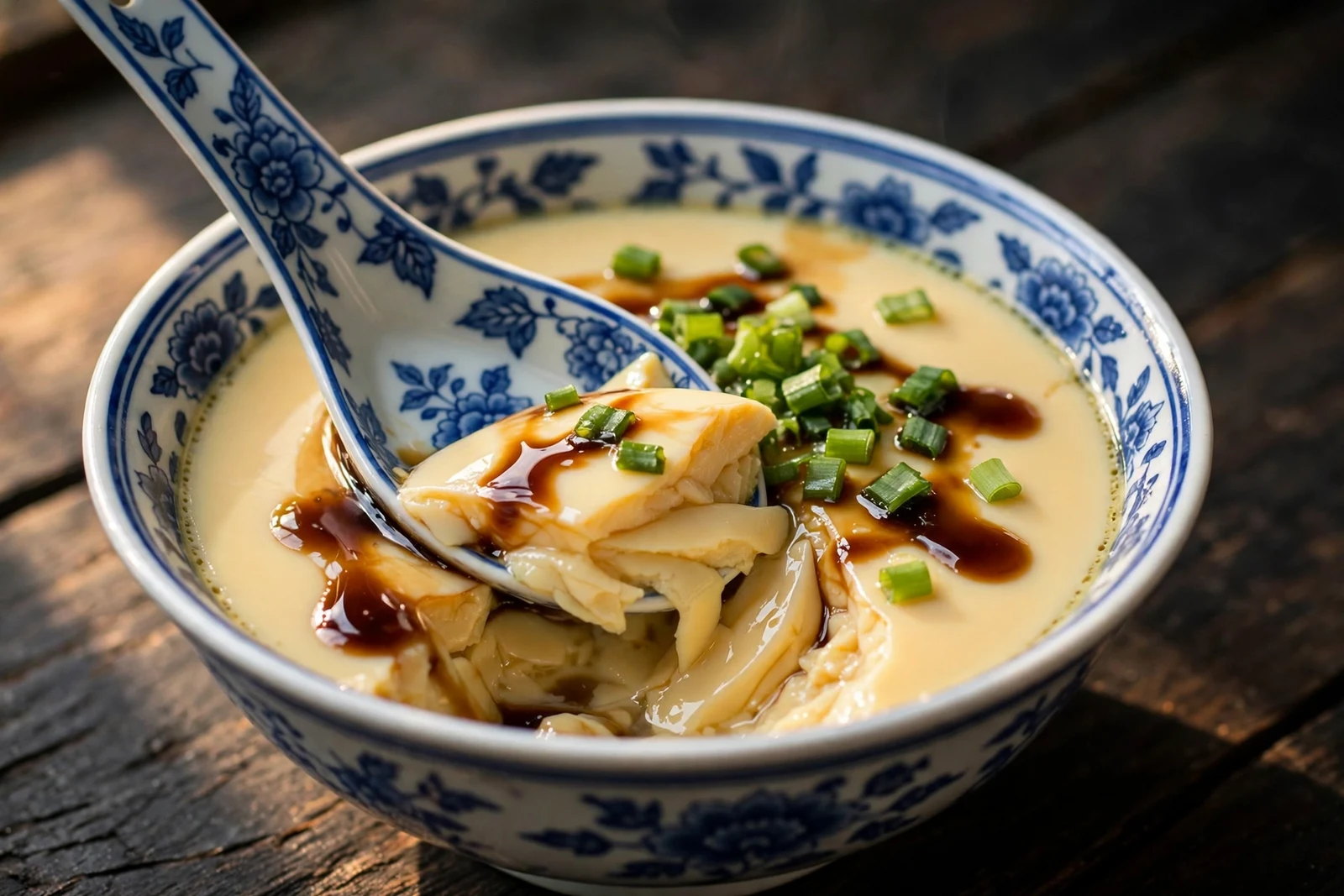
This custard belongs next to strong flavors and plain rice. A spoonful of tomato egg stir-fry and a bowl of rice turn it into a complete light meal, and it sits happily on any table that already has a braised or stir-fried main. For serving, drizzle the soy sauce and sesame oil over the hot custard right before it reaches the table, then scatter the scallions so the residual heat wakes them up.

More Chinese recipes
If this one worked for you, three more from the same kitchen: Mapo Tofu is the Sichuan classic with its numbing bean-paste sauce; Kung Pao Chicken brings the sweet-savory crunch of peanuts and dried chiles; and Hot and Sour Soup is the bowl to make when you want something warming with real backbone.
From the garden
The scallions on top came from the same regrown bunch sitting on my windowsill. Green onions are the easiest thing I keep alive in the kitchen: set the cut bases in a glass of water and they send up new shoots within a week. The full method is in my green onion growing guide.