

Daikon is the long white radish that shows up in Japanese simmered dishes, Korean pickles, and Vietnamese soups, and it is one of the easiest Asian vegetables to grow in a pot, with one condition. The root grows straight down, so the pot has to be deep enough for the variety you picked. Get the depth right and the rest of the job is simple: loose soil, cool weather, steady water, and patience for about two months.
A container is actually a good home for daikon. You control the soil completely, which matters because a single stone or a hard layer in the mix is enough to fork or bend a root. In a bed you are stuck with whatever the ground gives you. In a pot you decide.
What daikon radish is
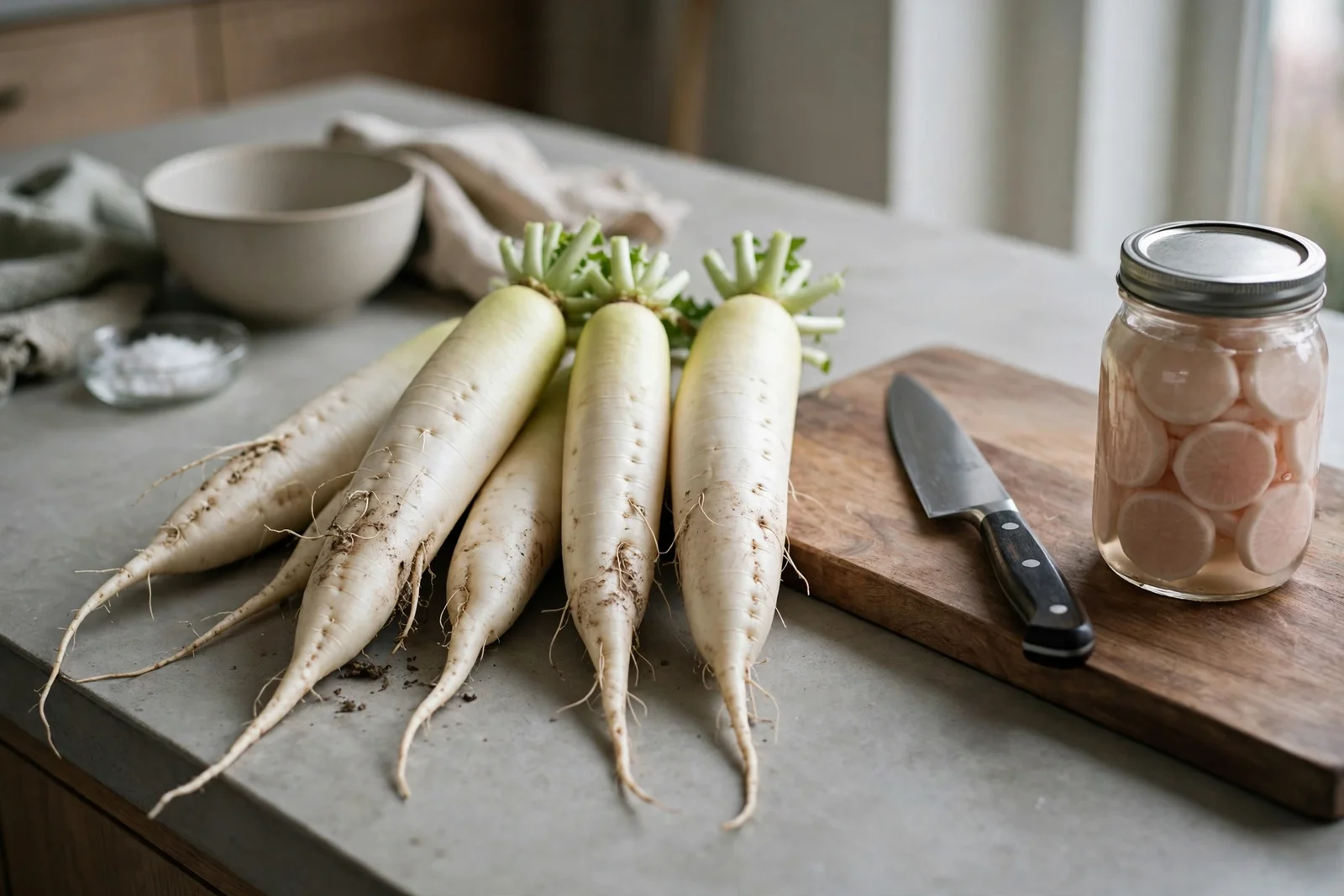
Daikon (Raphanus sativus var. longipinnus) is a white radish from East Asia, grown for its long, mild root rather than its leaves. The flavor is crisp and gentle, closer to a mild turnip than to the sharp little red radishes sold in bunches, with a faint peppery bite at the tail end. In the kitchen it goes into pickles, soups, and simmered dishes, or gets grated raw as oroshi to serve beside fried food.
The plant is a cool-season crop. It grows best when days run 60–70°F, slows down in summer heat, and bolts when a spring sowing meets lengthening days and warm nights. That one fact decides the whole calendar: in most of the United States, daikon is a fall crop, sown in late summer and pulled in autumn.
Pick a variety that fits your pot
Varieties differ mainly in root shape, and the shape decides how deep a pot you need.
- Long types like Miyashige White and Minowase grow roots 12–18 inches long. They need a pot at least 16–18 inches deep, and they give the classic long white root for slicing and pickling.
- Short types like Alpine grow roots closer to 6–8 inches. A 12-inch-deep pot handles them fine.
- Round types like Shogoin grow a turnip-shaped root about 4 inches across instead of a long one. They fit the shallowest pots of all, 10–12 inches deep, and they are the safest pick if you only have standard pots on hand.
If you already own a pot, buy the variety that fits it. If you have your heart set on a long variety, buy the pot first. A long daikon in a shallow pot does not grow a short root. It grows a bent, forked one that stops where the soil stops.
The pot: depth is the whole game
Depth matters more than width. One plant needs about 6 inches of width around it, so a 12-inch-wide pot holds two plants and a 5-gallon bucket holds one long root comfortably. What you cannot compromise on is depth: the pot must be at least as deep as the mature root, plus an inch or two of soil underneath.
- For long varieties: a 5-gallon bucket, a tall planter, or a fabric grow bag at least 18 inches deep. Drill drainage holes if the container does not have them, and raise it on pot feet or bricks so water runs out freely.
- For short and round varieties: a standard 12-inch-deep pot works, the same size that grows a healthy eggplant in How to Grow Japanese Eggplant in Containers.
- Material: any material works. Fabric bags dry out faster than plastic, so check them more often in warm weather. Dark pots in full sun heat the soil more; light-colored pots or a spot with afternoon shade keep roots cooler.
- Drainage: daikon hates wet feet. Water that sits in the bottom of the pot rots the tail of the root. If your pot sits in a saucer, empty it after watering.
Soil: loose, stone-free, no fresh manure
The root pushes straight down through the mix, so the mix has to offer no resistance at all.
- The mix: a good potting mix with about one part compost to three parts mix. Sift out stones, sticks, and hard lumps before you fill the pot. Anything solid in the path of the root bends it or splits it into two.
- pH: 6.0–7.0 is fine, which is where most bagged potting mixes already sit.
- Fresh manure: skip it. Fresh manure makes roots fork and split, the same way it does for carrots. Finished compost is the right call; if you want to feed, do it after the seedlings are up.
- Fill to the top: fill the pot to about an inch below the rim, water it once, and let it settle before you sow. Soil that sinks after sowing buries the seeds deeper than you planned.
When to sow
Fall is the season for daikon in most of the country. Sow 8–10 weeks before your first expected frost, which lands in late August or early September in much of the U.S. and in October in mild-winter places like Southern California, where a winter harvest works well. The seasonal picture in When to Plant Asian Greens: A Seasonal Calendar shows where a fall-sown root crop fits against the rest of the cool-season garden.
Spring sowing is possible but less reliable. Sow as soon as the soil can be worked, and pick a fast variety, because a slow variety sown in spring often bolts: it sends up a flower stalk and turns woody once days get long and warm. If your spring daikon bolts, it is the season, not a mistake you made.
- Germination: seeds sprout in soil from about 50°F to 85°F, fastest around 65–75°F.
- Days to harvest: 60–70 days for long varieties, 50–60 for short and round ones. Count back from your first frost and sow on time; a daikon sown two weeks late is a daikon pulled small.
- Frost: light frost does not hurt the root. A hard freeze, roughly below 25°F, does. If a hard freeze is coming and the roots are close to size, pull them first.

Sowing and thinning
Daikon grows a taproot from day one, so sow it where it will grow. Transplanting bends the taproot and you get a forked radish for your trouble.
- Depth: sow seeds 1/2 inch deep. Deeper than that and small seeds run out of energy before they break the surface.
- Spacing: sow two seeds per spot, spots 6 inches apart. Once seedlings have their first true leaves, snip the weaker one at the soil line and keep the stronger. Pulling the extra seedling out by the roots disturbs the one you want to keep, so cut it instead.
- Watering in: water gently after sowing so the seeds stay where you put them. A hard blast from a hose washes them to one side of the pot.
- One plant per spot, no exceptions: two roots in one spot push against each other and both come out bent. Thinning feels wasteful the first time you do it. The roots you keep are the payoff.
Water and feeding
Even moisture is the difference between a straight root and a split one. A dry spell followed by a heavy watering makes the root grow fast in bursts, and the skin splits along its length. The split root still tastes fine, but it does not store well and it looks rough in a pickle jar.
- Water: about 1 inch a week in cool fall weather, more if a warm spell hits. Water the soil, not the leaves, and water in the morning so the leaves dry by evening.
- Mulch: an inch of straw or shredded leaves on the surface keeps the soil moisture even between waterings and keeps the shoulders of the root from greening in the sun.
- Feeding: go light. Too much nitrogen grows a big leafy top and a small root. The compost in the mix plus one light feeding of a balanced fertilizer halfway through the season is enough.
- What the top tells you: leaves that wilt in the afternoon and recover by morning need water. Leaves that stay wilted into the evening need water right away, and the root may already have slowed down.

Pests and problems
Daikon has fewer pest troubles than leafy greens, and most of them are easy to head off.
- Flea beetles: tiny black beetles that chew small holes in seedling leaves. They rarely kill a plant, but a heavy attack on a young seedling slows it down. A light row cover over the pot from sowing until the plants have four or five true leaves keeps them off.
- Cabbage root maggot: a small fly lays eggs at the base of the plant, and the maggots chew the young root. The same row cover that stops flea beetles stops this fly, which is the simplest fix there is.
- Slugs: they chew the shoulders of roots that push above the soil line. Mulch pulled back from the crown of the plant and a nightly check after rain handles most of it.
- Bolting: a flower stalk shooting up means the plant has decided to make seed, usually from heat or long days. The root turns woody and the crop is done. Pull it, compost it, and sow the next round in the right season.
- Green shoulders: the top of the root turns green where sunlight hits it. It is harmless, but it tastes slightly bitter. A little extra soil or mulch mounded over the shoulder keeps it white.
Harvest: loosen first, then pull
Start checking at about 60 days. Brush the soil back from the shoulder of one root: if it measures about 1 1/2–2 inches across, it is ready. Smaller roots are still good eating, so pull a few early for the kitchen and leave the rest to size up.

The one technique that matters: loosen the soil first. Push a hand fork into the soil beside the root and lever gently to break the grip of the soil, then pull the root straight up by the leaves. A root pulled at an angle out of dry, tight soil snaps halfway down, and the broken half stays in the pot. If the soil is dry, water the pot an hour before you harvest. Damp soil lets go of the root.
- How to pull: grip the leaves at the base, pull straight up, steady and slow. Do not twist.
- Storing: cut the tops off about an inch above the root, brush the soil off, and store unwashed in a bag in the fridge. They keep 2–4 weeks. For longer storage, layer them in damp sand in a cool spot, the way root cellars used to hold winter radishes.
- Seed saving: daikon crosses easily with other radishes, so saved seed is only true to type if no other radish flowered nearby. For most home gardens, fresh seed each year is the simpler choice.
Using the harvest in the kitchen
A pot or two of daikon gives more radish than one household eats raw, so plan for the kitchen as well as the garden.
- Pickles: the classic use. Thin slices in a sweet vinegar brine turn into the crisp pickled radish served with Korean fried chicken in Korean Pickled Radish (Chicken-mu). One large root fills several jars.
- Soups and simmered dishes: cut into thick rounds and simmer until tender. Daikon soaks up broth without falling apart, which is why it shows up in so many winter soups.
- Grated raw: grate it fine for oroshi, squeeze out a little of the juice, and serve it with a splash of soy sauce beside fried food. Fresh-grated daikon is sharper than cooked, so a little goes a long way.
- Stir-fries: cut into thin batons and give them a short, hot cook so they stay crisp. They take garlic, chili, and fermented bean flavors well.
- Storing the glut: pickled daikon keeps for weeks in the fridge, which makes it the best answer to a harvest that all ripens at once.
Quick troubleshooting
| Problem | Likely cause | Fix |
|---|---|---|
| Seeds never sprouted | Sown too deep, or soil dried out before germination | Sow 1/2 inch deep; keep the surface damp until seedlings appear |
| Seedlings thin and leggy | Not enough light | Move the pot to a spot with at least 6 hours of sun |
| Roots forked or bent | Stones or hard layers in the soil, or transplanted | Sift the mix before filling; always direct sow |
| Roots split lengthwise | Uneven watering: dry spell, then heavy water | Water on a steadier schedule; mulch to hold moisture even |
| Big leaves, small root | Too much nitrogen | Skip extra feeding; let the compost in the mix do the work |
| Flower stalk shot up | Heat or long days (spring sowing) | Pull it and re-sow in late summer for a fall crop |
| Small holes in seedling leaves | Flea beetles | Cover with row cover until plants have 4–5 true leaves |
| Root snapped during harvest | Pulled at an angle from dry soil | Loosen with a fork first; water an hour before pulling |
| Green shoulders on the root | Sunlight hitting the exposed top | Mound soil or mulch over the shoulder |
More garden guides
- How to Grow Japanese Eggplant in Containers
- How to Grow Bok Choy in Containers
- How to Grow Thai Chili Peppers in Pots
- Container Garden Plan for a Vietnamese Herb Garden
From the garden
A pot-grown daikon tells the truth about your soil the moment you pull it. A straight root means the mix stayed loose all the way down; a bent one points at the exact spot where it hit something hard. That is the whole lesson of this crop in one pull, and it is why the prep work, sifting the mix and filling the pot deep, matters more than anything you do after sowing.
Give daikon a deep pot, loose soil, a fall sowing, and steady water, and one container hands you roots that are crisp, mild, and big enough to pickle by the jar.