
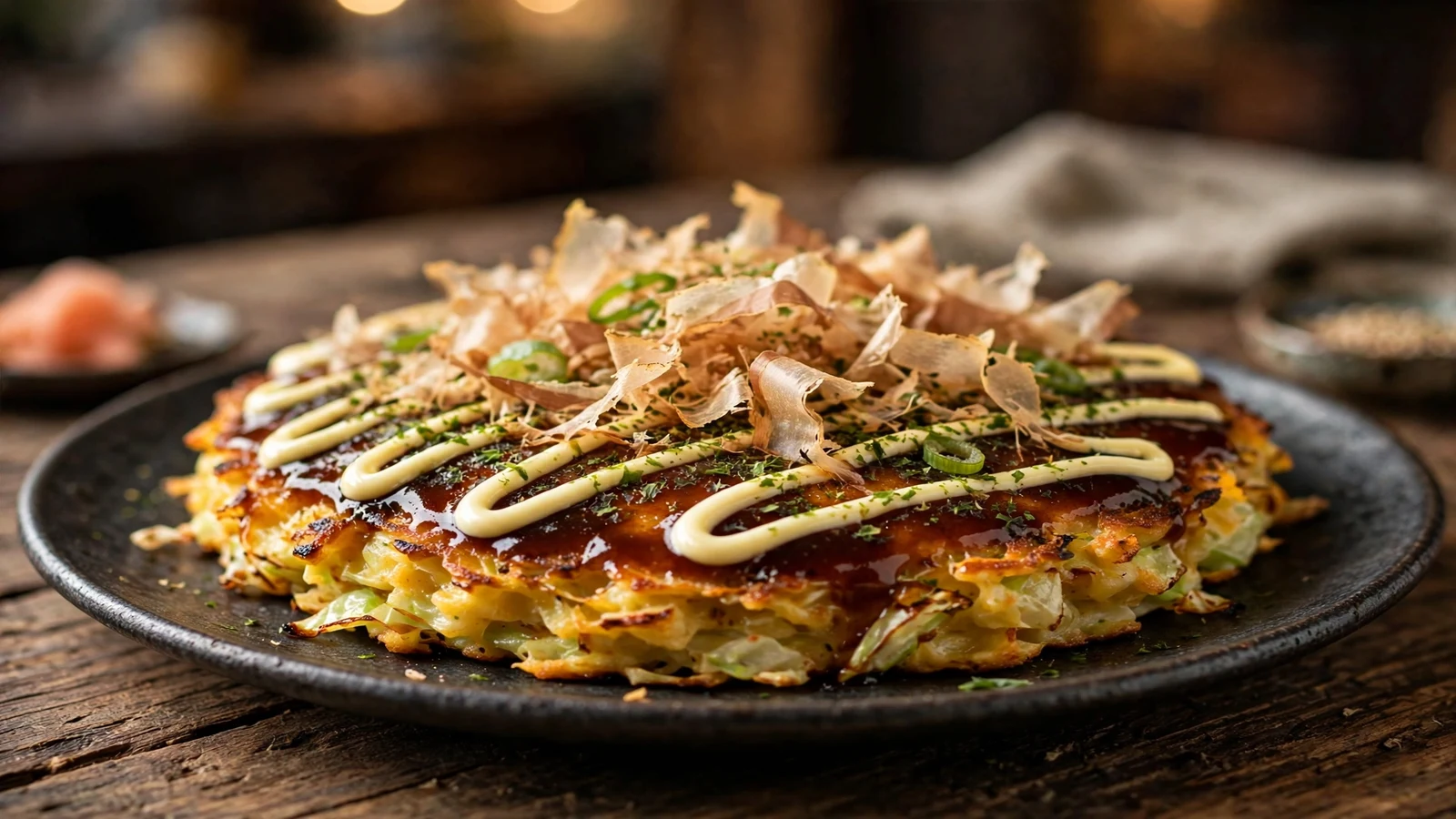
There’s a sound okonomiyaki makes when it hits a hot pan that tells you everything is going right: a steady, confident sizzle, not a furious spatter and not a weak hiss. Get that sound, leave the pancake alone for five full minutes, and what lands on the plate is crisp at the edges, steamy and tender in the middle, and striped with sweet-savory okonomi sauce and mayo. This is the Osaka-style version — everything mixed together, pork belly laid on top, flipped once with conviction.
What Is Okonomiyaki?
Okonomiyaki (お好み焼き) means “grilled as you like it,” and the name is the whole philosophy: a savory pancake of batter, shredded cabbage, and whatever you have on hand, cooked on a griddle. It’s Osaka street food at its core — the city where it’s practically a religion — but the Kansai (Osaka) style is the one most home cooks make: batter and fillings mixed in one bowl, spread into a thick pancake, pork belly pressed on top, flipped once, then finished with okonomi sauce, Kewpie mayonnaise, bonito flakes, and aonori seaweed. Hiroshima’s layered version is a different (glorious) project; this post is the weeknight-friendly Osaka one.
Expect a pancake about an inch thick: golden-brown and a little crisp outside, soft cabbage ribbons and creamy batter inside, with the pork belly rendering down into the surface as it cooks. The flavor is deeply savory-sweet from the sauce — think of it as Japanese comfort food in pancake form.
The Batter Ratio That Makes It Work
After a few sticky, falling-apart attempts, I landed on a ratio that holds together every time: 120 g (1 cup) all-purpose flour, 120 ml (1/2 cup) dashi, 2 large eggs, and 300 g (about 4 packed cups) of finely shredded cabbage. That’s enough batter to coat the cabbage generously without turning soupy. Here’s the trick most guides rush past: whisk the batter smooth, fold in the cabbage without overmixing, and let the bowl rest in the fridge for at least 30 minutes (an hour is better). Resting relaxes the gluten, and relaxed gluten is the difference between a tender pancake and a gummy one.
Two more numbers from Paul’s kitchen: keep the pancake about 1.5 cm (roughly 1/2 inch) thick when you spread it in the pan, and cook the first side a full 5 minutes over medium heat without touching it. That undisturbed five minutes is what builds the crust that lets you flip it in one piece.
Ingredients
For the batter:
– 120 g (1 cup) all-purpose flour
– 1/2 teaspoon salt
– 1/4 teaspoon sugar
– 120 ml (1/2 cup) cold dashi stock (instant dashi dissolved in water is fine)
– 2 large eggs, beaten
– 2 tablespoons grated nagaimo (Japanese mountain yam; optional but wonderful for fluffiness — a tablespoon of grated raw potato gets you partway there)
For the pancake:
– 300 g green cabbage (about 4 packed cups), shredded as thinly as you can — 3 mm ribbons are the goal
– 3 green onions, thinly sliced
– 2 tablespoons tenkasu (tempura bits; optional, adds little crispy pockets)
– 2 tablespoons neutral oil, for the pan
– 6–8 thin slices pork belly (about 100 g)
For topping:
– Okonomiyaki sauce (Otafuku is the classic), about 3–4 tablespoons
– Kewpie mayonnaise, for the zigzag
– 1 tablespoon katsuobushi (bonito flakes)
– 1 teaspoon aonori (green seaweed powder)
How to Make Okonomiyaki
-
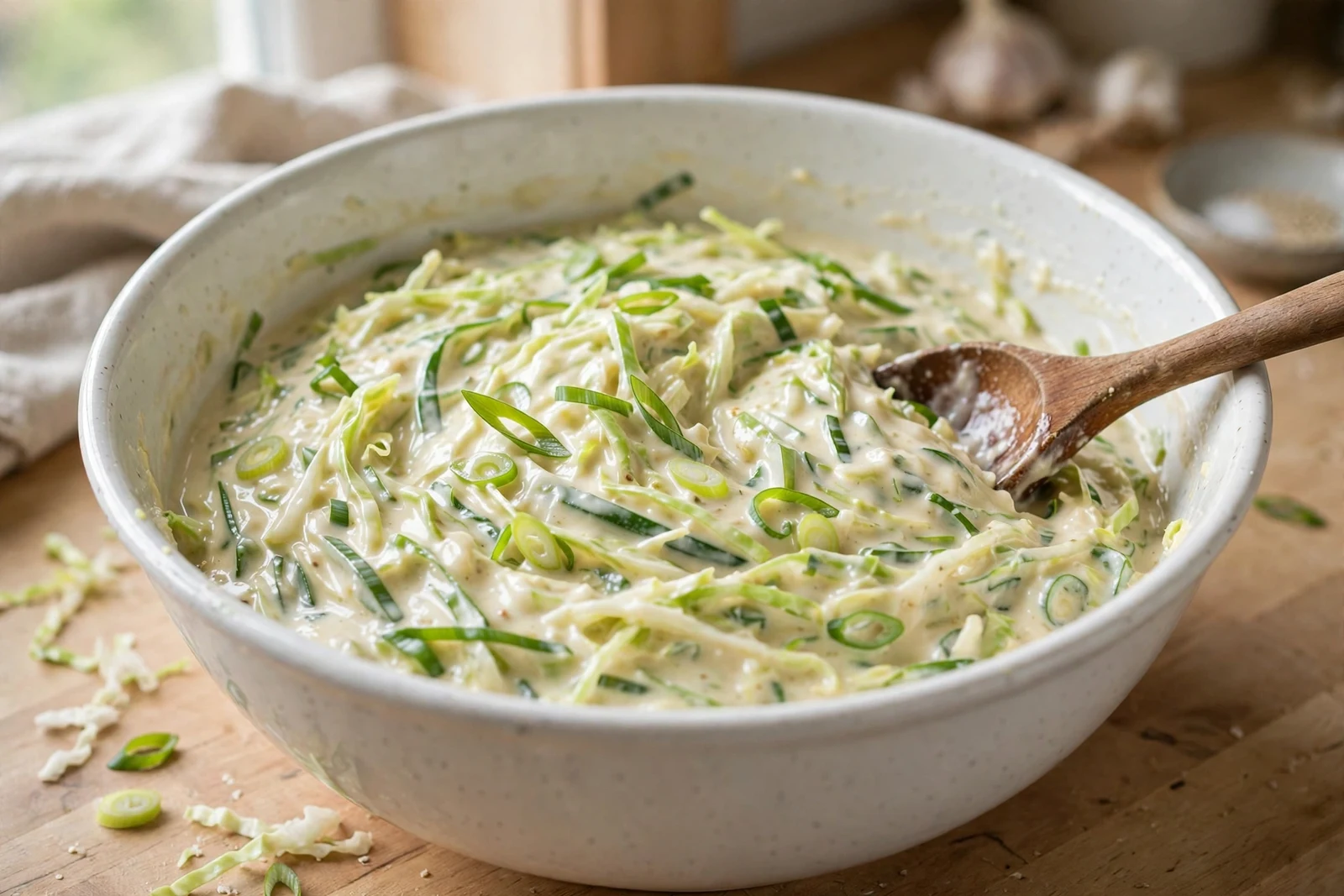
Whisk the batter. In a large bowl, whisk the flour, salt, and sugar, then add the dashi and eggs and whisk until completely smooth. Stir in the grated nagaimo if using. The batter should pour like thick cream.
-
Fold in the cabbage. Add the shredded cabbage, green onions, and tenkasu. Fold gently until every shred is coated — stop the moment it’s combined. Overmixing develops gluten and turns the pancake dense and gummy. Cover and rest in the fridge 30–60 minutes.
-
Heat the pan. Warm a large nonstick skillet over medium heat with a tablespoon of oil. You want that confident sizzle — if the oil smokes, you’re too hot; back off before the batter goes in.
-
Spread and top. Pour in half the mixture and nudge it into a round pancake about 20 cm (8 inches) across and 1.5 cm thick. Lay 3–4 pork belly slices across the top, pressing them in lightly.
-
Cook undisturbed, 5 minutes. Leave it alone. No peeking, no pressing, no shaking the pan. The bottom needs that full time to set into a golden crust. Gentle pressing flattens the fluffy texture, so resist.
-
Flip with conviction. Slide a wide spatula fully underneath, support the top with a second spatula or a plate, and flip in one decisive motion. Cook the second side 4–5 minutes, until the pork is cooked through and browned and a skewer poked into the center comes out with no wet batter.
-
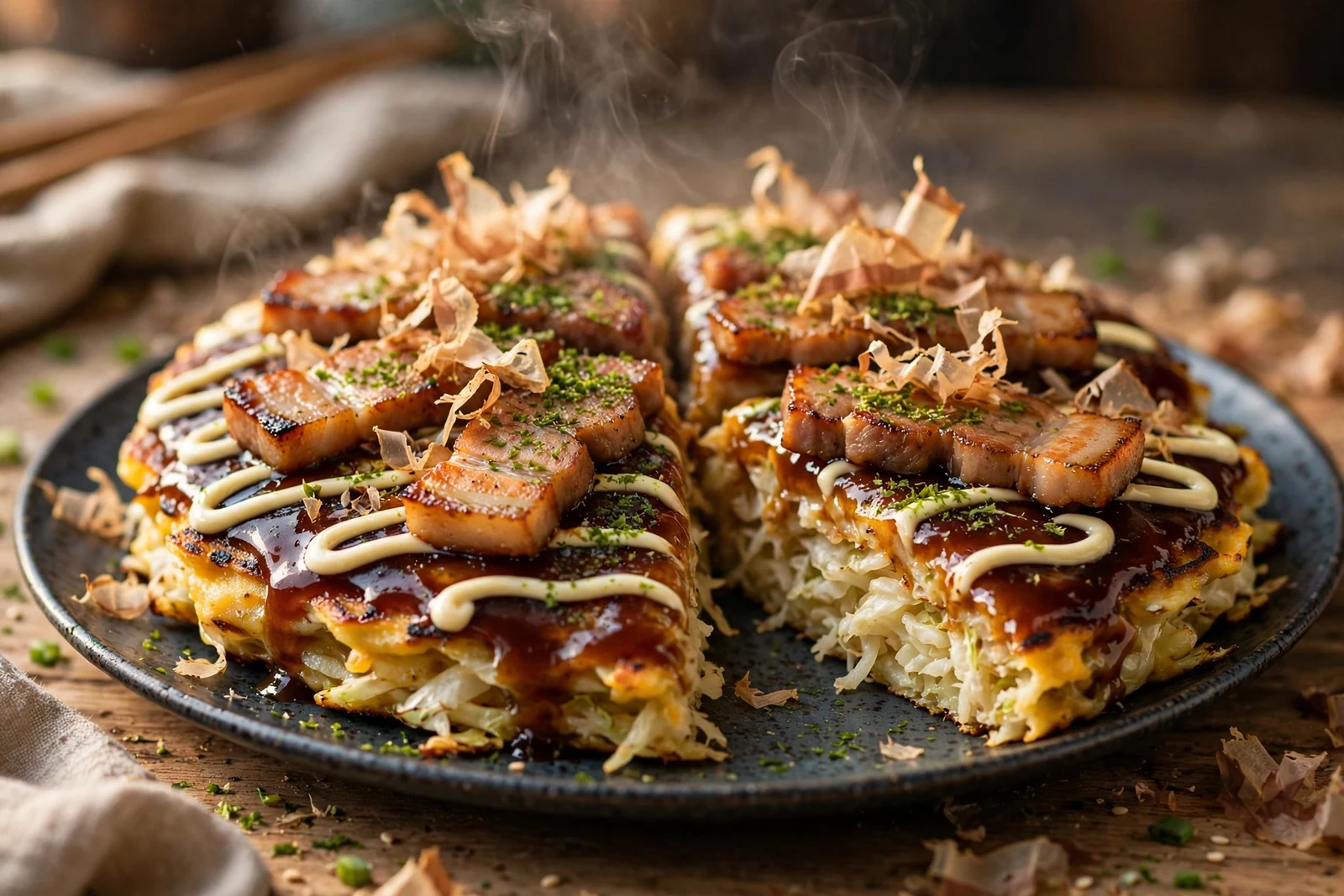
Sauce it. Slide onto a warm plate, pork side up. Brush generously with okonomiyaki sauce, squeeze Kewpie in a zigzag over the top, then scatter the katsuobushi and aonori. The bonito flakes will dance in the heat — that’s how you know it’s fresh off the pan. Serve immediately.
Troubleshooting: Fix My Okonomiyaki
It fell apart on the flip, the middle is gummy, or the outside browned before the inside cooked — every one of these has a cause and a fix. Tell the tool what went wrong:
HERB & LIME · KITCHEN HELP
Fix My Okonomiyaki
Choose what went wrong to see a practical next step.
Possible cause
What to try next
For next time
From Paul's kitchen. Results vary with cabbage water content and stove heat — adjust timing to your setup.
Quick reference (also works without JavaScript)
The pancake fell apart when I flipped it
Cause: The batter was too thin to bind the cabbage, or the cabbage was cut too thick and stayed raw inside.
Try: Patch it back together in the pan with your spatula, press the edges gently to rejoin, and cover your repair with sauce and toppings — nobody will know. Next batch, stir a spoonful of flour into the batter before it hits the pan.
Prevent: Keep the batter at a thick-cream consistency (120 g flour to 120 ml dashi) and shred the cabbage about 3 mm thin — thick chunks don't cook through and the pancake shears along them. Flip in one confident motion with two spatulas.
The center is gummy and dense
Cause: The batter was overmixed, or it went into the pan without resting.
Try: Finish it as is — it's still tasty — but next time fold the batter only until the cabbage is coated and let it rest in the fridge for at least 30 minutes before cooking.
Prevent: Overmixing develops gluten, which turns the pancake chewy; resting lets the gluten relax and gives a more tender texture.
Burnt outside, raw inside
Cause: The heat was too high for a pancake this thick.
Try: Move the pan off the heat for a minute, then return it over medium-low and cover with a lid for 2–3 minutes so the center steams through without the crust darkening further.
Prevent: Cook the whole pancake over medium heat rather than high — its thickness needs time for the cabbage to steam inside while the crust develops.
It came out flat instead of fluffy
Cause: Pressing the pancake down while it cooked squeezed out the air and compacted the crumb.
Try: Once pressed, you can't un-press it — serve this one as a crispy thin version, which is honestly still good. For the next pancake, hands off during the first-side cook.
Prevent: Don't press down hard on the cooking pancake — leave it undisturbed for the full 5 minutes per side so the interior stays light.
It stuck to the pan
Cause: The pan or oil wasn't hot enough when the batter went in, or the pan wasn't nonstick.
Try: If it's stuck now, run a thin spatula under the edges and ease it loose bit by bit. For the next one, switch to a nonstick pan if you have one.
Prevent: Use a nonstick or well-seasoned pan and make sure the oil is properly heated — you want a confident sizzle when the batter lands — before the batter goes in.
Okonomiyaki: Japanese Savory Cabbage Pancakes
Ingredients
Method
- Whisk the batter. In a large bowl, whisk the flour, salt, and sugar, then add the dashi and eggs and whisk until completely smooth. Stir in the grated nagaimo if using. The batter should pour like thick cream.
- Fold in the cabbage. Add the shredded cabbage, green onions, and tenkasu. Fold gently until every shred is coated — stop the moment it's combined; overmixing develops gluten and turns the pancake dense and gummy. Cover and rest in the fridge 30–60 minutes.
- Heat the pan. Warm a large nonstick skillet over medium heat with a tablespoon of oil. You want a confident sizzle when the batter lands — if the oil smokes, back off before it goes in.
- Spread and top. Pour in half the mixture and nudge it into a round pancake about 20 cm (8 inches) across and 1.5 cm thick. Lay 3–4 pork belly slices across the top, pressing them in lightly.
- Cook undisturbed, 5 minutes. Leave it alone — no peeking, no pressing. The bottom needs the full time to set into a golden crust that survives the flip.
- Flip with conviction. Slide a wide spatula fully underneath, support the top with a second spatula or a plate, and flip in one decisive motion. Cook the second side 4–5 minutes, until the pork is cooked through and browned and a skewer poked into the center comes out with no wet batter.
- Sauce it. Slide onto a warm plate, pork side up. Brush generously with okonomiyaki sauce, squeeze Kewpie in a zigzag over the top, then scatter the katsuobushi and aonori. Serve immediately.
Notes
Paul’s Notes
- Shred the cabbage thin. Thick chunks don’t cook through in the time the batter needs, and undercooked cabbage is the number-one reason pancakes fall apart when flipped. If your cabbage is chunky, the batter sets but the chunks don’t — and the whole thing shears along the chunk lines.
- Two spatulas for the flip. One wide spatula fully underneath, the second supporting from above or catching from a plate. The flip is a single confident motion, not a hesitant wiggle.
- Medium heat, not high. The pancake is thick; high heat burns the outside while the center stays raw. Medium gives the cabbage time to steam inside while the crust develops.
- Cook one at a time. Two pancakes crowded in a pan are impossible to flip cleanly and they steam instead of crisping. The second one holds fine in a low oven while the first one is eaten.
Variations
- Seafood okonomiyaki: swap the pork for chopped shrimp and squid — classic at Osaka shops.
- Cheese okonomiyaki: scatter shredded mozzarella over the batter before flipping; it goes molten inside.
- Vegetarian: skip the pork and tenkasu, and use kombu dashi. The cabbage pancake stands on its own.
- No okonomi sauce? Stir together equal parts ketchup and Worcestershire sauce with a splash of soy sauce and a teaspoon of honey. It’s genuinely close.
More Japanese Recipes
If this hit the spot, these are next in line from Paul’s kitchen: Chicken Karaage (Japanese Fried Chicken) for the crispiest fried chicken you’ll ever make, Nikujaga: Japanese Simmered Meat and Potatoes for a gentle weeknight simmer, the Tofu Guide: Silken vs Soft vs Firm vs Extra-Firm so you always grab the right block, and Japanese Potato Salad — the creamy-creamy side dish that belongs next to everything.