
They sit next to each other in the freezer aisle, both little parcels of meat in wheat dough, and most of us have used the words interchangeably at least once. But wontons and dumplings are different tools built for different jobs. The short version: wontons wear a thin wrapper and live in soup; dumplings wear a thicker wrapper and stand on their own, steamed, boiled, or pan-fried. Here is the full breakdown, so you buy and cook the right one.
The short answer
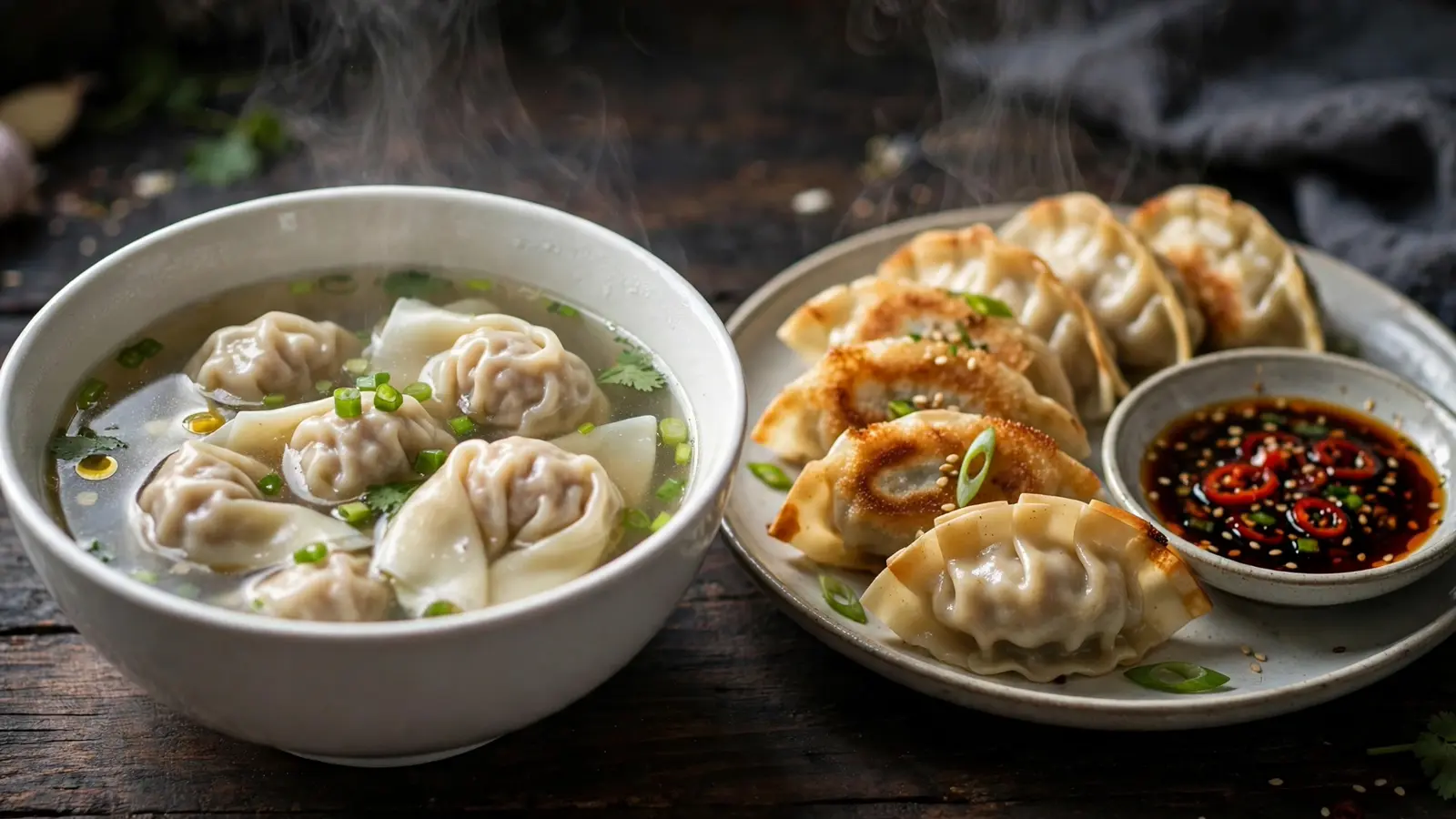
A wonton is a thin-skinned, lightly filled parcel, usually folded into a small pouch or nurse’s cap, and cooked in broth where its delicate wrapper turns silky. A dumpling (the northern Chinese jiaozi most of us picture) uses a thicker, chewier round wrapper, holds about a tablespoon of filling, gets pleated into a crescent, and can be boiled, steamed, or pan-fried. Same idea, different engineering.
Wonton wrappers: thin, square, delicate
Wonton wrappers are square, about 3.5 inches across, and rolled almost paper-thin. The dough contains egg, which gives them a pale yellow tint and a silky bite when cooked. Because they are so thin, each wonton holds only about a teaspoon of filling; more than that and the wrapper tears or the parcel will not seal.
That thinness is the whole point. A wonton is not meant to be the main event. It goes into a hot, flavorful broth, cooks in 3 to 4 minutes, and comes out tender enough to eat with a spoon. This is the wonton you know from wonton soup, where the wrapper matters as much as the filling.
One practical note: wonton wrappers dry out within minutes once exposed to air. Keep the stack covered with a damp towel while you work, or the edges crack and refuse to seal.

Dumpling wrappers: thicker, round, built to hold
Dumpling wrappers are round, roughly 3 to 3.5 inches across, and noticeably thicker than wonton skins, usually around 1 millimeter. The dough is just wheat flour and water, no egg, so it cooks up white and chewy rather than silky. Each wrapper holds about a tablespoon of filling, roughly three times what a wonton carries.
The extra body lets dumplings take real heat. They can be boiled for 6 to 8 minutes, steamed for 8 to 10, or pan-fried into potstickers with a crisp golden bottom. A wonton wrapper would fall apart under that treatment; a dumpling wrapper holds its pleats. My method for the pleated kind is in homemade gyoza with pork and cabbage.

How the folds differ
The fold follows the wrapper. Wontons are gathered, not pleated: bring the corners of the square up around the filling and pinch them into a small pouch, or fold it into a triangle and join the two ends. Either way it takes seconds, which suits a wrapper that only needs to survive a short swim in broth.
Dumplings get the classic pleated crescent. The round edge folds in half over the filling, and one side gets pinched into 5 or 6 small pleats to seal the curve. The pleats do real work: they distribute the filling evenly and give the thick dough enough surface to seal without glue. It takes practice, but the seal is what keeps a pan-fried dumpling from bursting open.

Fillings: similar, not identical
Both start with ground pork more often than not, but the classics diverge from there. Cantonese wontons lean toward pork and shrimp with ginger and scallion, seasoned lightly because the broth does the talking. Northern dumplings lean toward pork and napa cabbage, seasoned more boldly since the dumpling eats on its own with just a dipping sauce.
Can you swap the wrappers?
Yes, with adjustments, and it helps to know what breaks. Wonton wrappers can stand in for dumpling wrappers in a pinch, but use less filling, handle them gently, and cook them faster: they turn gummy if boiled as long as real dumpling skins. Dumpling wrappers can stand in for wonton wrappers, but the result is chewier and heavier in soup, closer to a noodle than a silk ribbon. If you make dumplings in bulk and freeze them, use real dumpling wrappers; the thin wonton kind splits after thawing. (My freezing method is in how to freeze dumplings without sticking.)
One more honest note: those crispy cream-cheese wontons at American takeout spots are not a Chinese original. They are a local invention, tasty in their own right, but they tell you nothing about how wontons eat in soup.
Which should you make?
Match the wrapper to the meal.
- Making soup or noodle soup: wontons. They cook in minutes and turn the broth silky.
- Want a pan-fried snack or appetizer: dumplings. Only the thick wrapper survives the fry.
- Feeding a crowd from the freezer: dumplings. They freeze, thaw, and reheat better.
- Short on time: wontons. A teaspoon of filling folds in seconds, and the whole batch cooks in under five minutes.
Neither is better in the abstract. A wonton in broth and a crisp-bottomed dumpling are two of the best bites in Chinese cooking, and now you know which wrapper earns each one.
1 thought on “Wontons vs Dumplings: What’s the Difference?”