
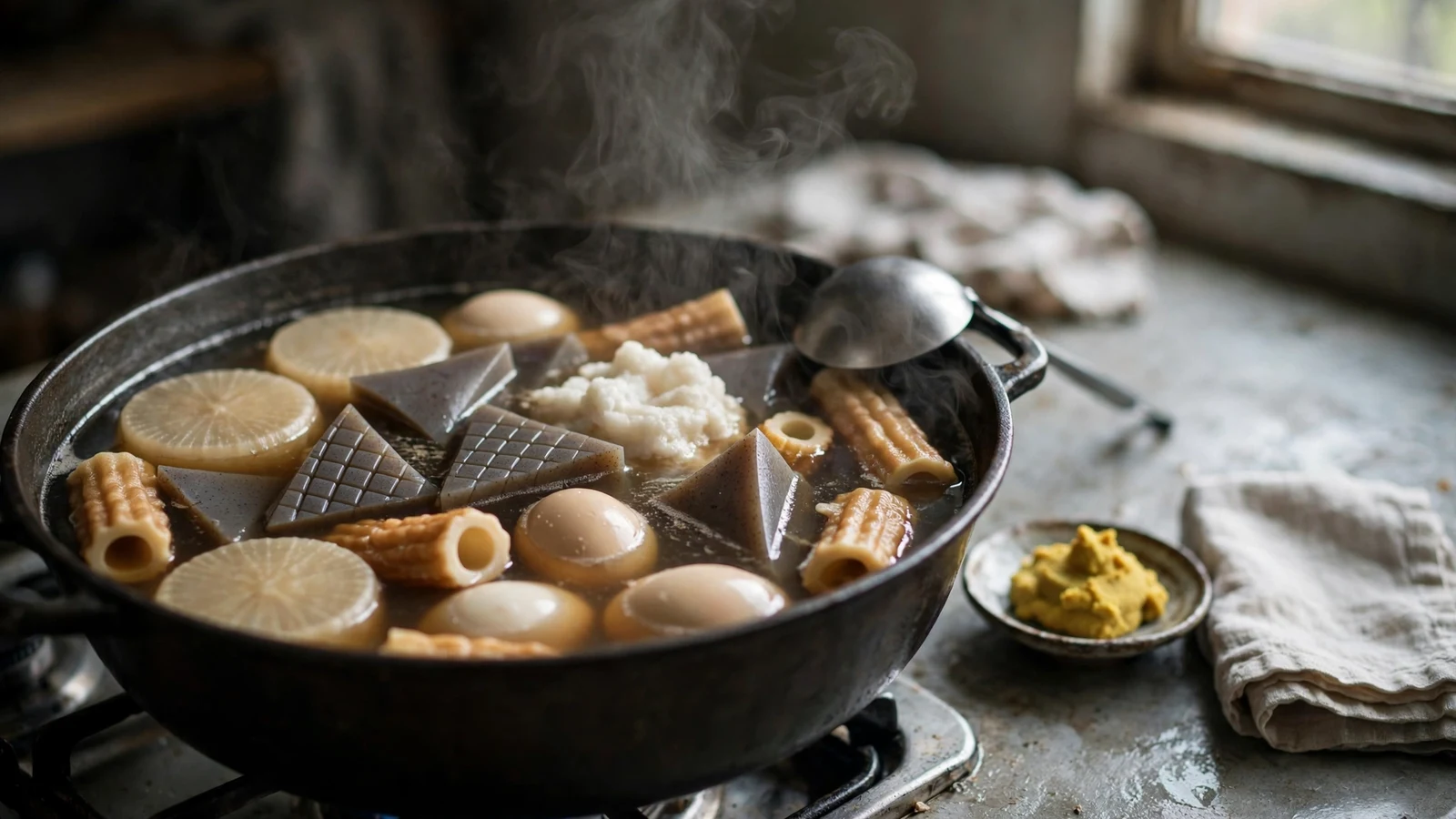
Oden is the Japanese fish cake hot pot Paul makes when the weather turns cold and dinner needs to mostly take care of itself. Daikon, boiled eggs, konnyaku, and fish cakes simmer in a light dashi broth seasoned with soy sauce, mirin, and sake, and the pot stays on the stove while everyone helps themselves. The broth ratio is 6 cups dashi to 3 tablespoons soy sauce, 2 tablespoons mirin, and 1 tablespoon sake, and that light hand with the soy sauce is what keeps the broth clear and amber instead of dark and salty. It takes 30 minutes of prep and an hour of gentle simmering, serves four, and tastes better the next day, after the daikon has had a night to drink in the broth.
What is oden?
Oden is a Japanese simmered one-pot dish, a kind of hot pot where daikon radish, boiled eggs, konnyaku, deep-fried tofu, and assorted fish cakes cook together slowly in a light dashi broth. It shows up at convenience stores and street stalls all winter in Japan, where each piece simmers in its own compartment and customers point at the ones they want, and it shows up at home as a pot that stays warm on the stove while people come back for seconds. The broth is awase dashi, made from kombu and bonito flakes, seasoned with soy sauce, mirin, and sake, and it stays light on purpose so each piece keeps its own texture. It is easy to mix oden up with yudofu, the plain simmered tofu hot pot that is mostly tofu in a kombu broth, but oden is a full spread of fish cakes, root vegetables, and eggs, and the variety is the point. Our homemade dashi guide covers the kombu and bonito stock this pot starts from, and classic miso soup uses the same dashi in a quicker, everyday bowl.
Ingredients
For the broth
- 6 cups dashi, homemade or instant
- 3 tablespoons soy sauce
- 2 tablespoons mirin
- 1 tablespoon sake
- 1 teaspoon fine sea salt
For the pot
- 1/2 medium daikon radish, about 1 pound
- 4 large eggs
- 1 block konnyaku, about 8 ounces
- 1 piece atsuage (deep-fried tofu)
- 3 chikuwa (tube fish cakes)
- 2 satsuma-age (fried fish cakes)
- 1 piece hanpen (soft steamed fish cake)
- 2 strips dried kombu, about 4 inches each
To serve
- Karashi (Japanese hot mustard)
How to make it
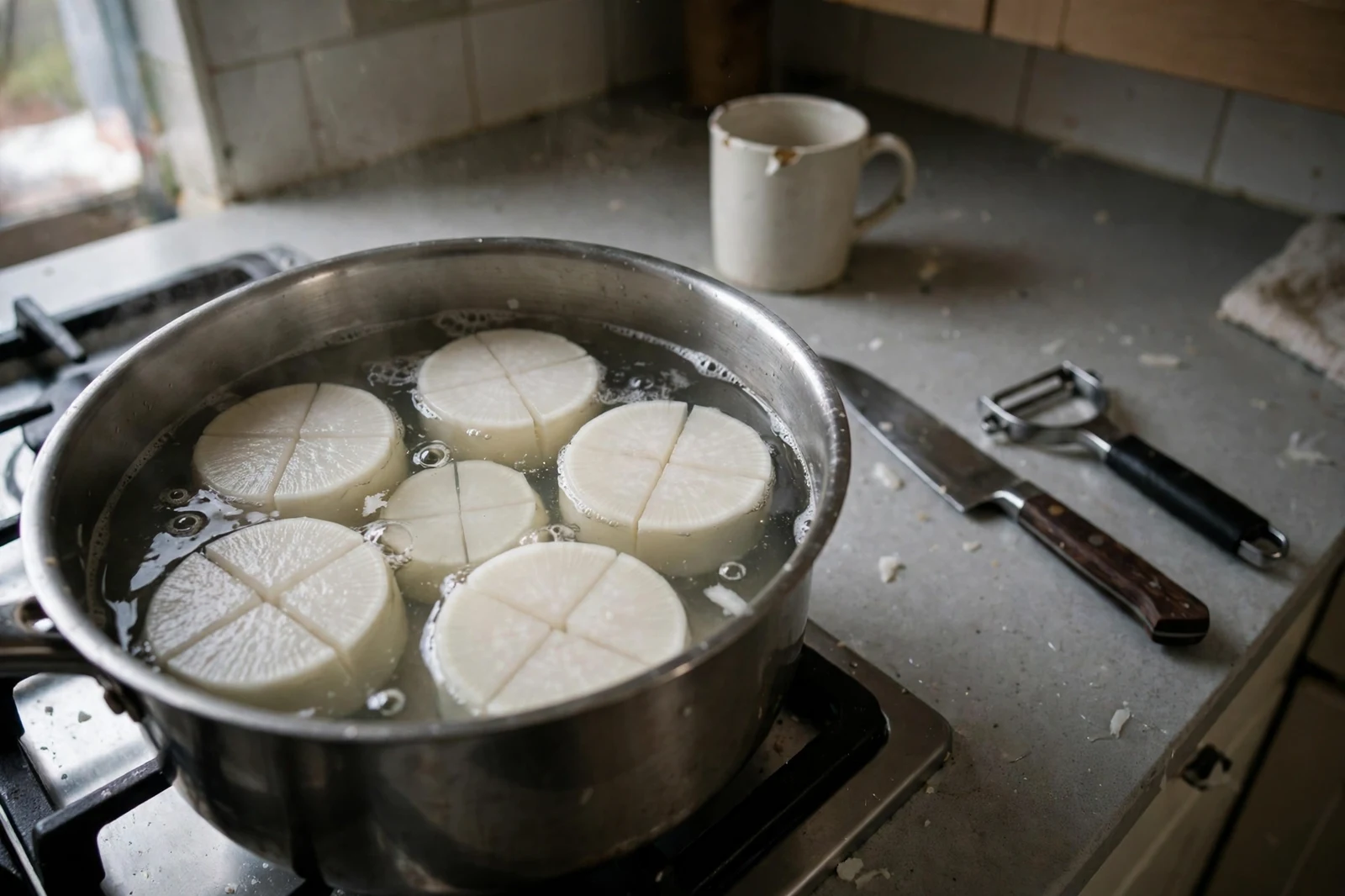
Peel the daikon and cut it into rounds about 1 inch thick, then trim the sharp edge off each round with a knife. That trimming, called mentori, keeps the edges from breaking apart during the long simmer. Put the rounds in a pot, cover with cold water, and boil for 20 minutes, then drain. A daikon that goes straight into the broth stays bitter in the middle and chalky on the outside, and no amount of extra simmering fixes it after the fact. Score a shallow X on the flat face of each round while it boils, which lets the broth soak in without the round falling apart.
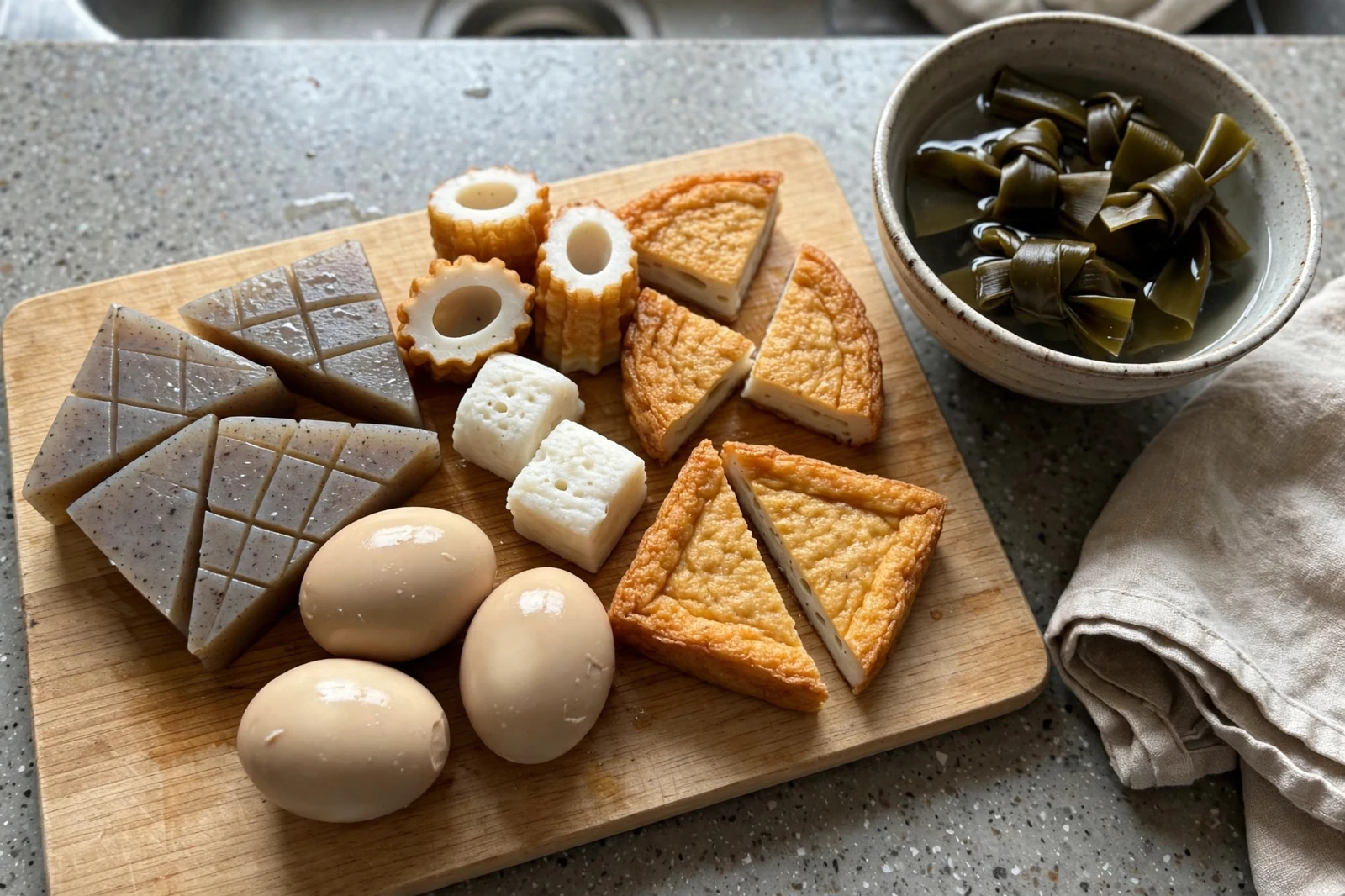
While the daikon boils, hard-boil the eggs for 10 minutes, cool them under cold water, and peel. Rinse the konnyaku, score both faces with shallow diagonal cuts in a crisscross pattern, cut the block into triangles, and boil for 3 minutes to take off its sharp smell, then drain. Cut the atsuage into triangles and the satsuma-age into quarters. Cut the chikuwa in half on a diagonal and the hanpen into quarters. Soak the kombu strips in water for 5 minutes until soft, then tie each one in a loose knot. Blanching the konnyaku first is not optional: an unblanched block keeps a fishy, alkaline smell that the broth cannot cover.
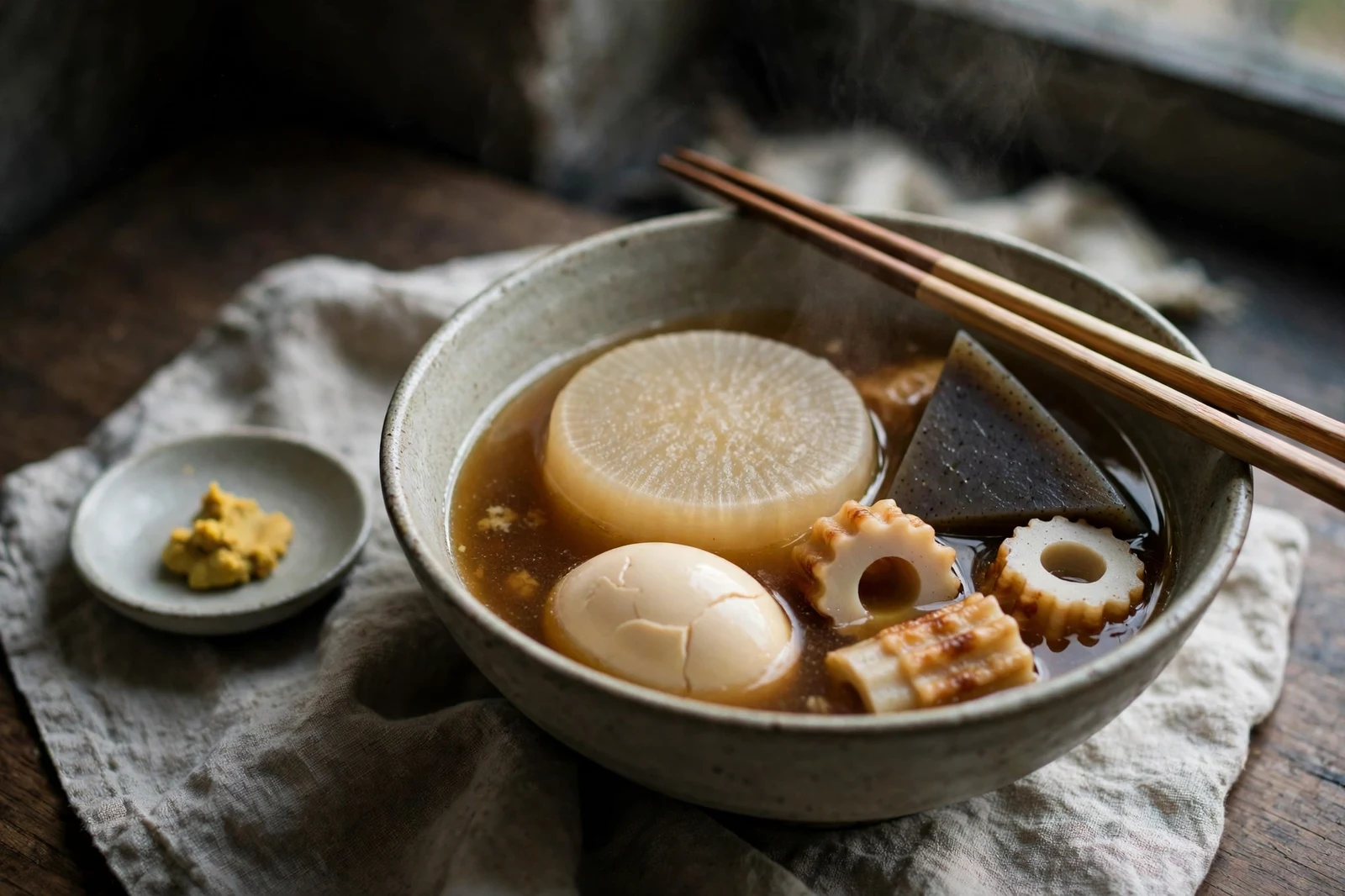
Put the dashi, soy sauce, mirin, sake, and salt in a large, heavy pot and bring it to a bare simmer, just a few bubbles breaking the surface. Add the drained daikon, the konnyaku, and the kombu knots, and simmer gently for 30 minutes. Keep the heat low the whole time: a rolling boil clouds the broth and splits the eggs, and the pot should never look like it is boiling. Add the atsuage, satsuma-age, chikuwa, and eggs, and simmer 15 minutes more. Add the hanpen last and simmer only 5 minutes, until it puffs up and turns soft. Hanpen that simmers for the full hour dissolves into the broth, and there is no way to fish it back out. Turn off the heat and let the pot sit for 30 minutes before serving, so the daikon finishes drinking in the broth. Serve hot in bowls with a little karashi mustard on the side, and put out onigiri if the table wants something to eat with the broth.
Troubleshooting: Fix My Oden
Most oden problems come from heat that is too high, pieces added in the wrong order, or a pot served too soon: a cloudy broth, hanpen that vanishes, daikon that stays bitter, or flavors that taste thin. Pick the problem that matches your pot below for a practical next step.
HERB & LIME · KITCHEN HELP
Fix My Oden
Choose what went wrong to see a practical next step.
Possible cause
What to try next
For next time
From Paul's kitchen. Results vary with daikon size, fish cake brands, and stove heat, adjust timing to your setup.
Quick reference (also works without JavaScript)
The broth turned cloudy
Cause: The pot boiled hard instead of simmering, or pieces broke apart and shed starch into the broth.
Try: Strain the broth through a fine mesh strainer, return it to a clean pot, and bring it back to a bare simmer.
Prevent: Hold the pot at a gentle simmer with only a few bubbles breaking the surface, and trim the daikon edges before cooking.
The hanpen disappeared into the broth
Cause: Hanpen is a soft steamed fish cake that dissolves when it simmers for too long.
Try: Fish out any pieces that are left, add fresh hanpen, and simmer it for only 5 minutes.
Prevent: Add hanpen in the last 5 minutes of cooking, never with the daikon at the start.
The daikon tastes bitter and stays hard in the middle
Cause: Raw daikon went straight into the broth without parboiling first.
Try: Lift the rounds out, boil them in plain water for 20 minutes, then return them to the pot.
Prevent: Parboil peeled daikon rounds for 15 to 20 minutes in unsalted water before they meet the broth.
The konnyaku smells sharp and tastes rubbery
Cause: Konnyaku was not blanched, so its alkaline smell stayed in the pot.
Try: Lift the pieces out, boil them in fresh water for 3 minutes, then return them to the pot.
Prevent: Score, cut, and boil konnyaku for 2 to 4 minutes before adding it to the pot.
The flavors taste thin right after cooking
Cause: The pieces have not had time to drink in the broth yet.
Try: Turn off the heat, cover the pot, and let it sit for 30 minutes before serving.
Prevent: Plan for a 30 minute rest off the heat, or cook the pot a day ahead and reheat it gently.
Oden: Japanese Fish Cake Hot Pot
Ingredients
Method
- Peel the daikon, cut into rounds about 1 inch thick, and trim the sharp edge off each round. Cover with cold water in a pot, boil for 20 minutes, then drain. Score a shallow X on the flat face of each round.
- While the daikon boils, hard-boil the eggs for 10 minutes, cool under cold water, and peel. Rinse the konnyaku, score both faces with shallow diagonal cuts in a crisscross, cut into triangles, and boil for 3 minutes, then drain. Cut the atsuage into triangles, the satsuma-age into quarters, the chikuwa in half on a diagonal, and the hanpen into quarters. Soak the kombu strips for 5 minutes until soft, then tie each in a loose knot.
- Put the dashi, soy sauce, mirin, sake, and salt in a large, heavy pot and bring to a bare simmer, just a few bubbles breaking the surface.
- Add the drained daikon, konnyaku, and kombu knots, and simmer gently for 30 minutes. Keep the heat low, never let the pot reach a rolling boil.
- Add the atsuage, satsuma-age, chikuwa, and eggs, and simmer 15 minutes more.
- Add the hanpen last and simmer only 5 minutes, until it puffs up and turns soft. Turn off the heat, let the pot sit for 30 minutes, then serve hot in bowls with karashi mustard on the side.
Notes
More Japanese recipes
Four more from the same shelf: Yudofu: Japanese Simmered Tofu Hot Pot is the plain tofu hot pot that shares this dashi; Chawanmushi: Japanese Steamed Egg Custard is the silky egg custard that uses the same kombu and bonito stock; Agedashi Tofu is the fried tofu in dashi that takes the same broth in a different direction; and Gyudon: Japanese Beef Rice Bowls is the quick beef bowl for nights when an hour of simmering is too long.
From the garden
The daikon in this pot is worth growing if you have a deep container and a cool season: it needs loose soil and room to grow down, and a container-grown root comes out milder than the big store-bought ones, which suits a light broth like this. That is the method in our daikon growing guide, and a home-grown root is the reason this pot gets daikon that turns tender all the way through instead of staying woody in the middle.
From Paul’s kitchen.