
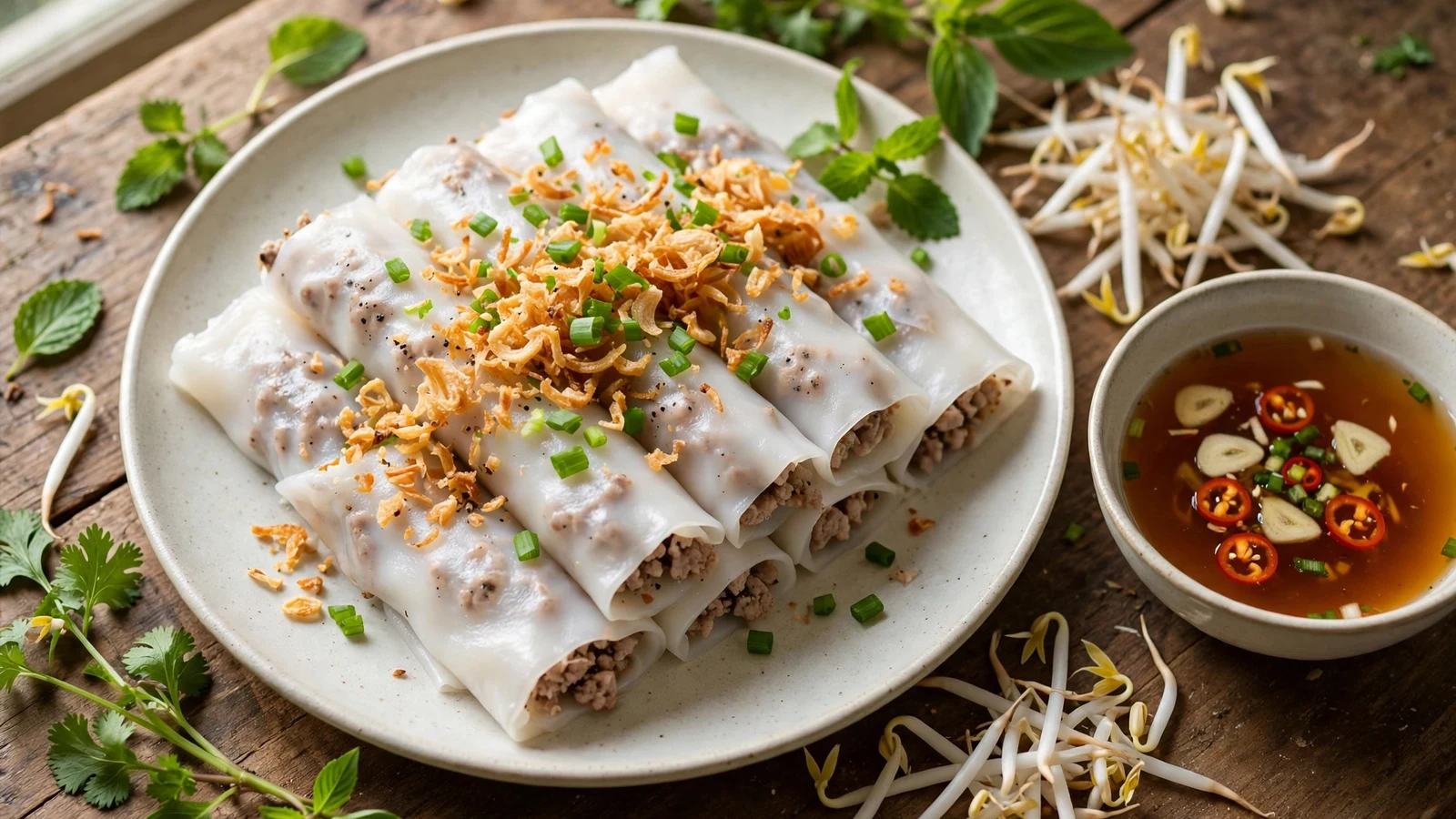
Banh cuon is the quiet show-off of Vietnamese breakfast. Paper-thin sheets of steamed rice batter, each one rolled around a spoonful of seasoned pork and wood ear mushrooms, then showered with crisp fried shallots and scallion oil. The sheets should be so delicate they’re almost translucent — but still strong enough to pick up with chopsticks. Getting there comes down to three things I measured and repeated until they were reliable: a 4-to-1 rice flour to tapioca starch batter, a cloth-lid steamer run at a full simmer, and one minute per sheet — no more.
What Is Banh Cuon?
Banh cuon (literally “rolled cake”) is a steamed rice-roll dish from northern Vietnam. A thin rice-flour batter is spread over a cloth stretched above boiling water, steamed for about a minute until it sets into a soft, silky sheet, then filled — classically with minced pork, wood ear mushrooms, and shallots — and rolled. It’s a breakfast and brunch staple across Vietnam, sold from street carts where the sheets are steamed to order.
Expect a texture closer to fresh cheung fun than to a dumpling wrapper: soft, slippery, and mild, which is why the toppings do the talking. The rolls are dressed with scallion oil (mơ hành), a heap of fried shallots, fresh herbs, bean sprouts, and nuoc cham for dipping. In Hanoi the sauce stays in a bowl on the side; in Saigon it’s poured over everything. Both are correct — pick your side.
The Batter Ratio and the Steam Method
The whole dish is the batter. My working ratio: 120 g (1 cup) rice flour to 30 g (1/4 cup) tapioca starch, plus 500 ml (2 cups) lukewarm water — a 4-to-1 flour split and roughly 4-to-1 liquid to flour. The rice flour gives the sheet its body; the tapioca starch gives it stretch so it peels off the cloth in one piece. The mixed batter should coat the back of a spoon and flow off clean, like thin cream. Thicker than that and the sheets turn gummy; thinner and they tear when you lift them.
On the traditional cloth steamer — a piece of cotton stretched tight over a pot of boiling water, or a large nonstick pan with a lid if you don’t have one — one 60 ml (1/4 cup) ladle of batter makes one sheet, steamed 60 to 90 seconds. The tell: the sheet turns fully translucent and the edges start to lift. Pull it the moment that happens. Ten seconds too long and the sheet dries out and cracks at the roll.
One more thing from my kitchen: rest the batter 30 minutes before you start. The starch hydrates in the rest, and the sheets stop pitting. If the batter has been sitting longer, give it a fresh stir before every ladle — the flour settles fast.
Ingredients
For the batter
- 120 g (1 cup) rice flour (not glutinous rice flour)
- 30 g (1/4 cup) tapioca starch
- 500 ml (2 cups) lukewarm water
- 1/2 teaspoon fine sea salt
- 1 tablespoon neutral oil, plus more for the cloth and plates
For the filling
- 225 g (1/2 lb) ground pork
- 20 g (about 1/2 cup dried) wood ear mushrooms, rehydrated and minced
- 2 medium shallots, finely minced
- 1 tablespoon fish sauce
- 1 teaspoon sugar
- 1/4 teaspoon freshly ground black pepper
For the scallion oil
- 60 ml (1/4 cup) neutral oil
- 4 green onions, thinly sliced
- Pinch of salt
For serving
- Nuoc cham (fish sauce dipping sauce)
- 1/2 cup crisp fried shallots
- Bean sprouts, blanched 30 seconds
- Cucumber, thinly sliced
- Fresh herbs: mint, cilantro, Thai basil
- Cha gio (fried spring rolls), optional but classic
How to Make Banh Cuon
- Mix and rest the batter. Whisk the rice flour, tapioca starch, salt, and water until completely smooth, then whisk in the oil. Let it rest 30 minutes at room temperature. Stir well right before each ladle.
- Make the filling. Soak the wood ear mushrooms in hot water 15 minutes, drain, and mince fine. In a skillet over medium-high heat, cook the pork, breaking it into small pieces, until the liquid reduces. Add the shallots, wood ear mushrooms, fish sauce, sugar, and pepper; cook 3–4 minutes more until fragrant. Set aside.
- Make the scallion oil. Heat the oil until shimmering, pour it over the sliced green onions and salt in a heatproof bowl, and stir. It should sizzle on contact and stay bright green.
- Set up the steamer. Stretch a piece of clean cotton cloth tightly over a wide pot of boiling water and secure it, or heat a large nonstick pan with a lid over medium heat. Lightly oil the cloth or pan. Have an oiled plate or tray ready for the finished sheets.
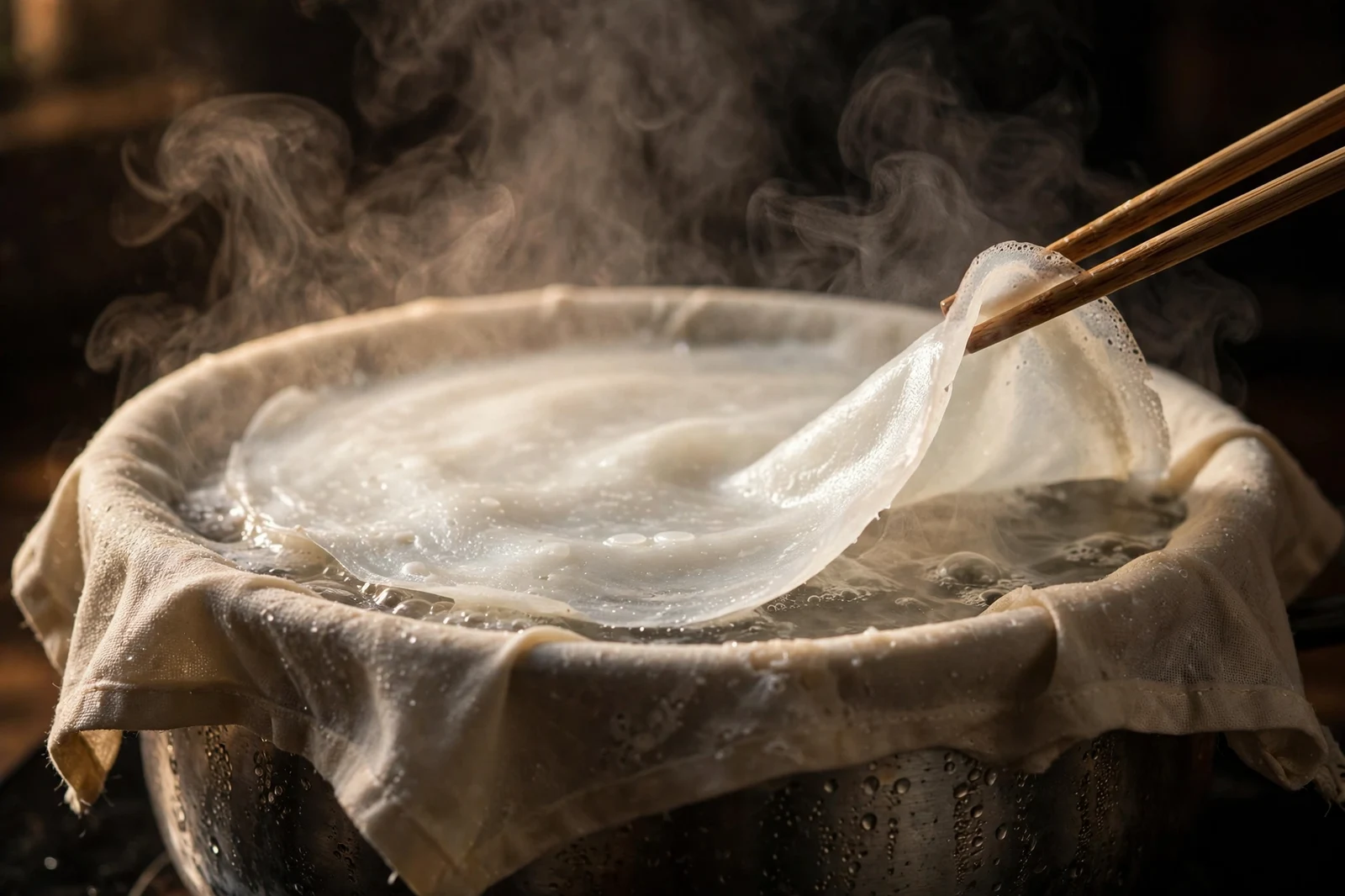
- Steam the sheets. Stir the batter, then ladle 60 ml (1/4 cup) onto the cloth and spread it thin in a circle. Cover and steam 60–90 seconds, until translucent and the edges lift. Lift the sheet off with a flat wooden spatula or chopsticks onto the oiled plate.
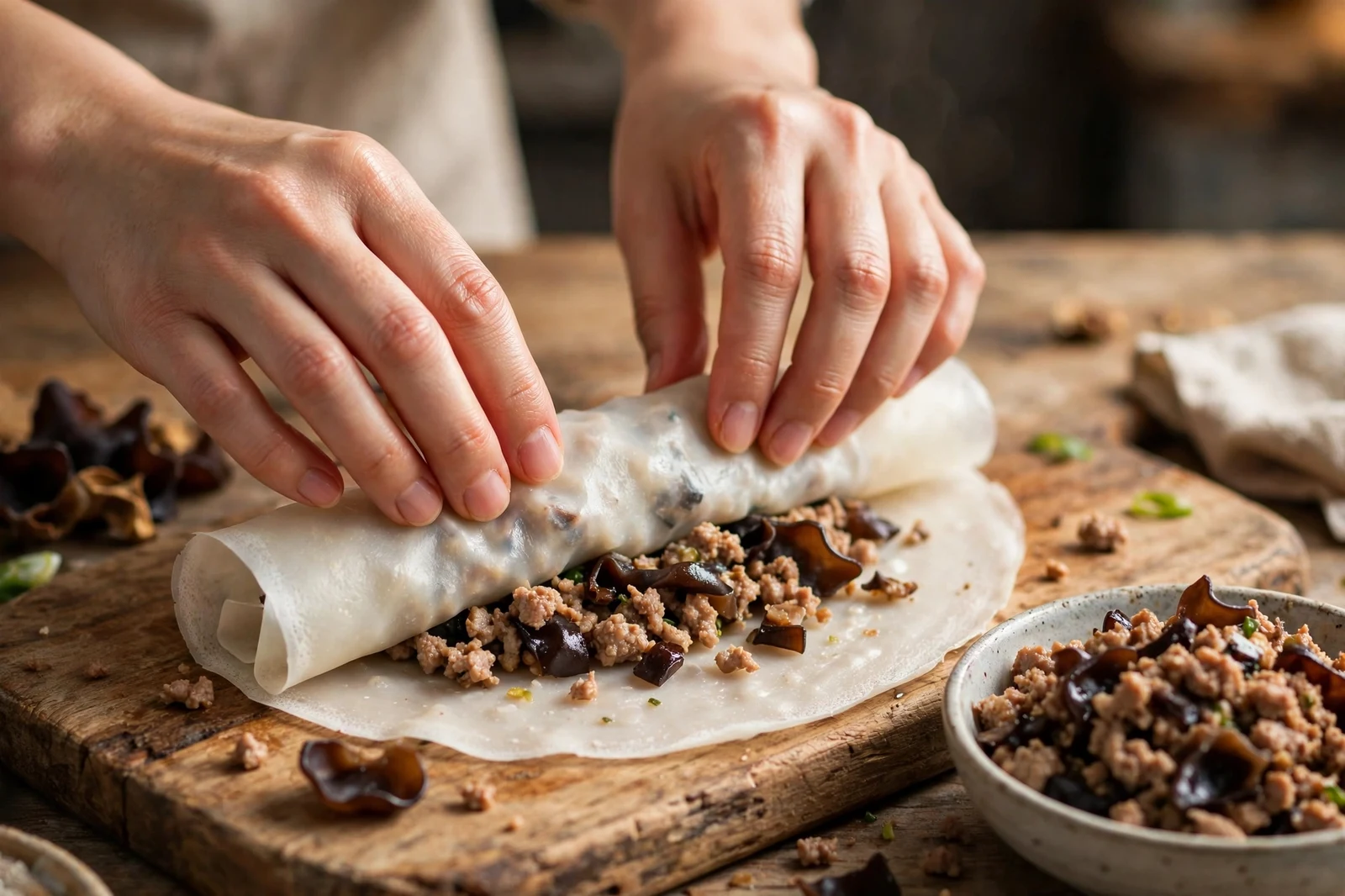
- Fill and roll. Spoon about 1 tablespoon of filling in a line across the lower third of the sheet, fold the sides in, and roll up snugly — not tight enough to split the sheet. Keep the finished rolls on the oiled tray, touching but not stacked, and cover loosely with a damp cloth as you go.
- Dress and serve. Arrange 4–5 rolls per plate. Drizzle with scallion oil, scatter the fried shallots over the top — homemade is worth it, and the method is in my crispy shallots guide — and add bean sprouts, cucumber, and herbs on the side. Serve with nuoc cham for dipping, Hanoi-style, or pour it over, Saigon-style. A few cha gio (crispy spring rolls) alongside turn this into the full breakfast spread.
Troubleshooting: Fix My Banh Cuon
Sheets that tear when you lift them, batter that won’t set, crepes gone gummy — each one has a cause and a fix. Tell the tool what went wrong:
HERB & LIME · KITCHEN HELP
Fix My Banh Cuon
Choose what went wrong to see a practical next step.
Possible cause
What to try next
For next time
From Paul's kitchen. Results vary with rice flour brand, stove heat, and steamer setup — adjust timing to your setup.
Quick reference (also works without JavaScript)
The batter won't set on the cloth
Cause: The steamer isn't hot enough yet, so the batter sits as a wet smear instead of flashing into a sheet.
Try: Give the pot another minute at a full rolling boil before the next ladle; the cloth should feel hot and the steam should be strong when the batter hits it.
Prevent: Let the water come back to a rolling boil between batches and top up with boiling water, not cold, if the level drops.
The sheets come out bubbly or patchy
Cause: The heat is too high — the batter sizzles on contact, which blisters the sheet instead of steaming it evenly.
Try: Turn the heat down a notch. The batter should glide and settle quietly, not fry.
Prevent: Once the water is at a full boil, back the burner down just enough to keep it boiling without roaring.
The sheets crack or dry out when rolled
Cause: They were steamed too long — past translucent, the thin sheet dries and loses its stretch.
Try: Pull each sheet the moment it turns fully translucent and the edges start to lift, about 60–90 seconds. If it cracks, steam the next one 15 seconds less.
Prevent: Time the first few sheets with a timer so the pull becomes automatic.
The sheets tear when lifted or rolled
Cause: The batter is too thin, so the set sheet has no body.
Try: Reduce the water by about 100 ml (just under 1/2 cup) and steam one test sheet before re-adjusting.
Prevent: Do the spoon test first: the batter should coat the back of a spoon and flow off clean like thin cream. Also stir before every ladle — settled flour gives a watery, tear-prone pour.
Everything sticks — spatula, plates, fingers
Cause: The sheets touched dry surfaces somewhere along the way; the delicate wrapper grabs anything un-oiled.
Try: Lightly oil every landing surface: the cloth before the first sheet, the plate or tray under the finished sheets, and the flat spatula or chopsticks used for lifting.
Prevent: Keep finished rolls touching but not stacked on the oiled tray, and cover loosely with a damp cloth so they stay supple while you work.
Banh Cuon: Vietnamese Steamed Rice Rolls
Ingredients
Method
- Mix and rest the batter. Whisk the rice flour, tapioca starch, salt, and water until completely smooth, then whisk in the oil. Let rest 30 minutes at room temperature.
- Make the filling. Soak the wood ear mushrooms in hot water 15 minutes, drain, and mince fine. Cook the pork in a skillet over medium-high heat, breaking it into small pieces, until the liquid reduces. Add the shallots, wood ear mushrooms, fish sauce, sugar, and pepper; cook 3–4 minutes more until fragrant. Set aside.
- Make the scallion oil. Heat the oil until shimmering, pour over the sliced green onions and salt in a heatproof bowl, and stir until it sizzles and stays bright green.
- Set up the steamer. Stretch clean cotton cloth tightly over a wide pot of boiling water and secure it (or heat a large nonstick pan with a lid over medium heat). Lightly oil the cloth or pan and have an oiled plate or tray ready.
- Steam the sheets. Stir the batter, ladle 60 ml (1/4 cup) onto the cloth, and spread thin in a circle. Cover and steam 60–90 seconds, until fully translucent and the edges start to lift. Lift the sheet onto the oiled plate with a flat wooden spatula or chopsticks.
- Fill and roll. Spoon about 1 tablespoon of filling in a line across the lower third of the hot sheet, fold the sides in, and roll snugly. Keep finished rolls on the oiled tray, touching but not stacked, covered loosely with a damp cloth.
- Dress and serve. Arrange 4–5 rolls per plate, drizzle with scallion oil, and scatter the fried shallots over the top. Add bean sprouts, cucumber, and herbs on the side; serve with nuoc cham for dipping.
Notes
Paul’s Notes
- The spoon test never lies. Dip a spoon in the batter, pull it out, and watch. If the batter sheets off in a steady stream that leaves the spoon mostly clean, it’s right. If it clings in a thick coat, thin it a splash at a time.
- One minute means one minute. Set a timer for the first few sheets. Fully translucent with lifting edges is done; still-opaque patches in the middle need 15 more seconds, not a guess.
- Keep the steam honest. If the water drops below a rolling boil, the batter steams instead of flashing set — the sheets stick and turn rubbery. Top up with boiling water between batches, not cold.
- Oil every landing surface. The oiled plate matters as much as the cloth. A sheet that sticks to a dry plate tears no matter how well it steamed.
- Don’t overfill. One tablespoon of filling per sheet. More than that and the roll splits at the seam when you lift it.
Variations
- Cha lua version: serve the plain steamed sheets (no pork filling, rolled thin) with slices of cha lua pork sausage — the northern Hanoi style.
- Shrimp: swap half the pork for finely minced shrimp; cook 1 minute longer in the filling step.
- Vegetarian: replace the pork with a mix of minced shiitake, jicama, and firm tofu, seasoned the same way.
- Banh uot style: skip the filling entirely, roll the plain sheets, and pile on the toppings — same batter, different dish.
More Vietnamese Recipes
Keep the Vietnamese kitchen going: Cha Gio: Crispy Vietnamese Fried Spring Rolls for the classic banh cuon sidekick, Com Tam: Vietnamese Broken Rice with Grilled Pork for the other great pork plate, Vietnamese Ginger Chicken (Ga Kho Gung) for a one-pan weeknight win, and Bun Bo Hue: Vietnamese Spicy Beef Noodle Soup when you want the boldest bowl in the cuisine.
From the Garden
The scallion oil here is the one topping that rewards a windowsill pot: a handful of green onions snipped right before the hot oil hits them stays brighter and sharper than anything from a week-old bunch, and it takes about three seconds. If you grow garlic chives too, they go in the same bowl.
1 thought on “Banh Cuon: Vietnamese Steamed Rice Rolls”