
Rice paper tears at the worst moment, right as you start to roll. The sheet splits under your fingers, the filling pokes through, and the roll you pictured turns into a damp bundle. I work with rice paper most weeks, and the batches that stay whole follow the same pattern: a short dip, a smooth board, and a light hand with the filling. This guide covers each part, with the times and amounts that work in my kitchen.
What rice paper is
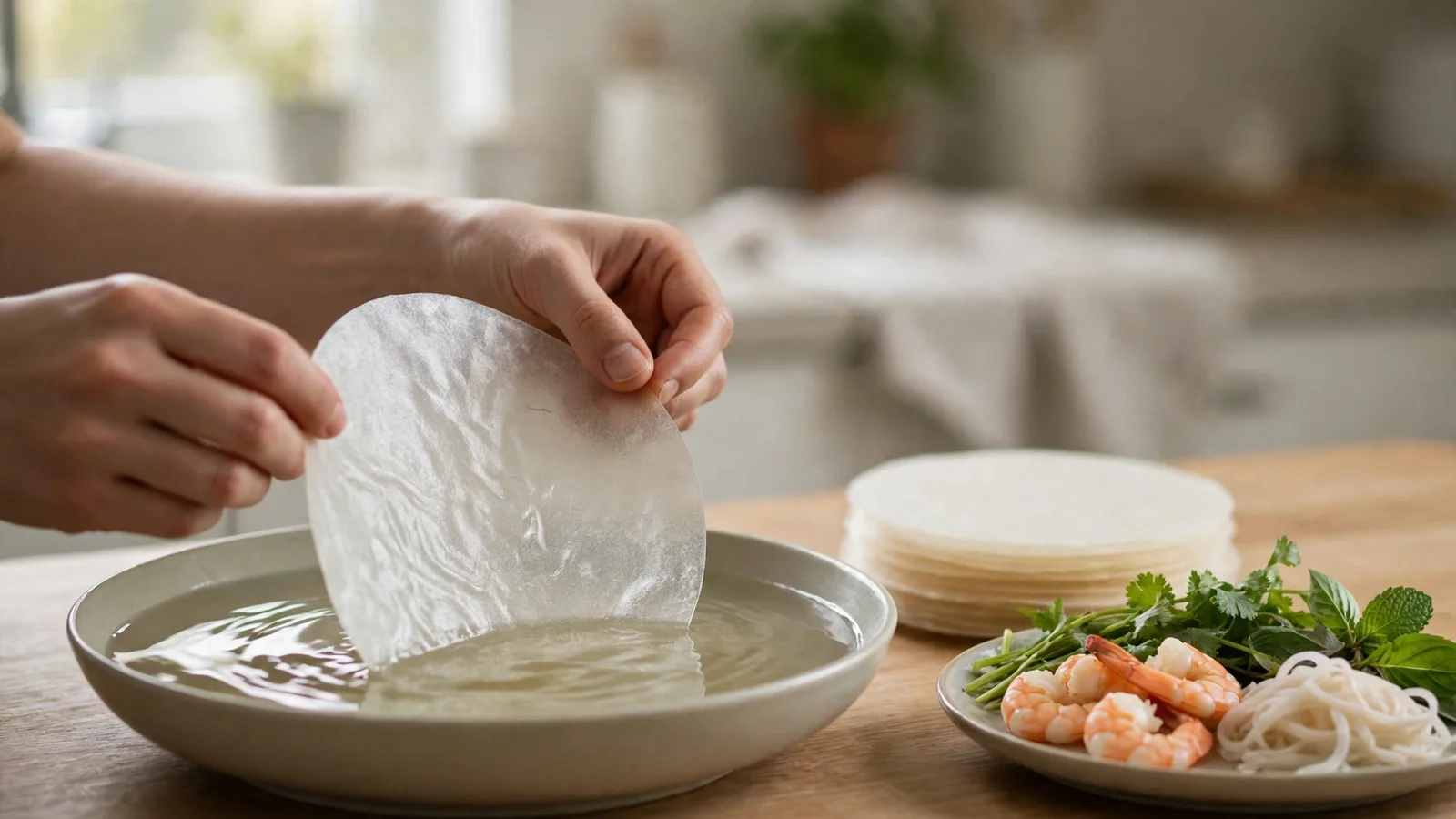
Rice paper, called banh trang in Vietnamese, is a thin round sheet made from rice flour, water, and salt, sometimes with a little tapioca starch for stretch. The sheets are cooked during making, so they need no cooking at home, only a quick soak to turn soft and pliable. Dry, they are stiff, pale, and slightly rough to the touch. Wet, they turn clear and clingy, and that cling is what seals a roll shut.
The size most stores carry is 22 cm across, about 8 1/2 inches, which fits a full spring roll with room to fold. Smaller 16 cm sheets suit bite-size rolls and snacks. Thicker sheets take a few seconds longer in the water than thin ones, so the times below shift a little by brand. When you buy a pack, look for flat sheets with no cracks and no grainy spots. A cracked sheet will split along the crack the moment it gets wet, and no amount of care saves it. Keep the pack sealed and dry at home, and the sheets last for months in the pantry.
Why rice paper tears
Four causes cover nearly every tear I have seen. The first is over-soaking. A sheet left in the water until it feels soft is already too wet, and it will stick to the board and split when you lift it. The second is water that is too hot. Hot water turns the sheet to a soft film in seconds, and it tears the moment you touch it. The third is too much filling. A full mound presses outward on the seam, and the seam is exactly where the sheet gives way. The fourth is the wrong surface. A porous wooden board drinks the water from the sheet and glues it down, and a rough board catches the soft paper as you roll.
Sharp fillings cause their own trouble. A dry shrimp tail, a stiff herb stem, or a hard carrot stick can poke straight through a softened sheet. Trim shrimp tails off, slice carrot into thin matchsticks, and keep anything hard away from the edge of the roll.
Set up before you dip
Everything must be ready before the first sheet touches water, because a wet sheet waits for no one. Slice the fillings, cook and cool the noodles, wash and dry the herbs, and set them all within reach. You need a shallow dish wider than the sheet, filled with about an inch of warm tap water. The water should feel warm on your fingers, not hot. A pie plate or a wide shallow bowl works, and a deep narrow bowl does not, since the sheet will not lie flat in it.
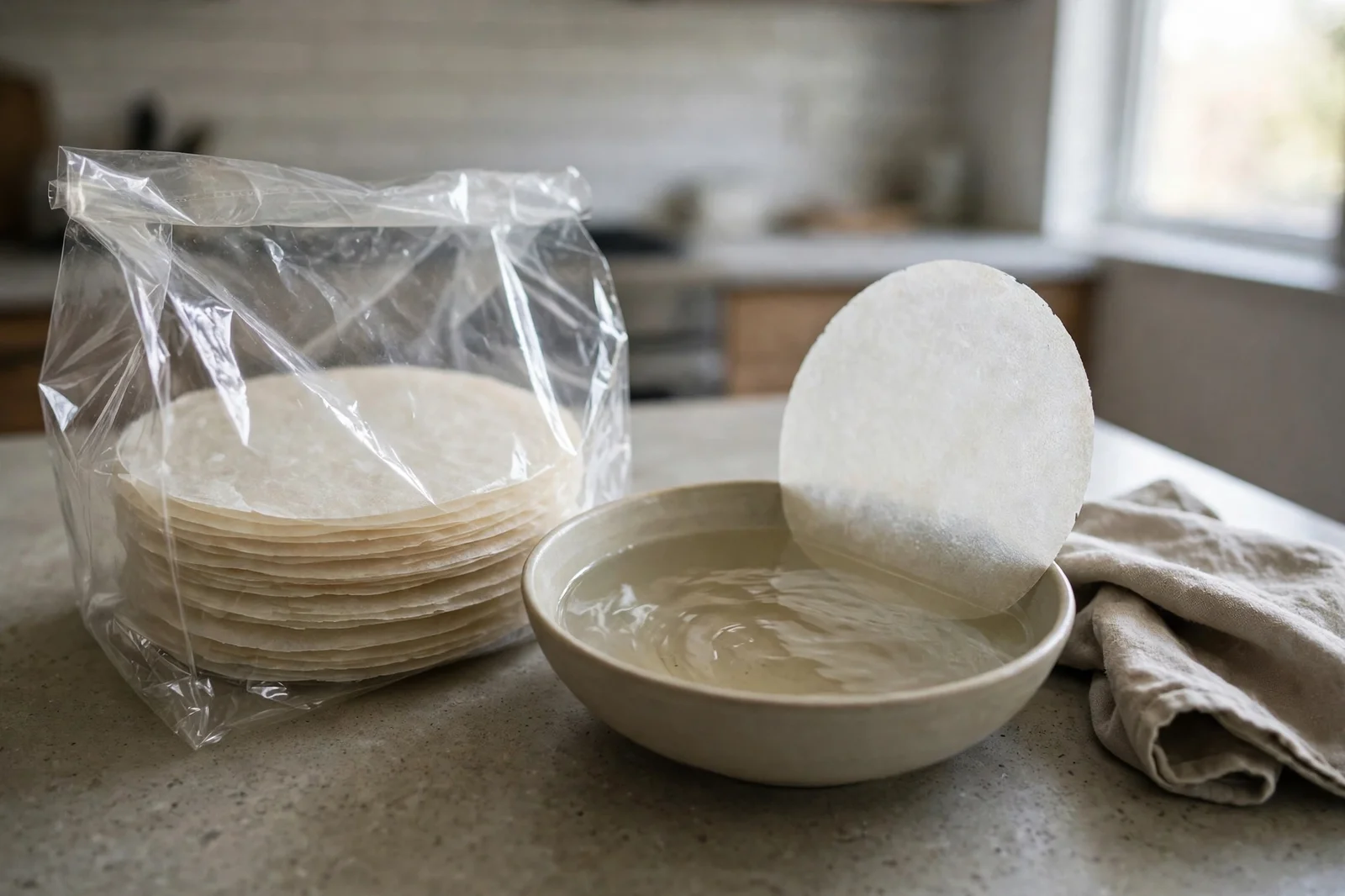
The board matters as much as the water. A smooth plastic, glass, or marble board works best, lightly dampened so the sheet rests on it without sliding. Keep a damp cloth nearby for wiping your hands, and work one sheet at a time. Soaking two sheets at once means one of them sits too long while you roll the other, and the one that waits is the one that tears.
The 5-second dip
Hold one sheet by the edge and lower it into the warm water. Turn it slowly, like a steering wheel, so the whole surface gets wet. Count to five, and up to ten for a thick sheet, then lift it out. It should still feel firm and a little stiff in your hands. That is exactly right. Let the extra water drip off for a second, then lay the sheet flat on the board.
The sheet finishes softening on the board, not in the water. Give it about 30 seconds while you set the filling in place, and the leftover moisture will soak through the fibers until the paper turns pliable and clear. If it still feels stiff after 30 seconds, it needed two or three more seconds in the water, so give the next sheet a slightly longer dip. If it feels like a wet noodle when you lift it out, it soaked too long, and the next sheet gets a shorter dip.
Refresh the water when it cools or turns cloudy, which happens after four or five sheets. Cool water softens the paper too slowly, and cloudy water leaves a film on the sheets. A fresh pour of warm water takes seconds and keeps the rest of the batch even.
Place the filling and roll
Put the filling in the lower third of the sheet, not the center, and leave about an inch of bare paper at the sides and the top. A good amount for a 22 cm sheet is two or three shrimp halves, a small bunch of herbs, and a small bundle of noodles. That sounds light, and it is meant to be light. The roll seals better with room to fold than with a full belly.
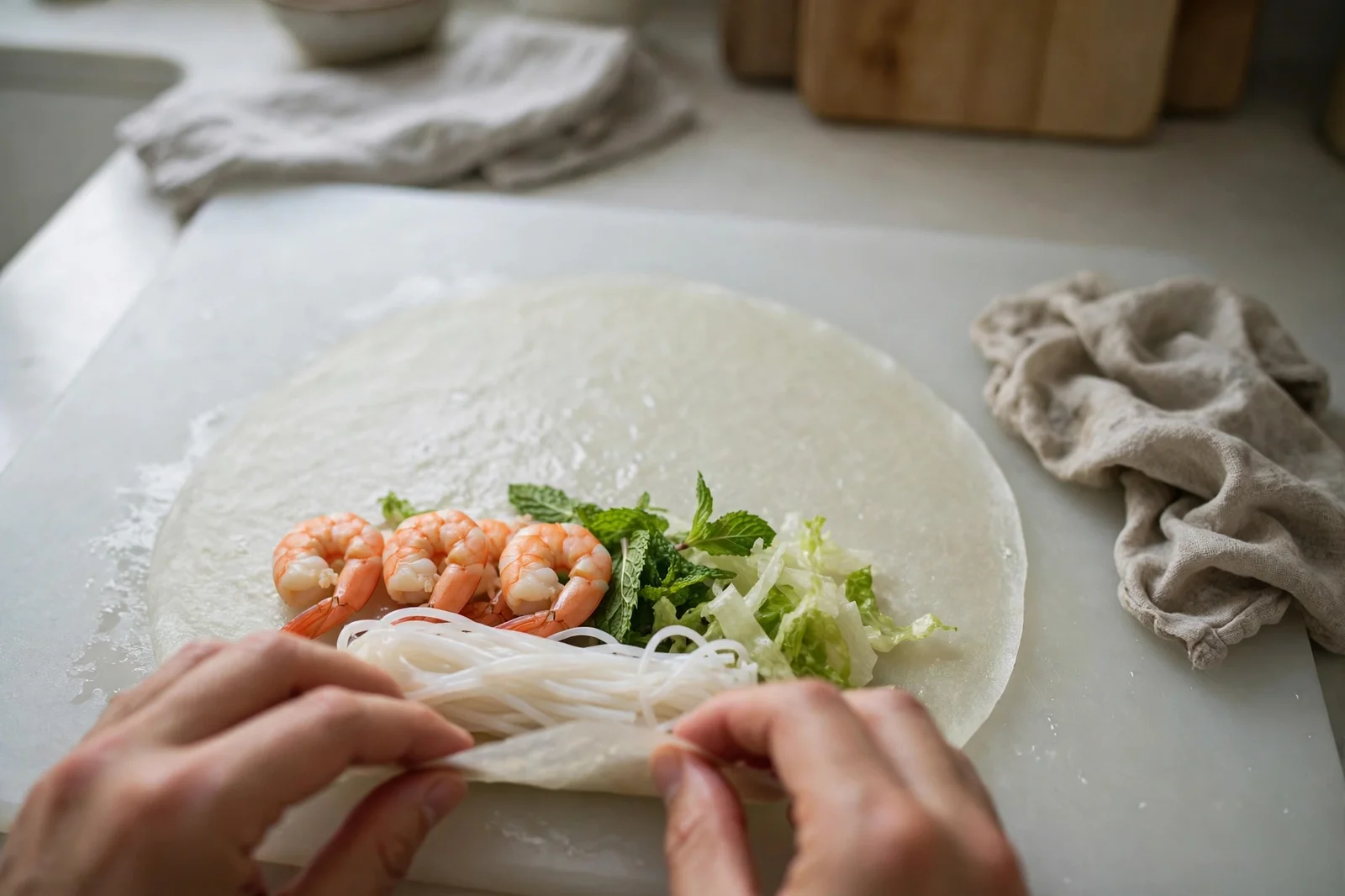
Fold the bottom edge up over the filling and tuck it under the filling with your fingertips. Fold the two sides in, then roll forward in one steady motion, guiding the sheet rather than pulling it. A snug roll holds its shape, and a tight roll stretches the paper thin and splits it. Set each finished roll seam side down on the plate. My Vietnamese shrimp spring rolls (Goi Cuon) use this exact roll, and the same method fills the pork rolls in my Banh Trang Cuon Thit Heo post. If you fry your rolls instead, my Cha Gio post covers the fried version, which uses the same sheet soaked the same way.
When one tears anyway
A small tear at the edge is easy to save. Cut a scrap from a spare sheet, wet it, and press it over the tear like a patch, then tuck the patched side under a fold as you roll. A tear at the fold is harder, so unwrap the sheet, take out a little filling, and roll it again with less inside. A sheet that has cracked from dryness is done, since it will not seal and patching only delays the split until you lift it. Set it aside and use a fresh one.
The double-wrap trick saves a roll that tore in the middle. Dip a second sheet, lay it flat, and set the torn roll on top of it, then roll the second sheet around the first. The outside sheet carries the roll, and the torn sheet inside never shows. A torn roll is still fine to eat, so if it is the last one in the batch, set it aside for the cook and serve the clean ones first.
Serving and storing the finished rolls
Fresh rolls are best within a few hours of rolling. Keep them covered with a damp cloth or plastic wrap while they wait, and leave space between them on the plate. Two rolls that touch will stick together, and pulling them apart tears the paper. A lettuce leaf between layers keeps a stacked plate safe.

The fridge dries rice paper out, so do not store finished rolls overnight and expect them to stay soft. If you must hold them for a few hours, wrap the plate tightly and keep it at room temperature, and serve them the same day. Serve with a dipping sauce, and my Do Chua pickled carrots and daikon adds a sharp bite on the side. The same care with thin sheets pays off in other folds too, and my guide to folding wontons and gyoza without tearing uses the same ideas: measure the filling, keep the wrapper from drying out, and press the air out before you seal.
More kitchen guides
– How to Freeze Dumplings Without Sticking
– How to Use a Bamboo Steamer
– How to Press Tofu for Crispy, Golden Results
– How to Store Fresh Herbs So They Last Longer
Roll one sheet first and eat it before you roll the rest. If the first roll holds, the dip time and the filling amount are right, and the rest of the batch will follow.